How Zenora Network Works: From Holding ZNR to a Final Transaction

How Zenora Network Works: Transactions, ZNR and Validators Explained
Zenora Network is still being built, so most guides blur what is real today and what is design only. This guide on How Zenora Network Works keeps both visible. Every claim comes from the official pages, read on 25 Nov 2026 (IST).
Key Takeaways
Users sign transactions with a private key. Validators order them, and the Ethereum Virtual Machine (EVM) runs them.
ZNR pays gas, backs staking and weights governance. Total supply is fixed at 1,000,000,000.
Mainnet has not launched. Consensus, block time and finality figures stay unpublished until public testnet.
What Is Zenora Network?
Zenora Network is a planned Layer-1 blockchain that runs the Ethereum Virtual Machine and is built with Polygon CDK. Its native coin, ZNR, pays fees and secures the chain through staking. As of 25 Nov 2026 (IST), the official site lists the community app as in progress and mainnet as upcoming.
The official homepage calls it an EVM-compatible Layer-1 and lists five build stages.
Source: official website.
How Zenora Network Works From Wallet to Final Block
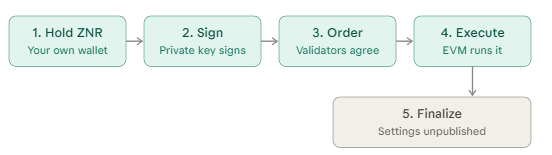
Zenora Network transaction flow, step by step
Hold. ZNR sits in a self-custodied wallet. Nobody can move it without the owner’s signature, the team included.
Sign. A transfer, stake or contract call is signed with a private key using secp256k1 ECDSA (Elliptic Curve Digital Signature Algorithm), then broadcast. The key never leaves the device.
Order. Validators agree on the sequence of transactions. The design tolerates some validators being offline or misbehaving.
Execute. The EVM runs the transactions, so Solidity contracts and standard Ethereum tooling work directly.
How are Zenora transactions finalized?
After execution, the resulting state is locked in as final. Zenora’s consensus and finality settings will be published before public testnet.
Parameter | Status on 25 Nov 2026 (IST) |
Consensus mechanism | Not published |
Validator set size | Not published |
Fault tolerance | Not published |
Time to finality | Not published |
Block time | Not published |
Chain ID and RPC endpoint | Not published |
The official whitepaper marks every row as revealed at testnet. Any figure quoted elsewhere is a guess, not a specification.
What Is ZNR Used For in Zenora Network?
It is the single native asset. The whitepaper states there is no separate gas, staking or governance token.
Use | What ZNR does |
Gas | Pays for every transaction and contract call |
Staking | Validators lock it up to propose and vote on blocks |
Governance | Votes on upgrades, fee structures and treasury spending, weighted by staked ZNR |
App premium | Optional paid tier in the community app, a convenience with no extra profit |
dApp fees | Apps built on Zenora settle fees in ZNR by default |
Zenora Network gas fees paid in ZNR
Fees scale with the computing and storage a transaction needs. A simple transfer costs a small amount, while a complex contract call costs more. A failed transaction still pays for the work it used.
The base fee schedule and minimum gas price are not published. Supply is fixed, so validator rewards come from a pre-allocated pool of 200,000,000 ZNR, not new minting, per the whitepaper.
Zenora Network Validators and Consensus Explained
Validators lock up ZNR to earn the right to propose and vote on blocks. Holders who do not run a node can delegate to a validator and share its rewards. They also share the risk of slashing, a penalty taken from locked stake.
Fault | Treatment |
Double-signing or provable misbehaviour | Severe slashing of bonded stake |
Extended downtime | Smaller penalty, scaled to missed participation |
The minimum validator bond is not final. The Zenora Node Program, capped at 10,000 nodes, is a separate status system and not a validator role.
Zenora EVM-Compatible Layer-1 Explained
A Layer-1 blockchain is a base network with its own validators and its own coin. EVM-compatible means it runs the same execution environment as Ethereum. Zenora lists Solidity and Vyper contracts, Ethereum-style accounts and the standard JSON-RPC (Remote Procedure Call) interface as fixed requirements.
Wallet support is planned with testnet. The whitepaper shows the MetaMask network setup as unavailable today.
Zenora is built with Polygon CDK (Chain Development Kit), an open-source framework for launching Ethereum-compatible chains. The whitepaper names the trade-off: less freedom to redesign, plus a managed dependency on upstream releases.
Independent check, 25 Nov 2026 (IST): Polygon’s documentation describes CDK chains as fully EVM-equivalent, which supports the compatibility claim. The same documentation frames CDK as a toolkit for Ethereum Layer-2 chains, while Zenora’s pages say Layer-1. Zenora has not published its settlement setup, so that label cannot be tested yet.
Zenora Miner: What Is Live Today
The web version of Zenora Miner is marked live. iOS and Android are listed as coming soon.
The official session flow has six steps: create a passkey-secured wallet, start an 8-hour session, watch it accrue, claim after a security check, grow the balance, repeat.
The miner is not proof-of-work. It is an engagement mechanism, and its rewards are pre-mainnet points that convert to on-chain ZNR at launch. The early-phase average is about 1 ZNR a day, capped per person. The preview screen shows a hash rate figure, but the page labels that screen as sample data.
Community pool program | Tokens | Share |
Mining | 120M | 60% |
Referral | 30M | 15% |
Airdrop | 20M | 10% |
Tasks | 14M | 7% |
Giveaways | 10M | 5% |
Reserve | 6M | 3% |
Referral rewards run across 10 levels, from 1.0 ZNR per verified referral at Level 1 to 3.0 at Level 10. The exact reward formula and anti-abuse rules are private.
Live Versus Design: Where the Build Stands
Component | Status on 25 Nov 2026 (IST) |
Community app | In progress, web miner live |
Core protocol | Upcoming |
Public testnet | Upcoming |
Mainnet prep | Upcoming |
Mainnet and exchanges | Upcoming |
ZNR coin | Not listed or tradable |
Due Diligence Before Joining
Unverified: mining balances, airdrop eligibility and ZNR’s value.
Team identity: confirm who runs the project before linking any account. This guide did not verify individuals.
Audits: the whitepaper plans independent audits before mainnet and claims no completed audit coverage.
KYC (Know Your Customer): the pages read do not state a KYC requirement. Confirm on the official domain before uploading any ID.
Wallet safety: never share a seed phrase or private key.
Sales: ZNR is not listed, so any offer to sell it is a red flag. .
An official link is not proof that a project is safe.
Glossary
EVM: Ethereum Virtual Machine, the environment that runs smart contracts.
CDK: Chain Development Kit, Polygon’s framework for launching chains.
ECDSA: Elliptic Curve Digital Signature Algorithm, used to sign transactions.
Gas: the fee for computing and storage, paid in ZNR.
Slashing: a penalty taken from a validator’s locked stake.
Delegation: assigning ZNR to a validator to share rewards.
JSON-RPC: the standard interface wallets use to talk to EVM networks.
Conclusion
How Zenora Network Works is clear on paper and unproven in practice. Verified on 25 Nov 2026 (IST): the official pages, the whitepaper draft and Polygon’s CDK documentation. Not verified: mining balances, airdrop eligibility, token value, team identities and audits.
Next update trigger: publication of testnet consensus settings, the chain ID, or a completed audit report.
Disclaimer: This article is for information only. It is not financial advice or an offer of securities. Crypto assets carry high risk, so do your own research before acting.












Frequently Asked Questions (FAQ)




