Kor Protocol: How KOR Token Utility Powers Its Ecosystem

What Powers Kor Protocol Token Utility Across Its Ecosystem?
What does a token do when creators get paid in dollars? That question sits at the center of Kor Protocol, an on-chain clearinghouse for creative assets built on Base.
The KOR token began trading on 4 November 2026. Since then, readers have mostly asked two things. What is the token for, and does that purpose hold up?
It covers supply, vesting, token functions, and a comparison with Story. It also marks what is still unproven. Market figures were checked on 24 November 2026.
What Is Kor Protocol, and How Does Its Ecosystem Work?
Kor Protocol is a way for creators to prove their work is theirs and get paid for it. Think of it like Visa for card payments, but for creative work.
It checks who made something and whether it can be used, then splits the payment between everyone who owns rights to it, using stablecoins like USDC. A third feature, which would help send work to buyers through AI agents, is still being built.
Major Kor Protocol Features:
-
Asset registration: Each work gets an ERC-721 identifier and an attestation graph that tracks claims about ownership.
-
Token-bound accounts: Every registered asset gets its own wallet, using the ERC-6551 standard.
-
Licensing: Terms attach directly to the asset and run through smart contracts.
-
Royalty splits: Shares are set at registration and paid out automatically.
-
KOR ID: an identity layer that links a user to assets, history, and reputation.
-
Five apps: Korus, VRSNS, Pacer, Streamline, and KOR Hubs—run on the protocol today.
The KOR crypto project also reports more than 1 million sign-ups, 285,000 assets minted on-chain, and over 1,000 IP partners.
It cites more than $2 million in gross product revenue too. Those are project claims, and gross revenue is not the same as token-holder revenue.
What Is the KOR ($KOR) Token and How Is Its Supply Allocated?
$KOR is an ERC-20 token issued on Base. Total supply is fixed at 10 billion, and the whitepaper says nothing beyond that amount will be issued.
At launch, 22.87% of supply was unlocked. That equals 2,286,666,667 KOR. Team and investor tokens received nothing on day one.
| Allocation | Share of supply | Release terms |
| Ecosystem Development | 35.32% | 4% at launch, rest monthly over 5 years |
| Investors | 22.38% | 12-month cliff, 10% at cliff, rest monthly over 2 years |
| Team and Core Contributors | 15% | 12-month cliff, 10% at cliff, rest monthly over 3 years |
| Foundation | 10% | 4% at launch, rest monthly over 5 years |
| Marketing | 8.30% | 5.87% at launch, 2.43% one month later |
| Liquidity | 5% | Fully unlocked at launch |
| Community Access | 4% | Fully unlocked at launch |
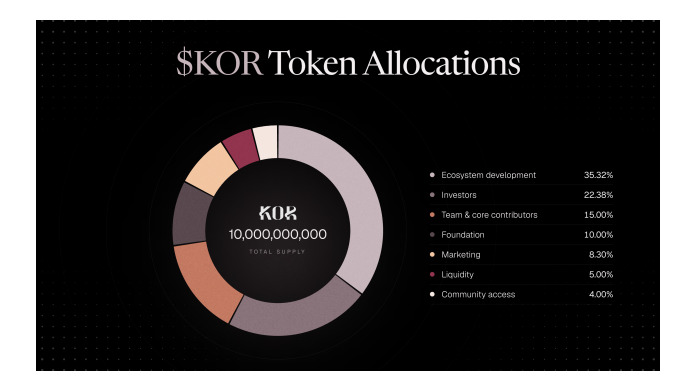
The Kor Protocol tokenomics lean heavily toward the ecosystem side. Ecosystem development, foundation, and marketing together hold more than half of supply.
Team and investors hold 37.38%, and both groups face a 12-month cliff. The first large unlock therefore lands about a year after launch. Readers can compare these token allocation details with the whitepaper.
Vesting is the schedule that controls when tokens become available. The white paper says the schedule is enforced on-chain by smart contract, so it should be verifiable once the contracts are labelled.
| Metric | Value |
| Date | 24 November 2026 |
| Current price (KOR) | ~$0.00005694 |
| Circulating supply (self-reported) | ~2.28 billion |
| Market cap | ~$125.415K |
| Total supply | 10 billion tokens |
| Fully diluted valuation (FDV) | ~$569.614K |
| All-time high | $0.0346 (4 November 2026) |
| Drop from peak | ~99.8% |
NOTE: Data taken from CoinMarketCap. As of November 24th, 2026.
What Are the Core Utilities of the Kor Protocol Token?
One detail shapes everything here. Creators are paid in USDC, not KOR. So the whitepaper rests the token's necessity on bonding, not on payment.
Bonding means locking tokens behind a claim. If the claim proves false, the stake can be slashed, which means forfeited.
The token carries four functions:
-
Bonding and slashing: Attestors, route agents, curators, and validators lock KOR behind claims that cannot be checked mechanically.
-
Fee discounts: AI workflow charges are priced in KOR. Staking cuts that bill on a tiered model, from 10% at 30 days to a hard cap of 50% at 365 days.
-
Governance: Holders vote on protocol parameters, and control passes to them over time.
-
Incentives: KOR funds creator rewards across the ecosystem.
Bonding rewards come from clearing fees, the protocol fee charged on value settled through its engines. That is how the whitepaper links token demand to real activity.
Two caveats apply. The stake size for each tier is marked illustrative and pending final modelling. Locked and unvested tokens also cannot be bonded or staked, so insiders earn nothing on locked supply.
Analyst view: This design ties demand to participation instead of checkout. That is cleaner than forcing a token into every payment. It also means demand depends on enough people bonding, and bonding needs clearing volume first.
Kor Protocol vs Story Protocol: Token Utility Compared
Both Kor Protocol and Story target creative IP, but their tokens do different jobs.
| Factor | Kor Protocol | Story Protocol |
| Network | Built on Base | Own Layer 1 chain |
| Gas token | No | Yes ($IP) |
| Supply | Fixed 10 billion | 1 billion at the start, new tokens issued over time |
| Main token job | Bonding, fee discounts, governance | Security, gas, governance |
| Creator payment | USDC | $IP |
Neither is automatically better: Story's token has built-in demand but ongoing issuance, while KOR avoids new issuance, but its demand depends on features still being built.
Can the Kor Protocol Ecosystem Sustain Long-Term Growth?
The $KOR token has some real strengths. Each token function is clearly defined, vesting is locked in by contract, and creators get paid in a stable asset instead of a volatile one. But there are some honest open questions:
-
Locked supply: Around 77% of tokens were locked at launch, and the team and investor cliffs only hit after 12 months. That's a lot of supply waiting in the wings.
-
Depends on volume: Bonding rewards only work if real value is being settled, and Route, the part meant to drive that, isn't finished yet.
-
Where does the revenue go: The $2 million in product revenue comes from the apps. It's not clear how much of it actually reaches token holders.
-
Still a work in progress: The whitepaper openly admits it hasn't solved everything, like how to handle disputes over unclear IP claims.
-
No audit yet: The documents I looked at don't include a smart contract audit report.
Even a well-designed token can struggle if people don't use it. What matters in the end is whether it shows up in real numbers: registrations, settlements, and tokens actually being bonded, not just a long feature list.
Kor Protocol: Key Takeaways on Its Token Utility and Ecosystem
Kor Protocol wants to be the system that verifies, routes, and settles creative work on-chain. The KOR token supports this through bonding, fee discounts, governance, and incentives, while creators themselves get paid in USDC.
The interesting part is the design choice: The token is tied to participation, not to payment. Supply is capped at 10 billion, and vesting follows a published schedule, so there are no surprises on that front.
Disclaimer:
This article is for information only and is not financial advice. Crypto assets are volatile and can lose their full value. Research the project independently before making any decision.
















