Quantum Crypto Explained: Risks, Fixes, and the Aftermath

Could Quantum Computing Change the Future of Bitcoin and Crypto?
Every Bitcoin payment rests on a secret key. A powerful quantum machine could one day work out that secret from public data. Here's how quantum crypto works, where the real risk sits, and what happens next.
What Is Cryptography, and Why Does Crypto Need It?
According to AWS, cryptography protects information with coded algorithms, hashes, and signatures. It has four goals. It keeps data private and proves nothing was changed. It also confirms who sent a message and stops senders from denying it.
Two tool types do the work. Symmetric ciphers use one shared key. Asymmetric systems use a public key and a private key that are linked by hard math.
Blockchains lean on the second type. Wallets sign payments with elliptic-curve signatures. Hashes, which turn any data into a short fixed fingerprint, link blocks together. Without that math, nobody could prove who owns which coin.
What Is Quantum Crypto, and What Does It Not Mean?
People use the term for three different things. Mixing them up causes most of the confusion.
First, quantum cryptography. IBM defines it as security built on physics instead of math. Its main form, quantum key distribution (QKD), was proposed in 1984 by Charles Bennett and Gilles Brassard.
Second, quantum computers. Peter Shor showed in 1994 that such a machine could break the math behind public-key systems. Third, post-quantum cryptography (PQC): new math that runs on normal computers and resists quantum attacks.
Keep these three apart, and the rest of the quantum crypto debate gets much easier to follow.
How Does Quantum Technology Break Public Keys?
Deloitte explains the one-way trick. A public key is easy to compute from a private key, but not the other way round. Classical computers would need an astronomical amount of time to reverse it.
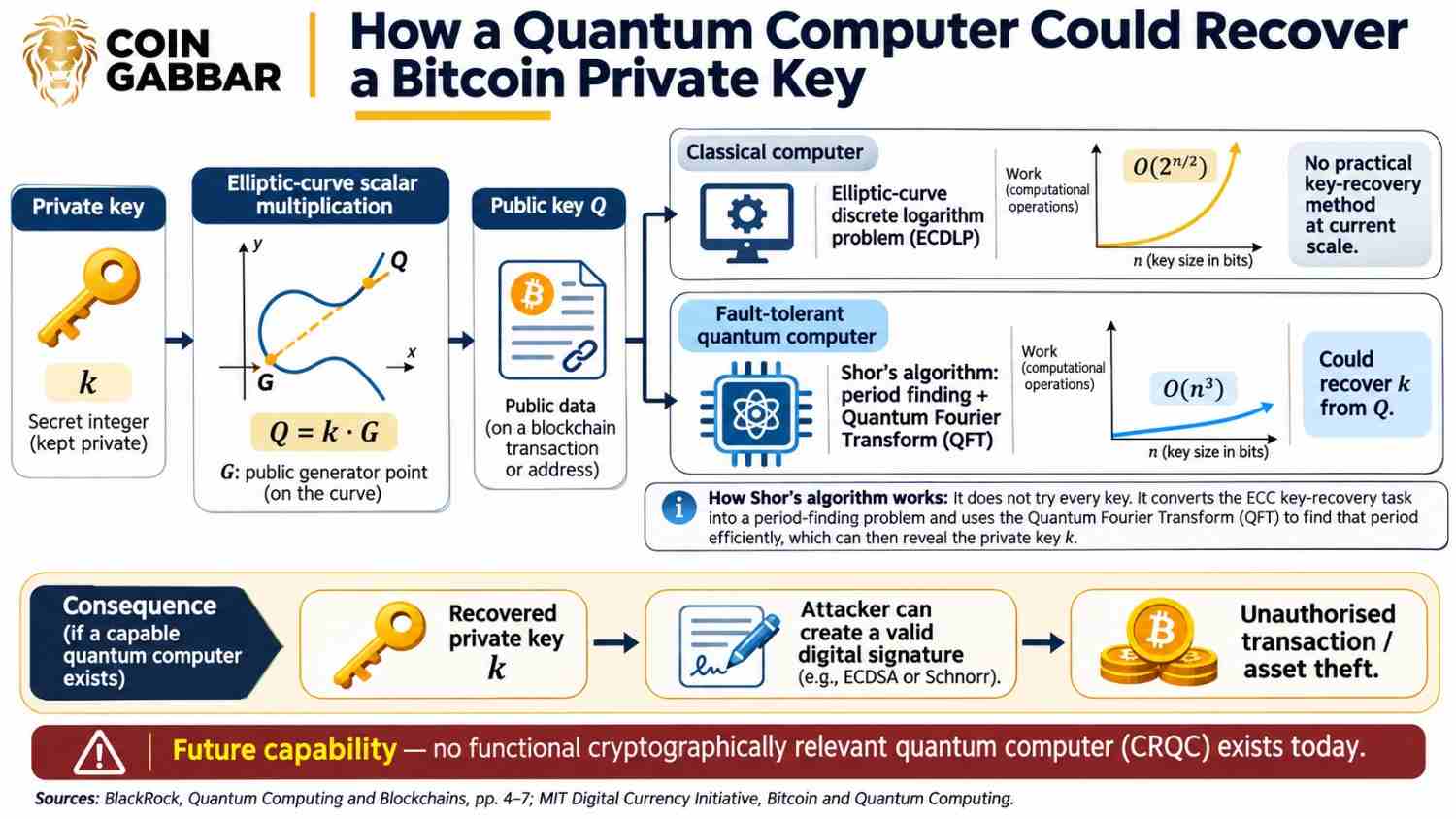
Shor's algorithm changes that. On a large enough quantum computer, it can derive a private key from its public key. The attacker could then forge a signature and spend someone else's coins.
Today's quantum machines are far too small for this, AWS notes. Whether a cryptographically relevant quantum computer (CRQC) will ever arrive is unknown. That's the core quantum crypto threat: a future capability, not a present attack. Our crypto dictionary covers the basic terms.
How Does Quantum Key Distribution Work Step by Step?
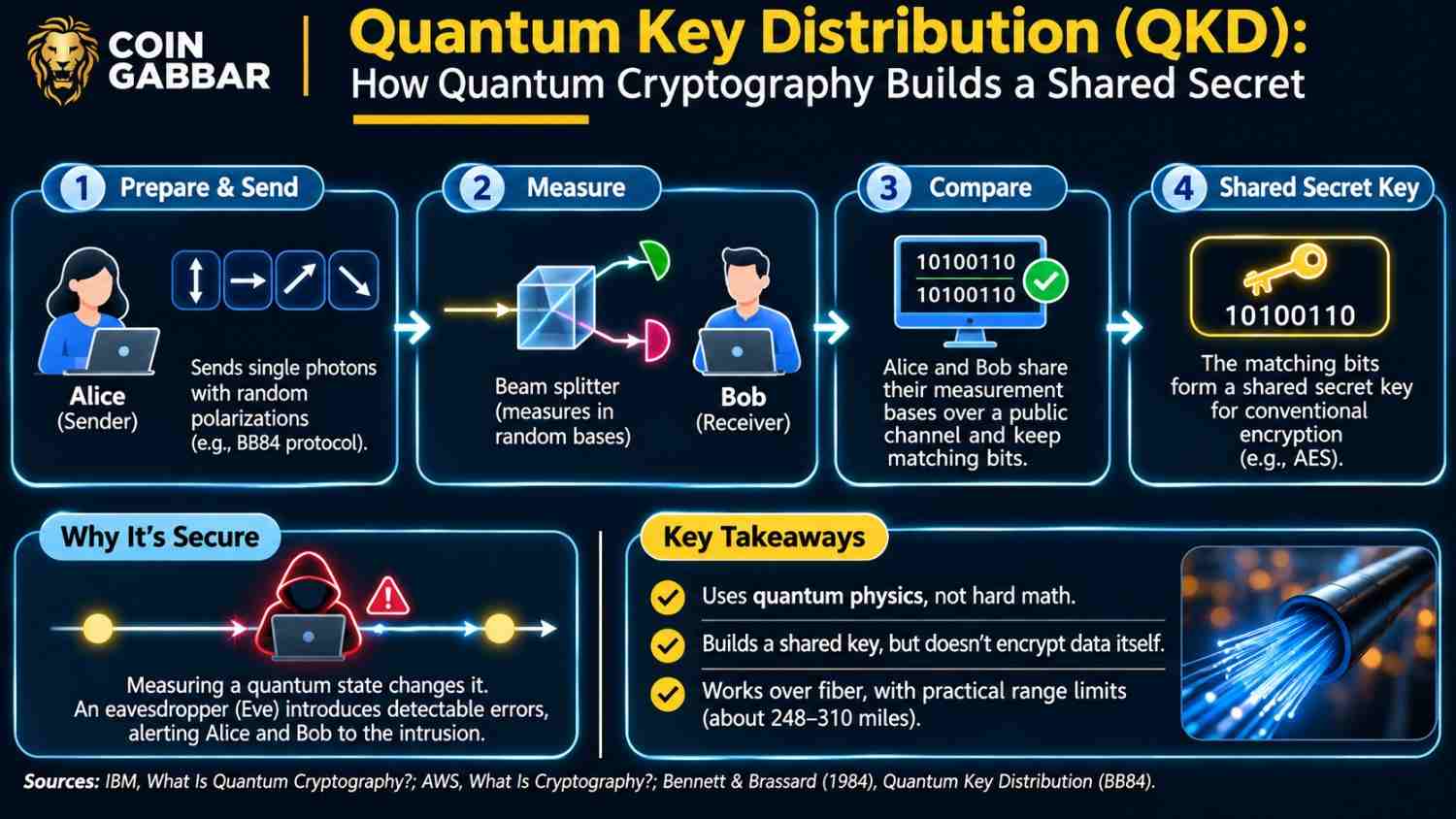
QKD is the protective side of quantum crypto. Alice sends single photons down a fiber cable, each polarized in a set direction. Bob reads each one with a beam splitter.
They then compare notes. The photons whose readings match become their shared key. Measuring a quantum state always changes it, so an eavesdropper leaves a trace that both sides can spot.
QKD doesn't encrypt your data, IBM notes. It only builds a shared key for ordinary symmetric encryption. Photons also fade over roughly 248 to 310 miles of fiber, which limits rollout.
Which Bitcoin Coins Face the Quantum Crypto Risk?
MIT's Digital Currency Initiative states that Bitcoin's signatures would break if a CRQC appeared tomorrow. It also stresses that Bitcoin isn't broken today.
Deloitte found that exposure depends on the address. Old pay-to-public-key addresses show the public key outright. Reused pay-to-public-key-hash addresses reveal it after the first spend. Compare that with past key-theft cases in our look at major exchange hacks.
Even a fresh address leaks its key during a spend. An attacker would then race the roughly ten-minute confirmation window. Deloitte's older estimates put one key break near 30 minutes, so an attacker would still miss that window today.
How Likely Is a Quantum Computer That Breaks Bitcoin?
Nobody knows, and experts disagree. IBM's explainer suggests the full quantum age may be 20 to 50 years away. Yet Google has set a 2029 target for its own move to PQC.
MIT's Neha Narula quotes a Google researcher who wouldn't bet against a 10% chance of a CRQC by 2030. She then offers a simple model. Risk equals the chance a CRQC appears, times the chance Bitcoin fails to upgrade in time.
Her sample numbers are 0.1 and 0.5, which give a 5% floor. They're illustrations, not forecasts. The last Bitcoin soft fork, Taproot, took 3 years and 10 months from proposal to activation. That gap is the heart of the quantum crypto timeline.
What Is Post-Quantum Cryptography and Who Is Building It?
NIST describes the goal as systems that stay secure against both quantum and classical computers. IBM lists six families, including lattice-based and hash-based designs.
Intel says it has worked on NIST's standards since 2016. It helped advance SLH-DSA (FIPS 205) for signatures and began adding PQC to its platforms in 2023. It targets full PQC across all new platforms by 2030.
Intel also names "harvest now, decrypt later" attacks. Attackers store encrypted data today and open it once quantum machines exist. That's why quantum crypto defenses can't wait for Q-day, the day quantum machines can break today's keys.
What Would the Quantum Crypto Aftermath Look Like?
Seen as a threat, the aftermath is a scramble. According to MIT, Bitcoin would need a soft fork, new wallet support, and users moving coins to new address types.
Seen as a new chapter, it's an engineering reset. Most post-quantum signatures are larger or slower, so a poor pick could raise node costs and squeeze block space. Dormant coins, such as Satoshi's, raise hard questions about whether to freeze them.
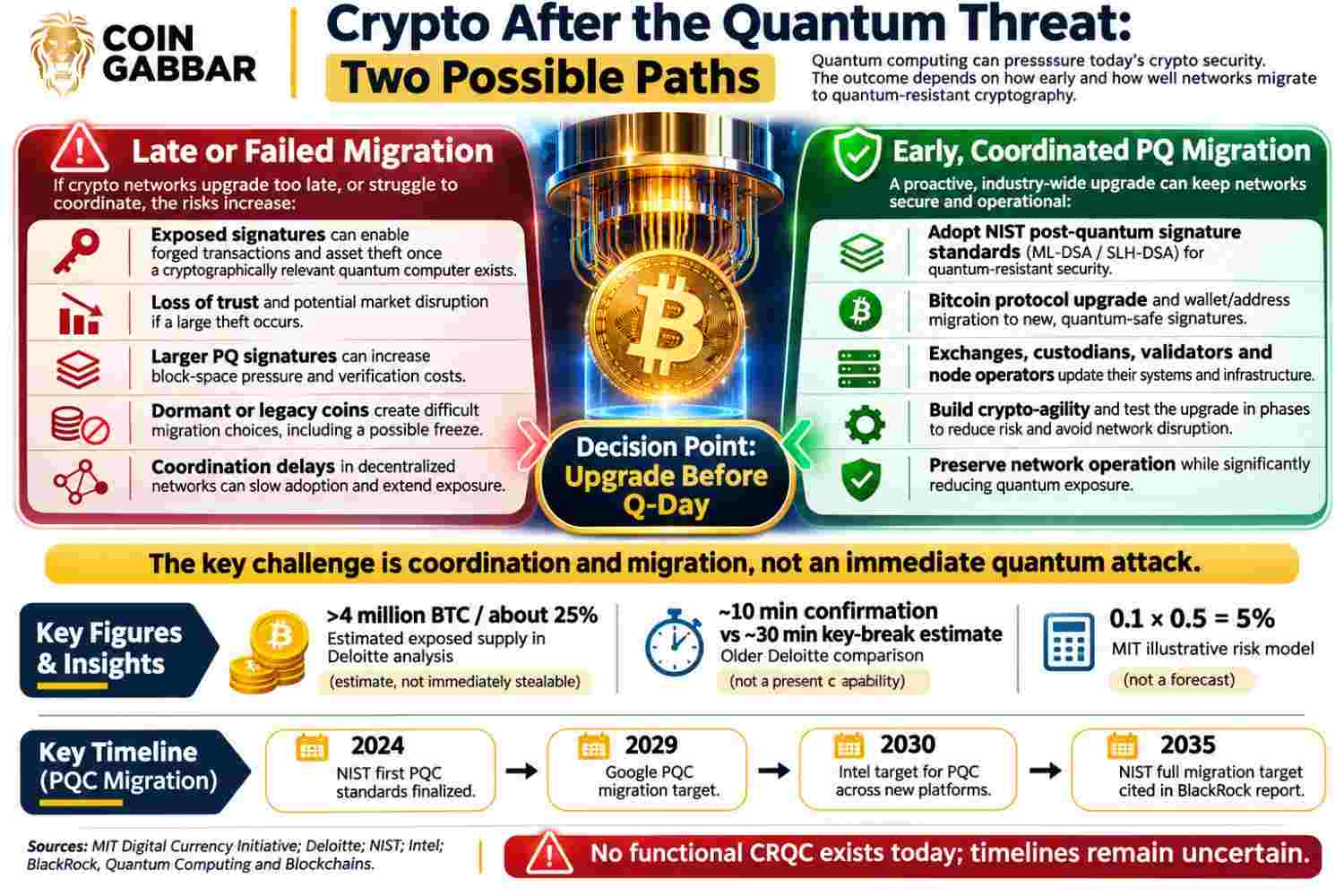
Seen as a long road, it's a coordination test. Deloitte warns that a large theft would likely crash prices and shake trust. Narula is far more confident that banks and HTTPS will upgrade than Bitcoin, because decentralized networks are harder to change.
What Can Crypto Users and Builders Do Right Now?
Follow the basics Deloitte recommends. Never reuse an address, and keep a secure backup of your private key. If you hold coins in an exposed address, moving them to a new one cuts the exposure.
Builders should track proposals like BIP 360, which MIT mentions, and plan for crypto-agility. That means designing systems where algorithms can be swapped without rebuilding everything.
Watch the standards bodies and wallet teams too. Ask your exchange or custodian whether it has a post-quantum plan. Their upgrade paths decide how smooth the switch feels for everyone else in the quantum crypto era.
Expert Opinion: What Does This Mean for Everyday Holders?
CoinGabbar analysis suggests the quantum crypto problem is a slow-burn engineering challenge, not an overnight collapse. The risk sits in coordination, because upgrading a decentralized network takes years.
The sources agree on the direction, even where their timelines differ. Exposed keys are the weak point, and post-quantum signatures are the fix. The open question is who upgrades first and how fast.
This view draws on MIT's Digital Currency Initiative, Deloitte, IBM, Intel, and AWS. It isn't based on hands-on testing, and the timeline estimates differ widely.
Disclaimer: This article is for information only. It isn't financial or investment advice. Crypto prices swing sharply, technology timelines can change, and nothing here promises any outcome.