How to Withdraw From MEXC Safely After the FinCEN Order

On November 7, a handful of OKX users posted screenshots of USDT deposits stuck in "risk review," meaning the receiving exchange had paused them for a compliance check. The coins were fine. Where they came from was the issue.
Every one of those transfers had started on MEXC, a day after the U.S. Treasury singled the exchange out.
Quick answer: how to withdraw from MEXC safely
- Confirm the receiving wallet or exchange supports the same coin and network.
- Open Wallets, then Withdraw, then On-chain Withdrawal.
- Pick the coin, paste the address and select the matching network.
- Add a Memo or Tag only if the coin needs one.
- Send a small test amount first.
- Move the rest and save the transaction hash.
What Did FinCEN Say About MEXC?
FinCEN, the Treasury bureau that enforces U.S. anti-money laundering rules, issued its order on November 6, 2026. Under section 9714(a) of the Combating Russian Money Laundering Act, it found MEXC Global to be of primary money laundering concern in connection with Russian illicit finance. The full text of the FinCEN order is published on the bureau's website.
According to the U.S. Treasury press release, MEXC facilitated at least $16 billion in illicit funds between May 2021 and May 2026. That includes about $1.5 billion tied to Russian sanctions evasion and roughly $1 billion with Iranian crypto exchangers.
The order itself is narrower than the headlines. U.S. financial institutions can no longer move money to or from MEXC, starting 30 days after the order is published in the Federal Register.
Does the Order Freeze Funds on MEXC?
No. The order does not seize user balances, and it does not tell the exchange to shut down.
In a statement posted on X on November 7, MEXC said its legal and compliance teams were reviewing the order. CEO Vugar Usi said the same day that deposits and withdrawals were still running, and the company said it had started an independent review of its anti-money laundering and sanctions controls.
The friction shows up at the receiving end. Users reported MEXC-origin deposits held for review at OKX, Binance and Gate. OKX founder Star Xu also advised users in a post on X to avoid direct transfers from MEXC to OKX. None of these exchanges has announced a platform-wide block.
What Should Indian MEXC Users Know First?
For Indian users, the FinCEN order is the second warning this year.
MEXC is not registered with FIU-IND, India's Financial Intelligence Unit, which oversees anti-money laundering compliance for crypto platforms. MEXC paused new Indian sign-ups on January 15, 2026. From February 28, it suspended most services for users accessing from India, including spot trading, on-chain deposits and INR P2P.
Its official India service notice asked users to withdraw their assets "to avoid inconvenience." So for Indian users, the question of how to withdraw from MEXC is now practical, not theoretical.
For context on the wider push against offshore platforms, see this report on India's FIU crackdown.
How to Withdraw From MEXC Step by Step?
The flow is short, and most mistakes happen at the network step.
- Log in, open Wallets and tap Withdraw. On the app, pick On-chain Withdrawal.
- Choose the coin, for example USDT.
- Paste the receiving address from your wallet or exchange.
- Pick the network the receiving side supports for that coin.
- Add the Memo or Tag, a short extra code some coins need to reach the right account.
- Check the MEXC withdrawal fee and amount, submit and complete the security verification.
MEXC shows the fee before you confirm, and it changes with network traffic. Most transfers arrive within an hour, depending on the network. The MEXC withdrawal limit depends on your KYC level, so check the current limit on your account page before moving a large balance.
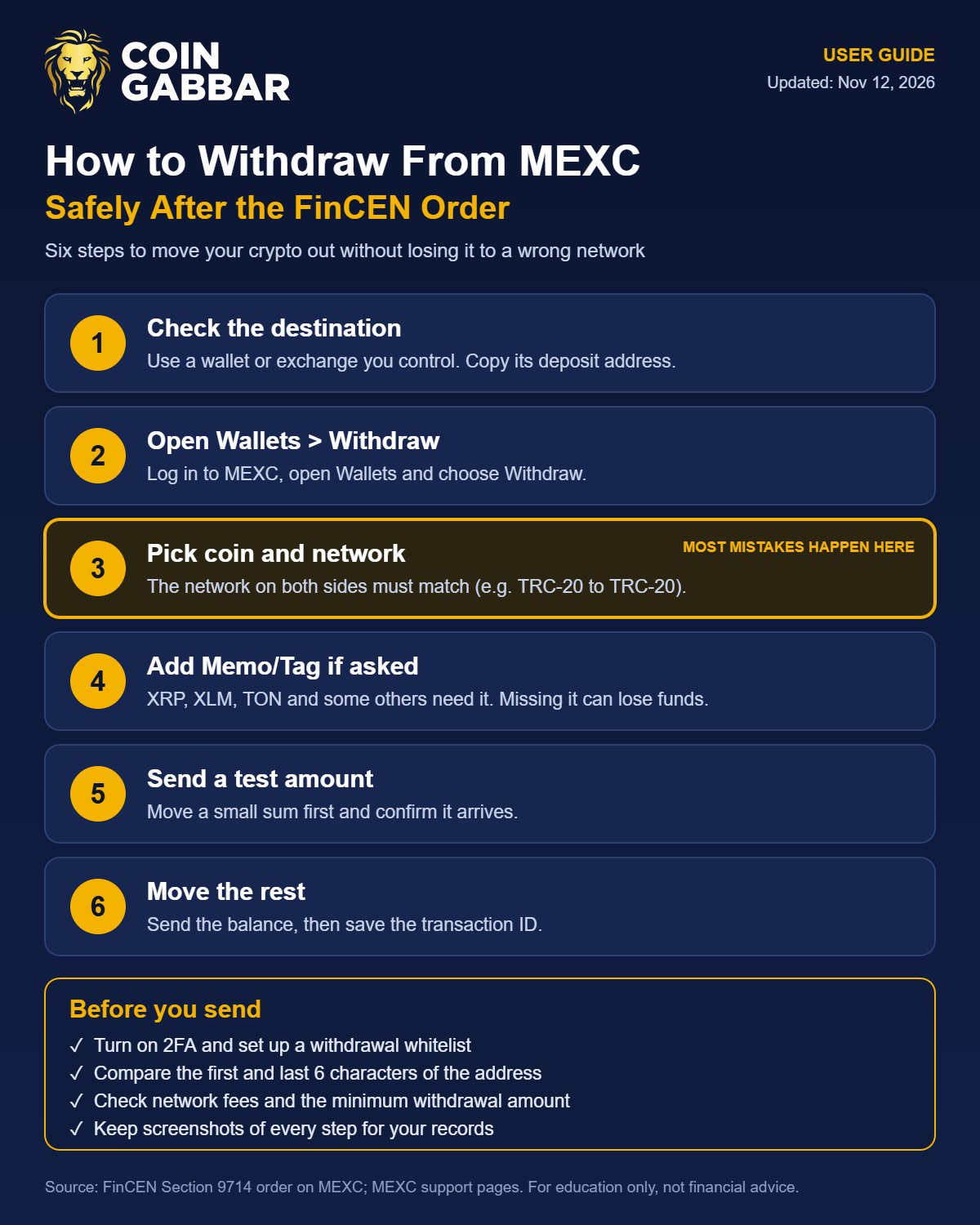
Infographic: CoinGabbar editorial guide to MEXC withdrawals, based on the MEXC help center and the U.S. Treasury notice. Updated November 12, 2026.
Which Network Should You Pick for a MEXC Withdrawal?
The network matters more than the fee when you decide how to withdraw from MEXC.
| USDT network | Typical fee level | Memo or Tag | Main risk |
|---|---|---|---|
| TRC-20 (Tron) | Low | Not usually | Receiving side must support Tron |
| BEP-20 (BNB Chain) | Low | Not usually | Address looks the same as ERC-20 |
| Solana | Low | Not usually | Receiving side must support Solana |
| ERC-20 (Ethereum) | Higher | Not usually | Fees rise when Ethereum is busy |
BEP-20 and ERC-20 addresses look identical, so a BEP-20 transfer to an ERC-20-only address goes through but lands on the wrong chain.
Send a small test amount first. Compare the first and last six characters of the address, since clipboard malware can swap addresses quietly.
Where Should You Send Funds to Avoid a Freeze?
A self-custody wallet, where you alone hold the private keys, keeps the coins under your control while exchanges decide how to treat MEXC-linked deposits. This hardware wallet setup guide walks through the basics.
Self-custody has its own risk. Store the seed phrase offline and never share it, because nobody can restore lost keys.
Do not route coins through extra wallets to blur their origin. Regulated platforms can ask about the source of funds, so keep your MEXC withdrawal history, transaction hashes and KYC records ready.
When you want rupees, use one of the FIU-IND registered crypto exchanges in India.
What If Your MEXC Withdrawal Is Stuck?
Even users who know how to withdraw from MEXC can see a MEXC withdrawal stuck on pending. Check your withdrawal history first.
If it shows a transaction hash, the coins have left MEXC. Paste the hash into the network's block explorer, such as Tronscan, BscScan, Solscan or Etherscan, to see where they are.
If there is no hash after a long wait, raise a ticket through MEXC's official support page with the coin, amount, network and timestamp. Keep screenshots, and ignore "support agents" who message you on Telegram or X. Real support never asks for a seed phrase or 2FA code.
Expert View on the MEXC Situation
As per CoinGabbar's analysis, the FinCEN order is not a reason to panic. It targets U.S. banking rails, and on-chain withdrawals have kept working so far.
Compliance pressure does tend to spread, though. MEXC was already restricted in other markets, for example when South Korea blocked MEXC and KuCoin in October.
As the effective date approaches, more exchanges may tighten checks on MEXC-linked deposits. Users who already planned to leave may prefer to act sooner, based on their own risk and records.
Conclusion
Knowing how to withdraw from MEXC safely comes down to checking the network, sending a test amount and moving funds to a wallet or FIU-IND registered platform you trust.
Indian users have extra reason to act, since MEXC has limited Indian services since February. A later sale falls under India's 30% tax on crypto gains and 1% TDS, or tax deducted at source, as covered in this 2026 crypto tax filing checklist.
Keep these records for filing too. This Bitcoin tax reporting guide explains what to document. Watch for the Federal Register date, MEXC's official channels and your next exchange's deposit policy.
Disclaimer: This article is for informational purposes only and does not constitute financial, legal or investment advice. Crypto transfers carry risk, including permanent loss from wrong addresses or networks. Readers should verify every step through official sources and consult a qualified advisor where needed.