

Monolithic chains handle execution, settlement, consensus, and data availability in one network. Modular blockchain architecture splits the work of a blockchain across separate layers. One layer runs transactions and then, another publishes data. A third checks results. A monolithic chain keeps these jobs inside one network. The better choice depends on the trade-offs in security, cost, and coordination.
What Are the Four Core Functions of a Blockchain?
A blockchain does four jobs. A real network may not build each as a separate layer.
| Function | Job | The question it answers |
| Execution | Runs transactions and updates state | What happens when a user sends a transaction? |
| Settlement | Checks results and decides which are accepted | Which network accepts the outcome? |
| Consensus | Agrees on the order of transactions | Which transaction came first? |
| Data availability (DA) | Publishes the data needed for checks | Can others get the data to verify the state? |
State means the current record of balances and contract data. For a short definition, see the CoinGabbar modular blockchain dictionary entry. Settlement is often not a separate network. In an integrated chain, one protocol covers it.
How Do Monolithic Blockchains Work?
A monolithic chain does the four jobs inside one base network. Picture one firm with four teams that share one security system.
Solana is a common example of an integrated Layer 1. Its developer documentation describes validators that keep one shared record of accounts, programs, and state.
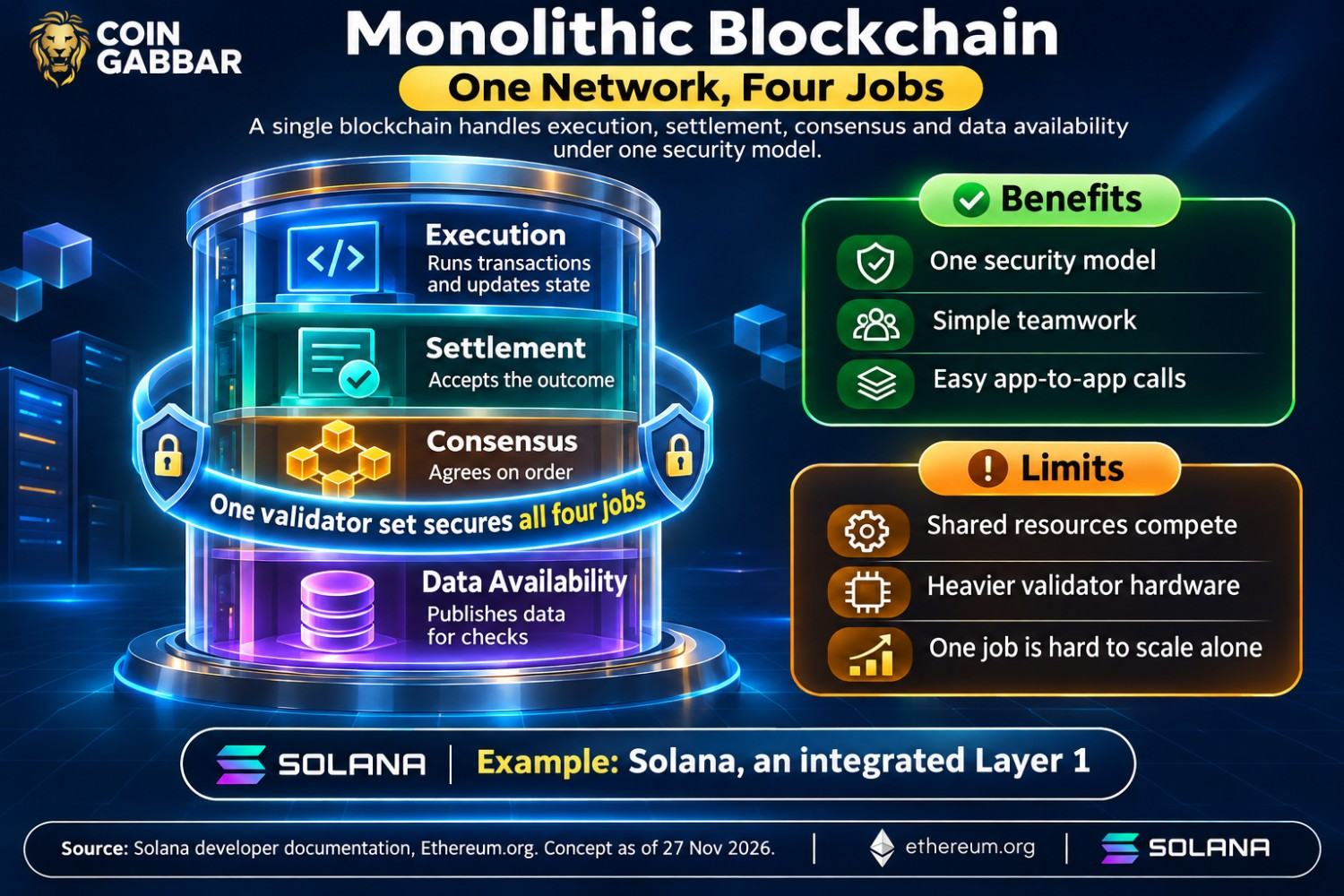
Benefits: one validator set, simple teamwork, and easy app-to-app calls on the same chain.
Limits: execution and data compete for shared resources. More capacity can need heavier validator hardware. One function is hard to scale alone.
Monolithic does not mean one piece of software. Ethereum runs separate execution and consensus clients. The label describes how duties and security are shared. Ethereum's data availability documentation (October 22, 2026 ) calls on-chain data availability a feature of monolithic blockchains.
How Does Modular Blockchain Architecture Work?
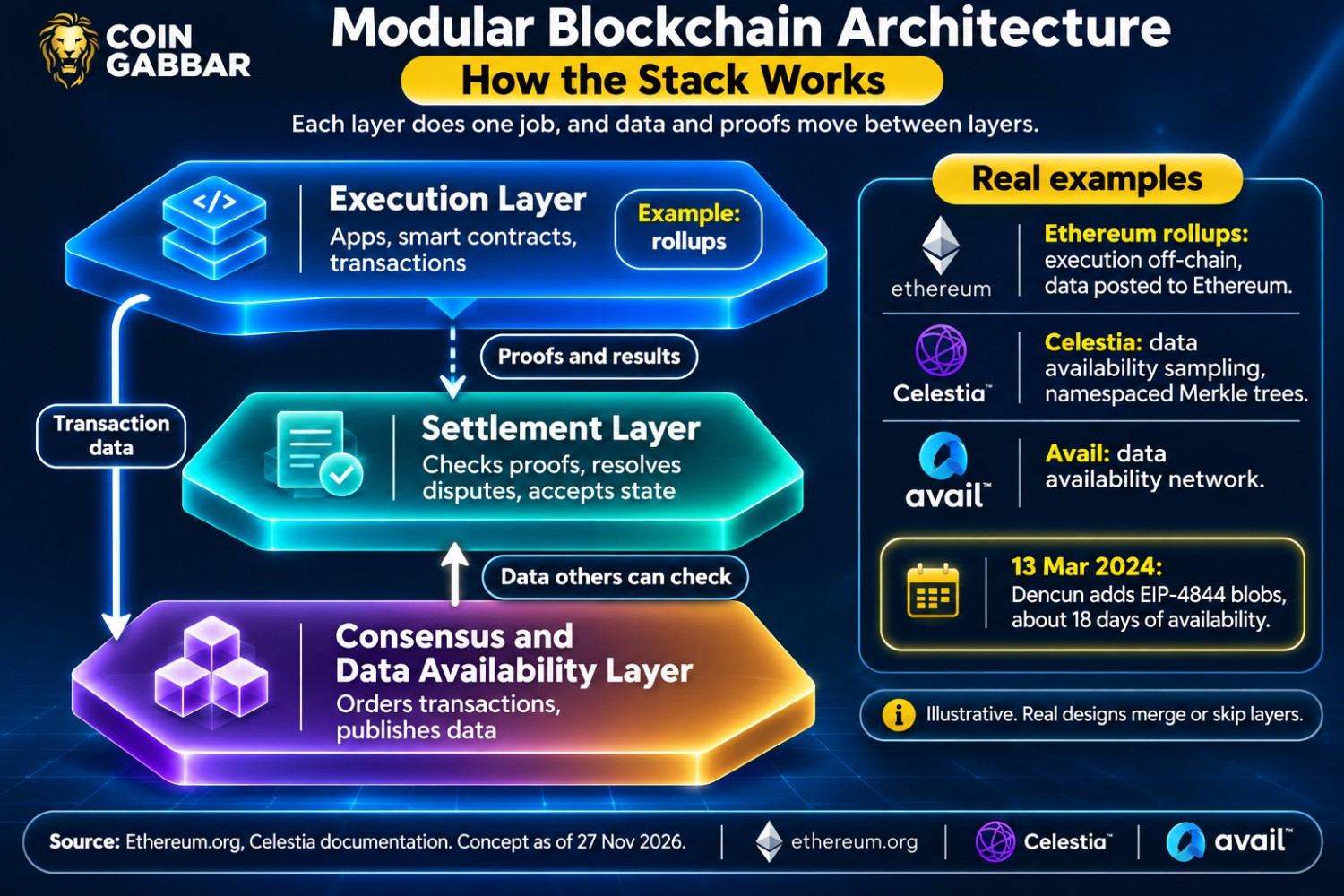
Modular blockchain architecture gives each job to a separate part. A simple stack might look like this:
Execution layer: apps, smart contracts and transaction processing
Settlement layer: proof checks, dispute handling and state recognition
Consensus and DA layer: transaction ordering and data publication
This is an illustration. A stack can merge consensus and DA or lean on an existing Layer 1 for settlement.
Modular vs. Monolithic Blockchains: Key Differences
| Dimension | Monolithic | Modular |
| Core design | Integrates the main functions | Separates selected functions |
| Data availability | Usually on the base chain | Base chain or external DA layer |
| Scaling | Tied to shared network resources | Layers can scale separately. |
| Security | One shared base-chain model | Depends on each layer |
This table compares designs, not speed. A well-built monolithic chain can be efficient. A modular system can add new trust points.
How Ethereum, Celestia, and Avail Use Modular Design
Ethereum and rollups. Rollups run transactions off Ethereum Mainnet. Rollups post bundled data and results to Ethereum, which gives consensus and data availability. Settlement contracts and proofs decide whether a result is accepted. Security varies by rollup. On 13 March 2024, the Dencun upgrade added EIP-4844 "blobs," a cheaper way to post rollup data. For the basics of Layer 2, see CoinGabbar's rollups explained simply guide.
Celestia. Celestia is built as a DA network, not a general execution chain. Data availability sampling lets light nodes check random pieces of a block instead of the whole block. Namespaced Merkle trees let an app fetch only its own data. Erasure coding can rebuild missing pieces. CoinGabbar's Celestia TIA guide covers the token side.
Avail. Avail is another DA network. Chains can publish data there and get proof of publication. Its documentation separates Avail DA from Avail Nexus, a cross-chain product.
Why Does Data Availability Matter for Blockchain Security?
Data availability asks one question: can others get the data needed to check the state? That is not the same as permanent storage. Ethereum's Dencun FAQ (November 16, 2026) says blobs give temporary availability of about 18 days. Other services must keep older history.
Imagine a network that posts a state update but hides the transaction data. Others cannot rebuild the state. Users may be unable to check balances, challenge a bad update, or withdraw funds.
| Feature | Rollup | Validium |
| Transaction data | Posted to the base chain | Kept off-chain |
| Data dependency | Base-chain DA | Outside provider or committee |
| Main trade-off | Base-chain data cost | Extra trust in off-chain data |
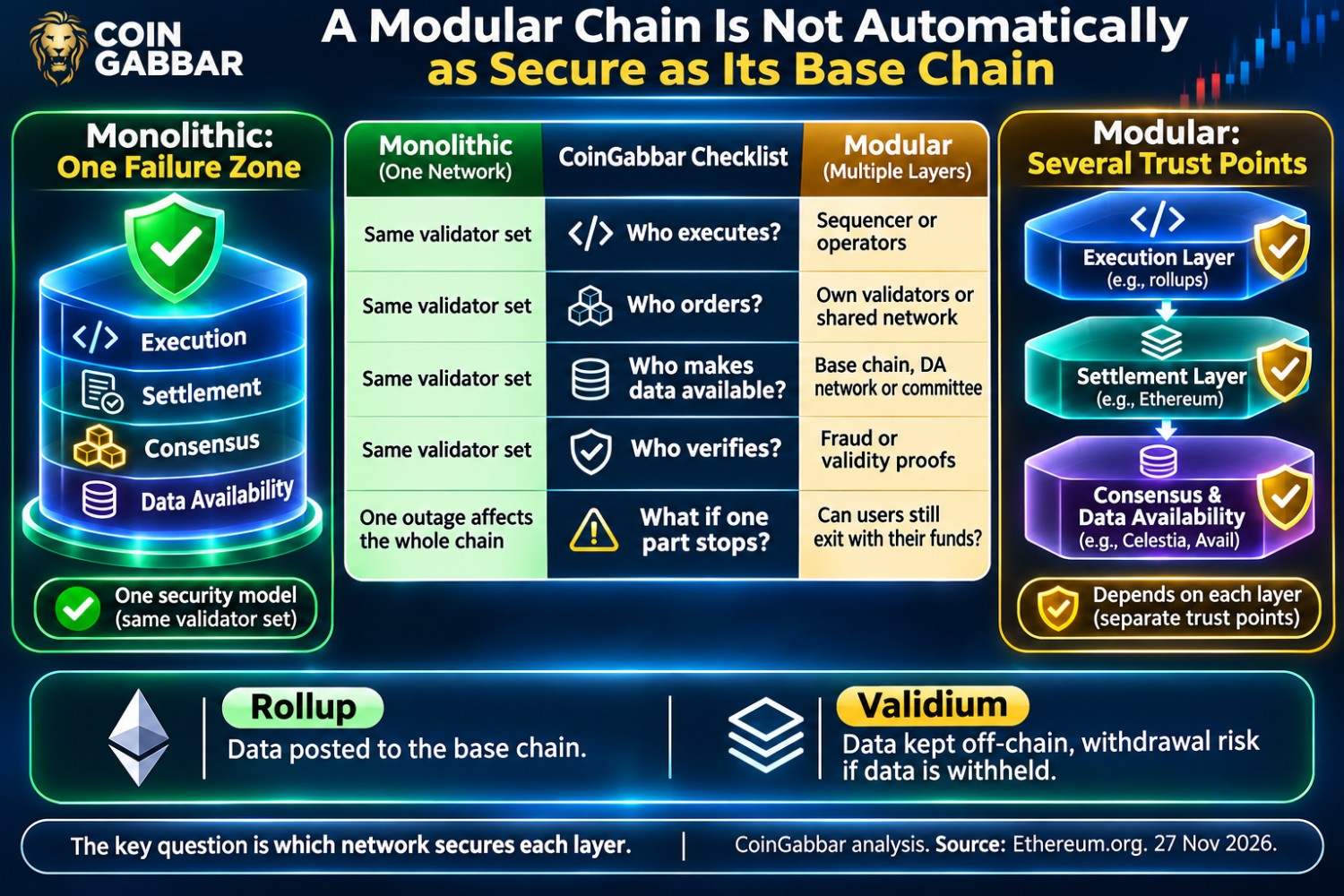
Ethereum's validium documentation (September 8, 2026) explains that validiums use off-chain data availability. Users can face withdrawal limits if data managers withhold state data. A modular chain is not automatically as secure as the base chain beneath it.
CoinGabbar Framework: Who Secures Each Layer?
This table is a CoinGabbar analysis of modular blockchain architecture. Readers can fill it in for any chain.
| Question | What to find out |
| Who executes transactions? | One sequencer or many operators |
| Who orders transactions? | The chain's own validators or a shared network |
| Who makes data available? | The base chain, a DA network or a committee |
| Who verifies the result? | Fraud proofs, validity proofs, or trusted parties |
| What if one part stops? | Can users still exit with the funds? |
The last row matters most. It shows which security a user truly inherits.
What Are the Risks of Modular Blockchain Architecture?
More trust assumptions: Each layer has its own validators and rules.
Bridge risk: Moving assets between networks can rely on outside validators or multisignatures.
Sequencer control: A single sequencer can create censorship and uptime concerns, even on a decentralized base.
Split liquidity: Balances and pools spread across several networks.
Harder teamwork: An outage or upgrade in one layer can ripple through the stack.
Is Modular Architecture Better Than Monolithic Design?
Not by default. A monolithic chain suits teams that want one shared setting. A modular stack suits teams that need custom execution or a different DA choice. The real test is who runs, orders, shares, and checks the data. It also asks what happens when one part fails.
Expert Opinion: What Should Readers Take Away?
From a CoinGabbar research view, the label "modular blockchain architecture" says little by itself. Ethereum with rollups, Celestia-based stacks and Solana each answer the four questions differently. The useful habit is to trace each function to its security source. CoinGabbar will update this article when the cited Ethereum, Celestia, or Avail documentation changes the design.
Disclaimer: This article is for education only. It is not financial or investment advice. Technical designs and documentation change, so check current official sources. Sources (checked Friday, 27 Nov 2026, 4:48 AM UTC): Ethereum.org documentation on data availability, the Dencun upgrade, and Validium, linked above.
Frequently Asked Questions (FAQ)




Owned by:-
DCG Tech FZCO, UAE
Delivery Partner:-
Gabbar MediaTech Pvt Ltd.
Copyright © 2026 Coin Gabbar. All Rights Reserved