Monad vs MegaETH: Which EVM Blockchain Offers Better Performance?

How Do Monad and MegaETH Compare in EVM Speed and Scalability?
Which EVM chain is actually faster, Monad or MegaETH? The Monad vs MegaETH question keeps coming up because both networks promise Ethereum-style apps at speeds Ethereum cannot match.
They get there in opposite ways. Monad is a standalone Layer 1 that speeds up how validators agree on and run transactions. MegaETH is an Ethereum Layer 2 that hands most of the work to one powerful sequencer.
Most performance numbers come from the projects' own documentation, so they remain claims until real usage backs them up.
What Is a Monad, and How Does Parallel Execution Work?
Monad is an Ethereum-compatible Layer 1 blockchain. Its mainnet launched on November 24, 2025. Category Labs builds the software, and the Monad Foundation stewards the MON token.
Ethereum-compatible means apps written for the Ethereum Virtual Machine, the software that runs smart contracts, can run on Monad without rewrites.
According to Monad's developer documentation, the chain targets 10,000 transactions per second, 400-millisecond blocks, and 800-millisecond finality. Finality is the point where a transaction can no longer be reversed.
Four design choices sit behind those targets. MonadBFT lets validators agree on order. Asynchronous execution runs transactions while the next consensus round happens. Parallel execution uses several processor cores at once.
MonadDb speeds up access to blockchain state. In Monad vs MegaETH terms, these choices show Monad's bet on shared validator consensus.
What Is MegaETH and Why Does It Use One Sequencer?
MegaETH is an Ethereum Layer 2 built on the OP Stack. A Layer 2 processes transactions off Ethereum and posts results back to it. The mainnet opened on February 9, 2026.
Its core idea is the mini-block. Per the MegaETH architecture documentation, the sequencer seals a mini-block about every 10 milliseconds and a standard EVM block about every second.
The sequencer is the node that orders and runs transactions. A wallet can show a confirmed transaction in roughly 10 milliseconds.
Data goes to EigenDA, and settlement on Ethereum follows through a fault-proof system called Kailua.
The project says a stress test processed 11 billion transactions in seven days, and it advertises up to 100,000 transactions per second. Both are project claims.
In Monad vs MegaETH, the trade-off is plain. One sequencer makes the speed possible, yet it concentrates ordering power. A standby node takes over within tens of milliseconds if the active one fails, and sequencer rotation is planned.
How Do the Monad vs MegaETH Speed Figures Compare?
Feature | Monad | MegaETH |
Network type | Layer 1 | Ethereum Layer 2 |
Mainnet launch | Nov 24, 2025 | Feb 9, 2026 |
Block timing | About 400 ms | About 10 ms mini-blocks, 1 s EVM blocks |
Stated throughput | 10,000 TPS | Up to 100,000 TPS (claim) |
Confirmation | About 800 ms finality | About 10 ms results, Ethereum settlement later |
Block producer | Validator set | Single sequencer |
Source: Each project's documentation. These are stated figures, not independent measurements.
On paper, MegaETH leads the Monad vs MegaETH table. Yet the columns do not measure the same thing.
Why Is Monad vs MegaETH Not a Simple Speed Race?
The Monad vs MegaETH debate often shrinks to 10,000 versus 100,000 transactions per second. That framing misses the point.
MegaETH's 10 millisecond figure shows how fast the sequencer reveals a result. Monad's 800 millisecond figure marks deterministic finality, meaning validators agreed the block is settled.
One is a quick preview, the other a locked result. It resembles comparing a till receipt with a cleared bank transfer.
Security assumptions differ too. MegaETH ties its results back to Ethereum, where fault proofs let anyone challenge a bad block. Monad takes a different route and leans on its own validators, whose incentives come from proof-of-stake economics.
In Monad vs MegaETH terms, use cases may split along that line. MegaETH targets latency-sensitive apps such as onchain order books and games. Monad is a general-purpose chain with full EVM bytecode compatibility.
Developers still need to test their contracts, because MegaETH’s documentation points out EVM differences and a gas model of its own.
Apps on both chains read data through RPC endpoints, and how RPC nodes work explains why mini-block streaming needs capable providers.
Official explorers show live blocks, so any Monad vs MegaETH speed claim can be checked against real activity.
How Do MON and MEGA Tokenomics Shape Monad vs MegaETH?
Tokenomics describes how a token is created, shared out, and released over time. Allocation is the share of supply each group receives.
MON allocation | Share | MEGA allocation | Share |
Ecosystem Development | 38.5% | KPI Rewards | 53% |
Team | 27% | Community | 15% |
Investors | 19.7% | VC | 15% |
Public sale | 7.5% | Team and Advisors | 10% |
Treasury | 3.95% | Foundation / Eco Reserve | 7% |
Airdrop | 3.3% |
In the Monad Foundation's published tokenomics, 100 billion MON existed at launch, with about 49.4 billion unlocked and 50.6 billion locked until Q4 2029. Locked tokens cannot be staked.
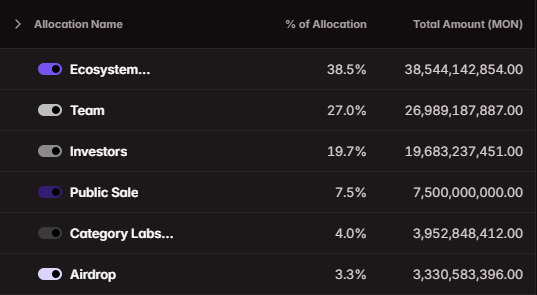
Each block mints 25 MON, roughly 2 billion a year, while base fees are burned. Team and investor releases begin at the one-year mark, November 24, 2026.
MEGA has a total supply of 10 billion tokens, and the token went live on April 30, 2026. The biggest slice is the 53% KPI pool, which the MEGA token distribution page describes in detail.
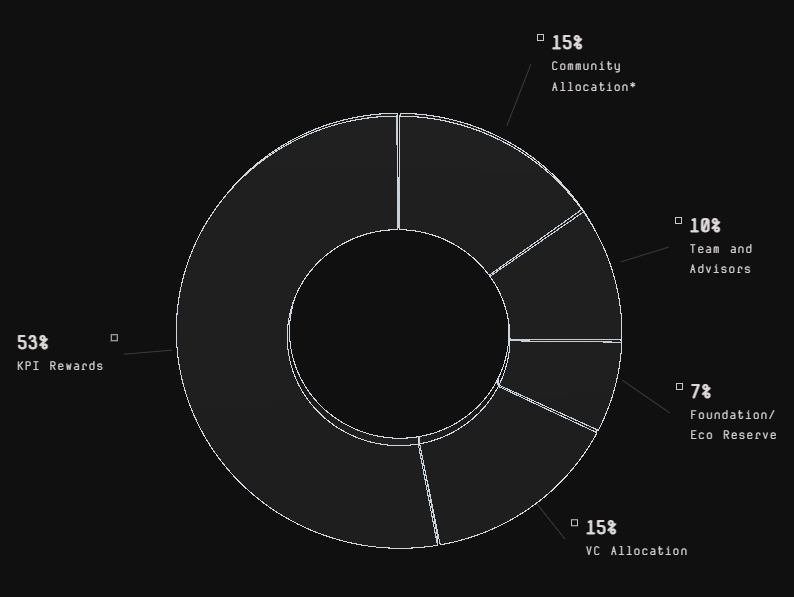
The Foundation defines and confirms those milestones in the first phase. Governance is meant to take over later, which touches the wider issue of DAO token holder rights.
What Do Market Cap and FDV Say About Both Tokens?
Market cap multiplies price by circulating supply. Fully diluted valuation, or FDV, multiplies price by total supply. Price alone says little about project value.
Metric (Nov 17, 2026) | MON | MEGA |
Price | $0.01495 | $0.04976 |
Market cap | $176.97M | $56.39M |
FDV | $1.7B | $499.19M |
Circulating supply | 11.82B | 1.12B |
All-time high | $0.04876 | $0.2187 |
Disclaimer: The figures above were taken from CoinMarketCap on November 17, 2026. Prices, market cap, FDV, and circulating supply change constantly, so the numbers may differ at the time of reading. Readers should check live data before relying on it.
Both tokens in the Monad vs MegaETH pairing have a thin float, since only about one in nine tokens is circulating today. FDV is about 9.6 times the market cap for MON and 8.8 times for MEGA.
Both also trade far below their highs, around 69% for MON and 77% for MEGA. Spreads on thin markets depend heavily on crypto market makers.
What Are the Main Risks in Monad vs MegaETH Today?
Neither side of Monad vs MegaETH comes without risk. A few points deserve a closer look:
Unproven speed: The headline figures are targets or project claims, and results under heavy real-world demand may look different.
Sequencer concentration: For now, MegaETH depends on a single active sequencer, and rotation is still only a plan.
Unlock pressure: About 50.6 billion MON are still on release schedules, so new supply will keep reaching the market.
Thin float, large FDV: Only a small share of each token circulates today, and the supply still to come could weigh on prices.
Adoption gap: Fast blocks alone do not bring users, apps, or liquidity.
Listings also change over time, so tracking new exchange listings is a useful habit for anyone following either token.
Final Take: What Should Readers Check Next?
Monad pushes EVM speed through parallel execution and fast validator consensus. MegaETH trades some decentralization for near-instant results and Ethereum (ETH) settlement.
The Monad vs MegaETH comparison has no clean winner yet. The numbers measure different things; both tokens carry large future supply, and adoption data is still thin.
Anyone following Monad vs MegaETH can check live blocks on official explorers, review published tokenomics, and track unlock dates. The outcome for both projects remains uncertain.
Disclaimer:
This article is for information only and is not financial advice. Crypto assets are volatile and high risk, and past performance does not predict future results. Readers should do their own research before making any decision.