Unipoly UNP: How to Verify Its Contract, Supply, and Liquidity

Unipoly UNP: Contract, Supply, and Liquidity Verification Guide
Unipoly UNP verification comes down to three checks done in order: confirm which token address is current after the September 2026 swap, compare supply figures instead of trusting a single number, and test real liquidity instead of reading headline volume.
The ticker alone does not prove token identity, and an old deployment may no longer be supported by exchanges. The new token address should come only from the project's official explorer and documentation, never from social media or an unrelated listing.
Why Unipoly UNP Verification Matters
Unipoly is a gaming-focused project, and UNP is its token. Anyone moving or trading Unipoly UNP needs the correct token version first, because sending tokens to an unsupported version can mean they are not credited, and recovery is not guaranteed.
The Unipoly Coin Unp Crypto Airdrop-Token guide covers how the token reached many holders, which is part of why so many people now need to check which version they hold.
The September 2026 token migration makes the question sharper. When a project replaces a token deployment, old and new references circulate side by side for a while, and guides, wallets, and listings update at different speeds.
Supply and liquidity data face the same lag. Two data providers can describe the same token differently, so the figures need cross-checking across several sources, and the ticker UNP alone cannot establish which asset is meant.
Unipoly (UNP) Tokenomics: 1 Billion Supply
Unipoly's published tokenomics describe a fixed total supply, stated in the billions, and the exact figure is on the official tokenomics page.
The official tokenomics page confirms:
-
Total supply: 1 billion UNP
-
Ecosystem and Rewards: 25%
-
Staking and Mining: 20%
-
Development: 15%
-
Team and Advisors: 15%
-
Marketing: 10%
-
Reserve and Partners: 15%
-
Transaction burn: 0.1% per transaction
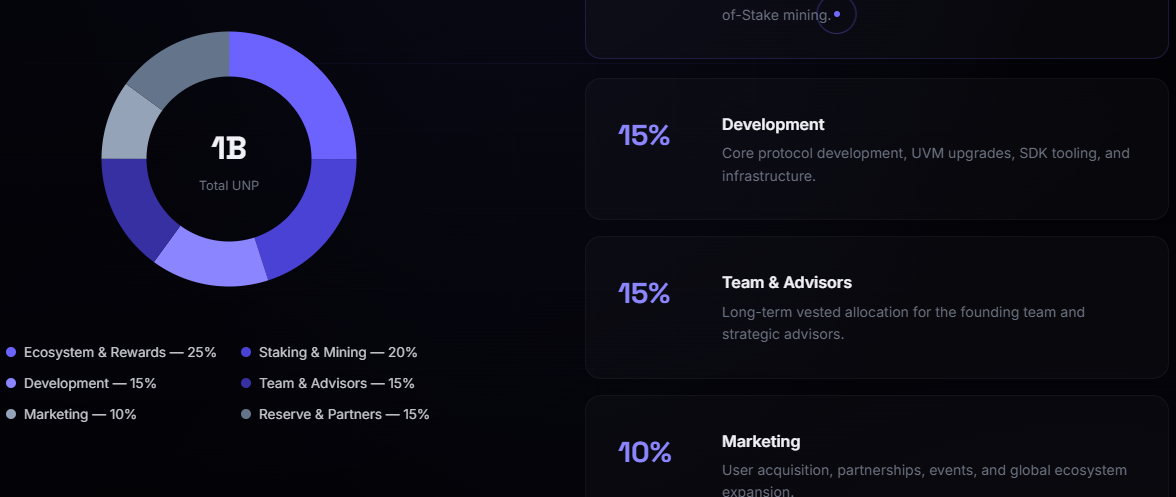
One important detail: the published vesting schedule accounts for 76.35% of total supply; the remaining 23.65% has no published release schedule.
Key Terms and Official Facts
-
Token address: The unique blockchain address of a token.
-
Token migration: A migration in which an old token deployment is replaced by a new one.
-
Total supply: The number of tokens recorded as existing.
-
Circulating supply: The tokens a data provider treats as available in the market.
-
Liquidity: How much buying and selling capacity exists without a major price move.
-
Market depth: The value of orders sitting around the current market price.
How the UNP Token Migration Works
The sequence is simple in outline:
-
Unipoly had an older Ethereum token.
-
The project completed a migration in September 2026.
-
One exchange supported the swap at a one-to-one ratio.
-
That exchange stopped supporting deposits of the old-contract.
-
Holders must confirm which contract their own exchange or wallet currently supports.
| Detail | Old contract | New contract |
| Token | Unipoly UNP | Unipoly UNP |
| Network or reference | Ethereum | Unipoly explorer |
| Contract information | Documented in the exchange announcement | Verify through the current official explorer |
| Migration | Replaced through the swap | Supported after migration |
| Exchange position | Old deposits discontinued | One-to-one swap confirmed |
The old address appears in the exchange announcement, and the full details are in that contract swap announcement.
The new address should not be guessed or inferred from an unrelated UNP listing. It should be read directly from the official explorer and current project documentation, and a smart contract page on an explorer is the place to confirm the details.
How to Verify UNP Token Supply
A reliable supply check follows these steps:
-
Open the relevant official blockchain explorer.
-
Search for the verified UNP-contract.
-
Read the total supply recorded by the contract.
-
Compare circulating supply across at least two market-data providers.
-
Record each provider's timestamp.
-
Check whether the reported figure counts migrated or cross-chain tokens.
Readers who track the token's market can also follow the UNIPOLY price today page, keeping in mind that it is one provider among several.
How to Check UNP Trading Liquidity
Liquidity is not the same as the displayed daily volume. A sensible check covers these points:
-
Which exchanges report active UNP trading pairs.
-
Whether volume is similar across venues or concentrated on one.
-
The bid-ask spread.
-
Market depth on both sides near the current price.
-
DEX pool reserves, where a decentralized pool exists.
-
Whether the intended trade size fits the available liquidity.
One market-data listing shows UNP trading against a major stablecoin on only two exchanges, with volume concentrated between them and depth that is very uneven.
A token can report large volume and still have thin executable liquidity, and the latest crypto news coverage shows how quickly market conditions shift.
Worked Example or Verification Steps
Suppose one platform reports a higher circulating supply than another. The check runs like this:
-
Confirm that both platforms describe the same Unipoly project.
-
Compare the listed contract-addresses and networks.
-
Read the September 2026 contract migration notice.
-
Inspect the explorer's total supply and token transfers.
-
Review whether the providers count migrated or cross-chain tokens differently.
-
Record the date and source of the final figure.
For liquidity , compare the quoted price, the spread, and the market depth before treating reported volume as evidence that buying or selling will be easy.
For further reading, the project's developer resources describe the network, and the UNIPOLY Price Prediction page offers one view of market sentiment, which is separate from verification.
What Can Go Wrong
-
Using the old-contract after the swap.
-
Depositing old-contract tokens into an exchange that no longer supports them.
-
Confusing different assets that share the UNP ticker.
-
Comparing supply from different networks without accounting for migration.
-
Treating total supply as circulating supply.
-
Assuming high volume guarantees strong liquidity.
-
Ignoring spreads and depth.
-
Trusting contract addresses shared through social media, a trap the guide on crypto phishing protection describes.
-
Treating a published allocation as proof of actual on-chain distribution.
Common Misunderstandings
| Misunderstanding | Correct explanation |
| Every UNP contract address is the same deployment | Addresses must be checked alongside the network |
| A one-to-one swap means both contracts stay supported | Exchange support for the old contract may have ended |
| Total supply equals circulating supply | They are separate measurements |
| High volume means easy selling | Depth and spreads decide execution |
| A verified contract guarantees a safe token | Verification confirms identity or source status, not safety |
| One data platform is always right | Providers differ in method and update time |
Final Thoughts
Unipoly UNP is a good example of why token research starts with identity. A contract swap, two circulating-supply stories, and thin, concentrated trading all point the same way: confirm the contract, cross-check the supply, and test the liquidity before acting. The value is the method, not any single figure.
Disclaimer: This article is for educational purposes only and is not financial or investment advice. Contracts, supply, and market data differ between sources and change. Verify details with official project sources before sending or trading any token.