Multisig Signer Rotation: How to Safely Replace Wallet Signers


Rotating a Multisig Signer Without Losing Control
Picture a DAO treasury secured by a 2-of-3 multisig. One signer leaves the team, but their laptop is still signed in everywhere. Multisig signer rotation is how you replace that person while the wallet keeps working.
The risk isn't the swap itself. It's the wrong order or a threshold nobody can reach. This guide covers the safe sequence, what to verify at each step, and how to respond when a key is compromised.
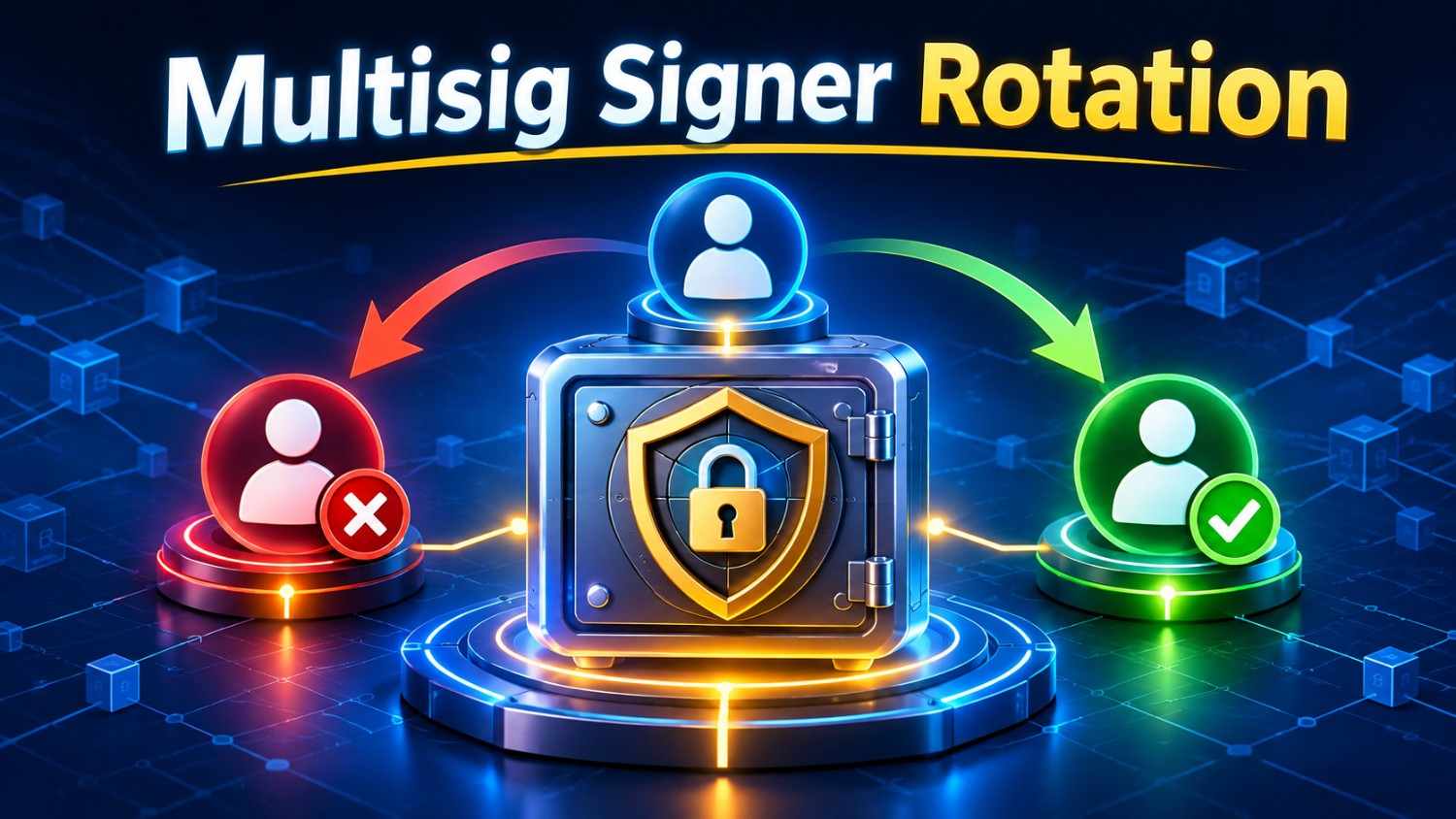
Multisig signer rotation replaces or removes an authorized wallet owner. It changes who can approve transactions, not the wallet address. In Safe, owner changes can only be made through a Safe transaction, so they need the usual confirmations.
What Is Multisig Signer Rotation?
A multisig needs a set number of approvals, the threshold, from its owners. New to the basics? Start with our multisig wallet guide. In Safe, multisig signer rotation relies on four owner functions:
Function | Purpose | Owner count |
Adds an owner | Up | |
removeOwner Function | Removes an owner | Down |
Replaces an owner | Same | |
Changes in approvals are required. | Same |
The steps below assume safety. Other multisig wallets have different owner rules, so check yours first.
Before You Rotate: What to Check
Before multisig signer rotation, get these things straight:
Signer inventory: List each signer's name, role, address, device, and backup location.
Owners and threshold: Read them from the wallet, not old notes. Safe requires a threshold of at least one and no higher than the owner count, and it won't remove an owner if too few would remain.
Backup signers: Confirm enough signers can approve today.
Pending transactions: Review the queue. Signatures can't be taken back, and only executing a transaction with that nonce consumes it. A rejection transaction can invalidate pending ones for a nonce.
The network: Confirm you're on the right chain and safe before signing anything.
Step by Step: Routine Rotation
A staged multisig signer rotation looks like this, using a hypothetical 2-of-3 treasury:
Stage | Setup |
Before | 2-of-3 |
New signer added | 2-of-4 |
New signer tested | Small test transaction |
The old signer was removed. | 2-of-3 |
Final check | Confirm owners and threshold. |
Verify the new address: Confirm it through a second channel, and have the person sign a message proving control. Use an address that can sign for itself, because Safe's docs warn that an owner that can't sign can block access completely. Skipping this is the usual way multisig signer rotation goes wrong.
Add the new signer: Safe can add an owner and update the threshold in one transaction.
Test the new signer: Have them approve and execute a low-value transaction.
Remove the old signer and set the final threshold.
Confirm the threshold still matches your policy: If you're replacing like-for-like, keep it. Dropping 3-of-5 to 2-of-4 to save effort makes theft easier, while raising it risks a signer being unreachable.
Adding first means you never lose your fallback. If the new signer's test fails, the old signer is still there to fix things.
swapOwner vs. Add and Remove
All three methods work for multisig signer rotation. Choose the staged one when time allows.
Method | Operation | Main consideration |
Add, test, remove | Separate transactions | Let you test before removal |
swapOwner | One replacement | The new signer isn't tested beforehand |
Batched add and remove | One atomic transaction | Useful when the old key is unavailable or time is short |
Safe's SDK allows batching more than one transaction into a single Safe transaction.
Emergency Rotation: When a Signer Is Compromised
Emergency multisig signer rotation isn't routine admin. You can shorten testing, but not verification:
Isolate the affected devices.
Verify the replacement address independently, for example, on a live call with the other signers.
Replace the signer using a fresh hardware wallet with a new seed, the recovery path the Security Alliance describes.
Execute the authorized owner change quickly.
Here's the hard part. If the affected signer, together with any other doubtful signer, meets the threshold, treat it as a full compromise event. Rotation needs an authorized transaction, so if an attacker can reach the threshold, it may not be possible.
Moving funds to a new wallet also needs valid authorization first, so it isn't an easy escape. Coordinate through a verified channel, since attackers may be watching shared ones.
Revoke the person's other access separately, because removing the signer must not delay that. Learn the common wallet scams too, because they target exactly this.
Modules, Guards, and Pending Transactions
Multisig signer rotation changes owners only. Modules are whitelisted addresses that can execute transactions for the Safe, and a malicious one can take over a Safe. Guards check transactions before and after execution.
Removing an owner touches neither, so review both. The Safe concepts page explains how they fit together. Reject or clear pending transactions before removing a signer, and don't assume a removed owner's collected signatures are void.
Verify After Rotation
After multisig signer rotation, don't trust the interface alone. Check on-chain:
The owner list and threshold.
Owner-change events.
Enabled modules and guards.
A low-value test transaction, approved and executed by the required signers.
Record the date, signers, and transaction hashes in your signer register.
Maintain Signer Backups
Keep a signer register and document every change. Security Alliance guidance says signer changes should be documented and that several signer keys on one device or in one location defeat the point.
Store backups apart from primary devices, and run a recovery drill now and then. Review signers regularly, not only during multisig signer rotation after an incident.
For storage basics, read our guide to wallet backup security and recovery phrase protection.
Conclusion
Multisig signer rotation is mostly order and verification: inventory, add, test, remove, and check on-chain. When a key is compromised, speed matters more, but verification still does. Make multisig signer rotation a written routine before you need it.
Disclaimer: This article is for educational purposes only and is not financial, investment, legal, or security advice. Crypto transactions are usually irreversible, and mistakes can lock a wallet permanently. Wallet software and procedures change, so verify steps against official documentation and test on a testnet or with small amounts first. Consult a qualified security professional for treasury decisions. Do your own research.












Frequently Asked Questions (FAQ)




