NBA Prediction Markets Deal: What Actually Changes for Users

Cryptocurrency World and Market Watchers Follow Event Contracts
This guide shows how event contracts, sports leagues, and regulators meet in the cryptocurrency world and the wider market.
It gives readers clear answers before they follow or trade any prediction market.
What Is the NBA Prediction Markets Deal and What Was Announced?
On October 26, 2026, the NBA announced deals that make Kalshi and Polymarket its preferred prediction market exchanges, as listed on the official NBA website.
The league also signed a cooperation agreement with the Commodity Futures Trading Commission, the federal agency that oversees these exchanges. Reports say the NBA will also license its official data to the platforms.
In short, the NBA prediction markets deal gives two exchanges official status with the league. It also adds rules to protect the game and a plan to work with the regulator.
Key Takeaways
The NBA named two preferred exchanges and signed a cooperation agreement with the CFTC on October 26, 2026.
Some markets will be limited, and league and team staff cannot trade NBA event contracts.
A legal fight between federal and state authorities is still open, so the rules may keep changing.
A contract price shows market odds, not a sure result, and money can be lost.
NBA Prediction Markets Deal: What Changes for Users
The announcement lists three protections. The types of markets on offer are limited, so some contracts may not appear on partner exchanges. League and team staff are barred from trading NBA event contracts. The exchanges must also share details about investigations and suspicious trading.
The reports do not say which markets are restricted. Users should read the rules page of each exchange before they assume a contract is available. The reports also do not describe any change to fees or settlement rules.
Official data could make result sources more consistent, but the reports do not explain how that data will be used.
How Do NBA Event Contracts Work in Simple Terms?
An event contract asks a yes or no question, such as whether a team will win a game. It trades at a price between 0 and 100 cents. Take a made-up example. A contract at 60 cents suggests the market sees about a 60% chance of yes, and it pays $1 if the answer is yes.
A buyer who pays 60 cents gains 40 cents if right and loses all 60 cents if wrong, before fees. Prices move as traders change their minds. So the number shows crowd opinion at one moment, not a forecast from the league.
Why the CFTC Agreement Matters for the NBA Prediction Markets Deal
The CFTC says it oversees prediction markets because event contracts are a type of financial instrument, as described on the CFTC website. Several states have sued to challenge this view, and New York is one of them. They argue that sports contracts should fall under state gambling laws.
The agreement was signed by CFTC Chairman Michael Selig and NBA Commissioner Adam Silver. It sets up a way to share information about threats to the integrity of the game.
The legal fight is still open, so the deal does not settle which level of government has the final say.
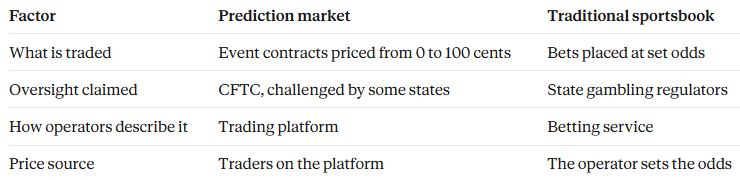
Prediction Markets vs Sports Betting: What Is the Difference?
The two models differ in structure and in who oversees them. The legal question is still contested.
Which Leagues Have Prediction Market Deals Now?
Reports call the NBA the third big North American league to sign such a deal, after the NHL and MLB. The NHL announced its partnerships in October 2025, and MLB announced a relationship in March. The NFL is the one major league without a deal.
Risks Users Should Know Before Trading
A contract can lose its full value. Thin liquidity can also make it hard to sell a position at a fair price. Resolution rules differ by market, so the fine print matters before any trade.
Access rules vary by location and platform. Fake apps and lookalike websites are a constant danger, so users should open exchanges only through official links and confirm the web address. Seed phrases and private keys should never be shared with anyone.
Glossary: Key Terms in Plain Words
Event contract: a yes or no question that trades like an asset.
Preferred exchange: a platform that the league names as an official partner.
Integrity protections: rules meant to stop the misuse of inside knowledge.
Implied probability: the chance that a contract’s price suggests.
Liquidity: how easily a position can be bought or sold.
How to Follow NBA Prediction Markets Deal Updates
A few simple steps help readers track the story without relying on rumors:
Check the official NBA and CFTC pages for new statements.
Read the rules page on Kalshi or Polymarket before opening any NBA market.
Watch for court news on the dispute between federal and state authorities.
Look for lists of allowed and restricted markets once they are published.
This guide will be updated when the league, the regulator, or the exchanges share new details.
Conclusion
The NBA prediction markets deal adds guardrails to a fast-growing category. It pairs preferred exchanges with limits on markets, a trading ban for league insiders, and a cooperation agreement with the CFTC.
It is still unclear which markets will be restricted and how the fight between federal and state authorities will end.
Before using any platform, readers should check the official rules and confirm the website address. They should also risk only money they can afford to lose.
Disclaimer: This article is for informational and educational purposes only and is not financial or investment advice. Prediction markets and crypto assets carry a high risk of loss, and rules, figures, or plans can change over time. Readers should do their own research before making any decision.