Tokenization in India: Demat 2.0, e-Rupee, and RBI’s Line Explained

Cryptocurrency World and Market Readers Follow India’s Digital Asset
This guide shows how digital assets, central bank money, and regulators meet in the cryptocurrency world and the wider market.
It gives readers a clear place to start before they follow any news on this topic.
What Is Tokenization in India? A Simple Definition
Tokenization in India means keeping the record of a real asset, such as a bond, as a digital token on a shared ledger. The holder keeps the same legal rights. Only the way the records are kept changes. It is a new way to run an old asset, and it is not the same as buying a crypto coin.
Two public bodies sit at the center of the story. SEBI runs the securities side through its Demat 2.0 pilot. The Reserve Bank of India supplies the digital rupee that pays for the trades.
Key Takeaways
SEBI and the RBI launched the Demat 2.0 pilot on September 10, 2026, to issue tokenized corporate bonds.
The bonds are paid for in the wholesale e-Rupee, and the bond and the payment move together or not at all.
The RBI backs tokenization and shared ledger technology, but it stays careful on crypto.
A tokenized bond keeps its usual legal rights, so it is quite different from a crypto coin.
Demat 2.0 Explained: How Tokenised Bonds Work in India
SEBI and the RBI announced the Demat 2.0 pilot together at the Global Fintech Fest in Mumbai. The regulator posts its notices on the SEBI website.
Under the pilot, companies issue bonds as digital tokens on a ledger that the depositories run. Issuers still use the current online bidding platform. The tokens land in a Demat 2.0 account after allotment.
SEBI says tokenization only changes how ownership is recorded. It does not create a new kind of asset. The depository stays the official record of who owns each bond. Coupon payments and redemptions can also run through smart contracts, which are programs that follow set rules.
The rollout comes in phases, and big firms issue the bonds first. Reports say trading among investors and retail access may come later. SEBI has also said that no separate exchange will be set up for tokenized bonds, so prices will keep forming through the channels already in use.
How the e-Rupee Settles Tokenized Bonds With Atomic Settlement
The e-Rupee is the digital form of the Indian rupee. The RBI issues it as a central bank digital currency. The wholesale version is meant for banks and financial firms.
It began as a pilot on November 1, 2022, and was first used to settle trades in government securities. A retail version also exists for consumers and businesses. In Demat 2.0, the wholesale e-Rupee pays for the tokenized bonds.
The key feature is atomic settlement. It ties the bond token and the payment together on the same ledger. Either both parts go through or neither does. This closes the gap where one side has delivered but the other has not yet paid.
Take a made-up example. A fund agrees to buy bonds worth ₹10 crore from a seller. The bond tokens move to the fund at the same moment the digital rupee payment moves to the seller. If the payment fails, the token transfer is cancelled too.
RBI’s Line on Crypto and Tokenization in India
RBI Governor Sanjay Malhotra spoke on October 3, 2026, at the Kautilya Economic Conclave in New Delhi. He said India stays careful on crypto but supports the tools behind it, such as shared ledger technology and tokenization.
He named three worries: control over the country’s money, monetary policy, and the flow of capital. The central bank posts its own statements on the RBI website.
He also spoke of the singleness of money. This means every form of a currency should hold the same value and stay easy to swap for another. The RBI is testing tokenized corporate bonds, certificates of deposit, and a programmable digital rupee.
These projects settle in central bank money. That may explain why they get support while private crypto money draws caution.
Tokenized Bonds vs. Crypto: Key Differences
The table below shows how tokenized bonds differ from crypto assets, based on the points covered above.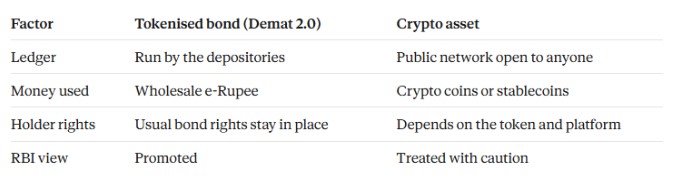
What Tokenization in India Means for Crypto Readers
Crypto readers can treat Demat 2.0 as a hint of where regulated tokenization is heading. The technology is welcome, and private crypto money is viewed with care. As described so far, the pilot does not offer a public token to buy. It also does not change the status of any crypto coin.
Scammers often use fresh headlines as bait. Readers should open only official SEBI, RBI, and depository pages. They should never share seed phrases or one-time passwords. Questions about tax on digital assets are best checked on the official income tax pages.
Risks and Open Questions for Tokenization in India
Several points are still open. The pilot is at an early stage and begins with big firms, so wider access depends on later phases. The sources reviewed give no firm dates for those phases.
They also do not say how tokenized assets will be treated in law and tax for retail holders. Technology risks, such as software errors, remain too.
Crypto rules are a separate matter. Because of the RBI’s careful stance, tokenization in India is moving ahead on a different track from crypto trading.
Glossary: Key Terms in Plain Words
Tokenization: keeping the record of who owns an asset as a digital token.
Distributed ledger technology (DLT): a shared record that several parties keep in sync.
CBDC: digital money issued by a central bank.
Atomic settlement: a payment and a delivery that happen together or not at all.
Singleness of money: the idea that all forms of a currency keep the same value.
Conclusion
Tokenization in India is moving ahead on a regulated path. SEBI handles the securities side, and the RBI supplies the digital rupee for payment.
The RBI’s line is clear on one point: the technology is welcome, while crypto draws caution. It is still unclear when retail investors may get access and how the rules will grow after the pilot phases.
Readers should follow the official SEBI and RBI pages for updates. They should treat any unofficial claim about access or returns with care. This guide will be refreshed when either body shares new details on the pilot or the next phase.
Disclaimer: This article is for information only and is not financial or investment advice. Crypto assets and tokenized products carry risk, and rules, figures, or plans can change over time. Readers should do their own research before making any decision.