Orbinum Network news: What Does Vault v7 Change on the Testnet?


Privacy Upgrade Version 7 Goes Live on Testnet
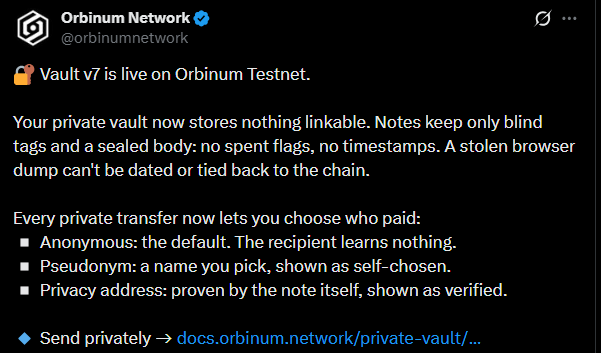
Orbinum Network news on Oct 16, 2026, centers on Vault v7, a privacy update now live on the testnet. The team shared details in an official X post dated the same day. The release changes how records are stored and how senders appear.
This crypto news item matters because it affects how people hold and send funds. It applies to the testnet only.
What Gets Stored After the Upgrade
According to the project, the private vault now stores nothing linkable. Notes are private records of funds.
They keep only blind tags and a sealed body, with no spent flags and no timestamps. Spent flags show which entries are used, and timestamps show when activity happened.
The project also says a stolen browser dump cannot be dated or tied back to the chain.
Source: Official X Post
Three Sender Options for Every Private Transfer
Every private transfer now lets the sender choose who paid. In Orbinum Network news, this choice is a user-facing change, and the update lists three options.
Mode | What it shows |
Anonymous | The recipient learns nothing |
Pseudonym | A name the sender picks, shown as self-chosen |
Privacy address | Proven by the note itself, shown as verified |
Anonymous is the default, so a sender must choose another mode to show a name or a verified label.
The release graphic uses the phrase “Choose who paid” above a sample activity list of transfers.
Recover Notes: Rescan Needed After Unlocking
Orbinum Network news includes one required action. The vault upgrades when a user unlocks it, and a rescan rebuilds the records and full activity history.
The project lists these steps:
Unlock the vault.
Open Shielded Pool, then More Actions, then Recover Notes.
Wait for the scan to finish, since the balance may read 0 until then.
No backup is needed, according to the project, because the data is on-chain and encrypted to the user.
The announcement closes with a short instruction: rescan once, then pick a name.
Protocol and SDK Changes Under the Hood
Orbinum Network news also covers four protocol and SDK changes, where SDK means software development kit. The project links to a private vault guide that explains how it works.
Spends are unsigned, with no relayer and no account tied to nullifiers.
Merkle paths are built on the user’s device, so the node never learns which notes are theirs.
New notes can be spent the moment they land.
Activity is rebuilt to show what a user paid, received, and unshielded, even after a restore.
A relayer is a third party that submits transactions for others. A nullifier is a marker that stops a record being spent twice.
A Merkle path proves where an entry sits in a data tree. To unshield means to move funds out of private balances.
Expert Take: Privacy Gains and Open Questions
The update focuses on reducing what a stored vault can reveal. Removing spent flags and timestamps leaves fewer details that could be matched against on-chain activity. Unsigned spends and device-side Merkle paths also limit what the node can learn.
These points come from the project’s own post, which does not mention an independent review. Its roadmap lists code audits as a Q4 item.
Testnet use can differ from mainnet use, so results here do not predict later behavior. The post also does not mention the planned ORB token sale or the Q4 mainnet stage.
For readers following Orbinum Network news, the update is a testnet change, not a mainnet release.
Where the Privacy Update Stands Today
Orbinum Network news for Oct 16, 2026, confirms that Vault v7 is live on the testnet. It adds new sender options and a one-time rescan.
Readers can check live activity on the public explorer, which shows test data only. Updates will appear on the official X account, so details may change.
YMYL Disclaimer: This article is for educational and informational purposes only. It is not financial advice, a price prediction, or a guarantee of returns. Crypto assets carry risk, so readers should verify details on official channels.






