Orbinum Network vs Zcash: A Complete Privacy Blockchain Comparison

Orbinum Network vs Zcash: Features, Technology and Use Cases Compared
Imagine a person paying a friend back for dinner. On most blockchains, anyone can open an explorer, see that payment, check the sender's balance, and follow their history from there.
Nobody would accept that in a bank app. Yet on public chains, it is the default.
That is why privacy projects keep gaining attention. Zcash is the veteran in this space. Orbinum is a newer name with a different angle. This Orbinum Network vs Zcash comparison keeps things simple and looks at what each one actually does. It also works as a quick privacy coins comparison for readers who are still choosing.
Key Takeaways
Zcash has years of real use, wallets and exchange listings. Orbinum is earlier and currently runs as a public testnet.
Both use zero-knowledge proofs. Zcash lets users choose shielded or transparent. Orbinum is built around a shielded pool with selective disclosure.
Orbinum works with EVM tools like MetaMask and Solidity. Zcash has its own separate tooling.
What Is Orbinum?
Orbinum is a privacy blockchain on Substrate with a Frontier-based EVM. You shield tokens, send them privately, and withdraw them later.
Every step is backed by a Groth16 proof over BN254 with Poseidon hashing. The runtime checks these proofs natively, so no off-chain verifier is needed.
The idea is simple: not anonymous by default, not public by default. You choose what to reveal and to whom. For readers who want an Orbinum (ORB) privacy coin with an audit option, that is the main draw.
Source: official website
What Is Zcash?
Zcash describes itself as the first cryptocurrency to develop zero-knowledge encryption for private peer-to-peer payments. Its coin, ZEC, is pitched as encrypted electronic cash.
A simple way to picture it: a shielded Zcash address is a sealed envelope. A transparent address is a postcard. Both work, but only one hides what is written inside.
The official channels says that fees are usually only a few cents. It also says development is funded by the ecosystem itself.
Source: Zcash official website
Orbinum vs Zcash: Quick Snapshot
Feature | Orbinum | Zcash |
Core idea | Shielded pool with selective disclosure | Optional shielded or transparent addresses |
Built on | Substrate with Frontier EVM | Its own protocol, with the Zebra client |
Proofs | Groth16, BN254, Poseidon | zk-SNARKs |
Privacy choice | Reveal only what is needed, to whom you choose | User picks the address type |
EVM support | Full, including MetaMask and Rabby | Not EVM-based |
Wallets | Orbinum Hub | Zodl (Zashi), Edge Wallet |
Exchanges | Testnet stage, check official channels | Gemini, Kraken, Coinbase |
Maturity | Public testnet | Established network |
Two Common Myths
Myth 1: Zcash is always private.
Not quite. Privacy applies only to shielded funds. Anything in a transparent address is public.
Myth 2: Privacy means hiding everything from everyone.
Orbinum challenges this. Its disclosure key (orbdisc) lets a user prove one note's exact value and asset to a chosen verifier. The spending key stays hidden.
How Privacy Works in Each
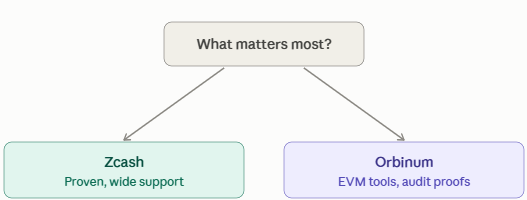
Orbinum privacy vs Zcash comes down to design. One builds privacy around a pool. The other builds it around address choice.
Zcash. Privacy depends on staying shielded. Funds in a transparent address are visible to everyone.
Orbinum. Value moves inside the shielded pool. A disclosure key (orbdisc) lets you prove a note's exact value and asset to a verifier. Your spending key stays hidden.
Source: official ORB documentation
Orbinum also uses validator-based relayers by default. This is meant to cut metadata exposure.
Technology and Developer Tools
Orbinum runs Solidity contracts without changes. Shielded pool actions can be called from EVM through precompiles.
One Secp256k1 keypair covers both EVM and Substrate accounts. Developers can start with a Docker node or a local dev node. A TypeScript SDK is in active development.
Zcash offers the Zebra client and a Build with Zcash section. Its docs also cover the zcashd deprecation and the ZIPs process.
In any privacy blockchain comparison, this is a big split. Orbinum suits Ethereum-style builders. Zcash suits teams working inside its own stack.
Ecosystem and Community
Zcash has a wide, organized ecosystem. The official ecosystem lists wallets like Zodl (Zashi), Edge Wallet and Keystone, plus exchanges, custodians, block explorers and developer tools like Zebra. Its Community Hub covers Build, Learn, Discuss and News, and grants are available through Zcash Community Grants.
Source: Zcash ecosystem page
Orbinum is younger but active. It offers a web app, a faucet, an explorer and public code on GitHub.
Its Polkadot treasury proposal reported 36,000+ transactions and 20,000+ shielded ORB on the testnet. These are team-reported numbers, so verify them yourself.
Who Should Pick What?
If the goal is | Better fit |
A proven coin with wallets and exchange support | Zcash |
Privacy with built-in audit proofs | Orbinum |
Using MetaMask and Solidity | Orbinum |
A long-running network to learn from | Zcash |
A Zcash alternative with EVM tools | Orbinum |
Key Risks to Keep in Mind
Early stage: Orbinum runs on a public testnet. Features and plans can change before mainnet.
Audit pending: The team has said circuits, code and infrastructure will be audited before mainnet. Until that happens, the code is not independently verified.
Transparent exposure: On Zcash, transparent addresses give no privacy at all. Only shielded funds are protected.
Market risk: Crypto prices swing sharply, and a total loss is possible.
Regulatory risk: Rules on privacy-tools differ by country and may change.
Final Verdict
Orbinum Network vs Zcash is not a fight with one winner. They solve a similar problem in different ways.
Zcash fits readers who want proven, everyday privacy with wide support. Orbinum is worth watching for those who want shielded transfers with EVM tools and selective disclosure.
Disclaimer: This article is for information and education only. It is not financial, investment, tax or legal advice. Information here comes from official sources at the time of writing. Readers should verify everything on the official websites and do their own research before acting.










.webp)




