Parallax Network Explained: Features, PAX Token and Whitepaper


How Does Parallax Network Plan to Build a Mobile-First Blockchain?
Most blockchains ask newcomers to buy equipment or tokens before anything else. Parallax Network asks for a phone and an email. That easy start, plus a research paper that keeps every past version online, makes the project worth a closer look.
Key Takeaways
Parallax is a Layer 1 blockchain built on Move, and the beta runs on a regular phone.
Network weight comes from a Trust Score and time, not from expensive hardware.
The project is in a closed early-access test. The PAX token cannot be sold, exchanged or redeemed for real-world value yet.
What Is Parallax Network Blockchain?
The project is its own Layer 1 chain, not a token sitting on another network. Its on-chain layer uses Move, an open fork from the Open Libra and Diem lineage under the Apache 2.0 license. The consensus engine is original Parallax technology.
The team calls it a decentralized multi-application network. Payments, apps, tokens and governance are meant to live in one hub. The stated goal is usability without giving up decentralization.
As a mobile-first Layer 1 blockchain, it treats the phone as the front door. The Android app and the iPhone app are both live, and no mining rig is involved.
Source: official website.
Quick Facts
Detail | Info |
Type | Layer 1 blockchain on Move |
Consensus | Proof of Trust and Time |
Token | PAX (utility and gas fee) |
Apps | Android 8.0+ and iOS |
Early adopters | 20,000+ |
Current stage | Phase 3, Convergence |
How Does It Work?
The features section of the official site explains the model through three ideas.
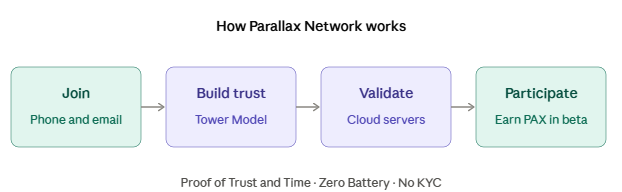
Zero Battery. The consensus runs on cloud servers. The phone is not asked to do heavy work in the background.
Tower Model. Each user builds a trust graph by inviting verified people. A larger graph raises that user’s network weight and rewards.
Fair and Secure. The protocol uses advanced metrics to spot bot farms, so rewards go to real people.
Underneath sits the Proof of Trust consensus model, paired with Proof of Time. Validation is tower-based. Work is spread across the network by Trust Score, which lets many transactions be checked in parallel.
Inside the Ecosystem
The ecosystem section lists six building blocks:
Consensus Layer: Proof of Trust and Time.
Native Wallet: non-custodial storage.
Governance: voting weighted by reputation.
PAX Token: the native token for utility and gas.
DApp Store: integrated applications.
Biometric Hash: privacy-first identity.
A non-custodial wallet means users hold their own assets rather than leaving them with a third party. The PAX token covers payments, participation, governance, validation incentives and access to apps.
Privacy Without KYC
The project says it never asks for documents or traditional KYC. Joining takes only an email.
An optional Fuzzy Biometric Hash proves that a user is one unique human. The face is processed on the user’s own device, and no image is stored or transmitted. The biometric step becomes mandatory only at token migration to the mainnet.
The Epoch Roadmap
The Epoch Roadmap has ten phases. Each phase advances on verified PAX emission rather than on calendar dates, so the dates shown are approximate.
Phase 0, Genesis (Q1 2026): Android launch. Completed.
Phase 1, Ignition (Q2 2026): iOS launch and the Fuzzy Biometric Hash. Completed.
Phase 2, Expansion (Q3 2026): desktop client and Tier 2 Validator Node linking. Partial.
Phase 3, Convergence (Q4 2026): Desktop Validator Node for Windows, macOS and Linux. Current.
Phases 4 and 5: internal and public Testnets without real liquidity.
Phase 6, Vanguard: the Core Node tier.
Phases 7 to 9: audits, post-quantum integration, SDKs, scalability work and finally the Mainnet, Savings Protocol and Token Generation Event.
Reading the Whitepaper
The Parallax Network whitepaper is organized as a version index, and its subtitle is “The Architecture of Usable Decentralization.” Two sections of it stand out.
Version 1.0 is the original publication. It covers the network architecture, the Proof-of-Trust protocol, the economic model, the roadmap, token allocation and the Savings Protocol.
Version 1.1 is the current release. Parallax Network whitepaper version 1.1 keeps everything from 1.0 and adds Section 12 on cryptographic agility. That section covers the threat model, the architecture’s weak points, candidate primitives, precedents and open problems. Parallax Network quantum resistance is treated as a design question, not a finished claim.
The idea of cryptographic agility is simple. If an algorithm becomes unsafe, the network should be able to swap it out. Section 12 applies this to the Sovereign Wallet Layer, Identity Decoupling, Biometric Hash Generation, committee vote signatures and Verifiable Random Function execution.
Why a Versioned Whitepaper Matters
In a recent post on X, the team argued that many crypto projects quietly rewrite their papers when deadlines slip. Parallax answers with a versioned whitepaper. Substantial updates get a new version number, and old versions stay online for anyone to compare.
The whitepaper page adds one more rule. Corrections that affect the whole protocol, such as roadmap changes, are applied to every version. This keeps any version from showing a schedule the network no longer follows.
Community and Open Code
The project keeps a public presence on X and Telegram, and its code lives in a GitHub organization. It also runs an Ambassador program for privacy advocates, community builders and digital pioneers.
Things to Keep in Mind
The network is still in a closed test. PAX has no exchange value, and most of the roadmap is ahead. Anyone considering the project should read the official material, check the version history and treat the dates as projections.
Final Thoughts
Parallax Network keeps its entry barrier low. A phone, an email and a few minutes are enough to join the beta. Behind that simple start sits a Layer 1 chain on Move, a Trust Score model and a roadmap that moves by verified emission instead of fixed dates. The versioned whitepaper adds something rare in this space: a public record that readers can check for themselves. The project is still early, and most of its roadmap is ahead of it. Anyone interested can start on the official website, read both whitepaper versions and follow the progress phase by phase.
Disclaimer: This article is for information only and is not financial advice. PAX cannot currently be exchanged, sold or redeemed for real-world value. Roadmap dates are approximate projections and may change. Please verify all details on the official website before taking part.
















