Phina Network: How the Platform Works and Where It Is Going


What Is Phina Network? A Simple Guide to Its Features and Goals
Phina Network is a crypto project that presents itself as a Web3 ecosystem on BNB Smart Chain, combining staking, mining, gaming, NFTs, and payments around a native token called PHN.
Interest has grown because the project runs a crypto presale and a crypto airdrop at the same time, and readers following Phina Network news want to know which details are confirmed and which are still plans.
This guide explains how Phina Network works, what its tokens do, how supply is divided, and where the published roadmap points, based on the official website, whitepaper, and documentation reviewed on October 21, 2026.
How Does the Phina Network Platform Work?
The white paper presents Phina Chain as a purpose-built blockchain with a multi-core design, where a main core stays compatible with Ethereum-style applications and specialized cores handle tasks such as registering digital assets, connecting to off-chain data, and passing messages between chains.
Consensus uses proof of stake, which means validators lock tokens as collateral and risk penalties if they cheat. The same paper adds a Proof of Creativity protocol, a registry where creators attach licensing and royalty terms to their assets.
The live tokens, however, are BEP-20 contracts on BNB Smart Chain, and the documentation never explains how they connect to the separate chain in the whitepaper.
That gap matters because technology claims are easier to trust when the live contracts and the technical paper tell one consistent story. So does the paper describe the product that actually exists?
Which Features Does the Ecosystem Offer?
Staking is the best documented feature.
The docs list flexible staking with no lock, locked staking for 30, 60, 90, or 180 days at higher rates, and liquidity pool staking on pairs such as PHN/BNB, while rewards vary by pool.
Mining is the second major pillar.
Turns out, the documentation outlines a hybrid model in which BTC mining servers pay bonus PHN, plus a mobile mining app and plug-and-play machines, while the website promotes hash power purchases with instant withdrawals, and none of the income figures could be independently verified.
Gaming and payments complete the broader picture.
The Gameverse plans NFT-based in-game assets with play-to-earn rewards in PHN, and the Phina PayCard aims to convert crypto into spendable funds.
What Do the PHN and PHNA Tokens Do?
PHN is the native token. According to the project, it covers gas fees, staking, and core ecosystem activity, and the contract has a fixed supply with no public minting after deployment, although the owner can pause transfers and holders can burn tokens. PHNA is a separate platform token meant for access, rewards, and platform services.
The contract pages publish 200 million PHN in total supply, with 100 million circulating and 100 million PHNA with 50 million circulating. Basically, market cap uses circulating supply, while fully diluted valuation uses total supply, and the two can differ widely. Readers should confirm both contract addresses on BscScan before interacting.
Phina Network Tokenomics and Token Allocation
The project’s published tokenomics split the 200 million PHN supply into six parts.
Allocation | Share | Purpose |
Liquidity | 30% | DEX and CEX liquidity for stable markets |
Presale | 20% | Public sale for early supporters |
Ecosystem and Gaming Rewards | 20% | Play-to-earn, staking incentives, treasury pools |
Team and Advisors | 10% | Locked and vested over 36 months |
Marketing and Partnerships | 10% | Listings, campaigns, partnership growth |
Community Reserve | 10% | DAO-governed grants, airdrops, future initiatives |
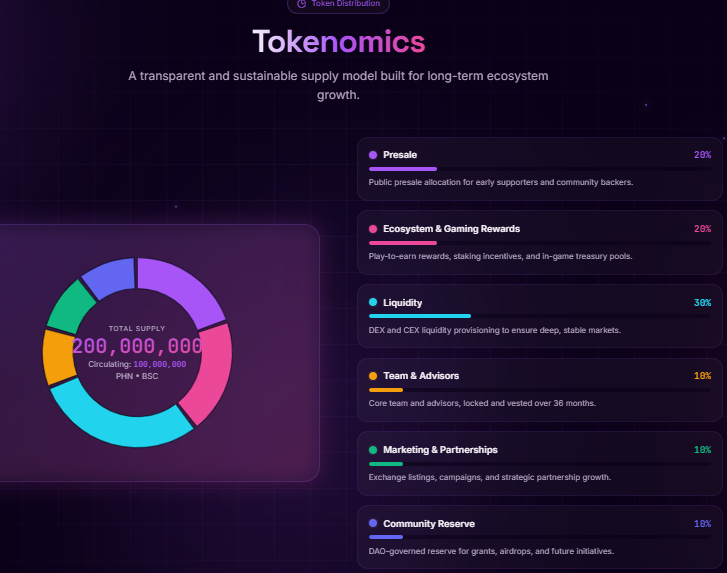
Liquidity receives the largest share, a sensible choice for a token that needs smooth trading, and the 36-month team vesting schedule releases tokens gradually, which lowers the risk of early selling. But earlier presale documents mentioned 30% to 40% for the sale against the 20% now published, and no unlock calendar appeared for the other buckets.
Presale, Airdrop, and Listing: What Is Published?
The presale documentation lists ten stages with prices rising from $0.015 to $0.25 and a planned crypto listing price of $0.30. The project claims early buyers could reach up to 20x by listing, which is a promotional projection and not a forecast.
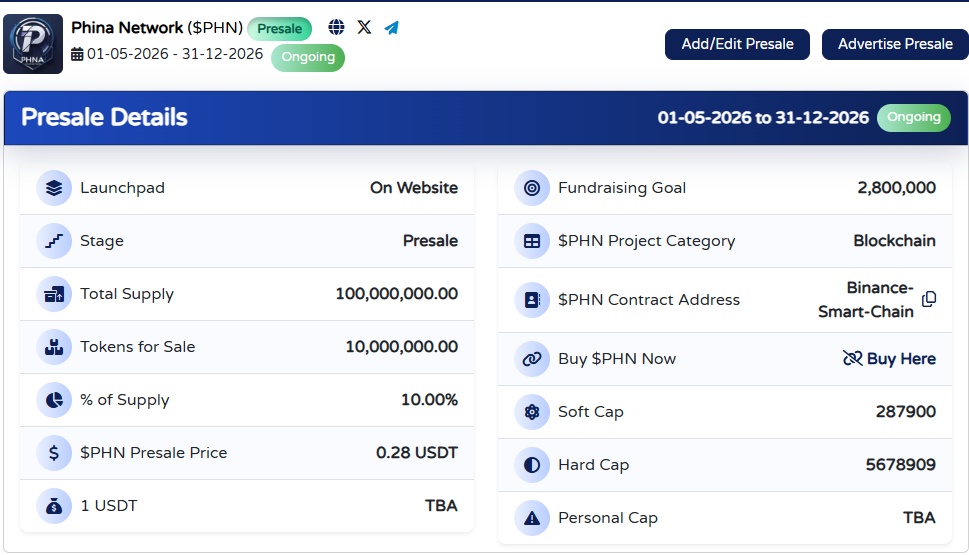
And a planned listing price is not a confirmed crypto price, while another published sale rate of $0.31 sits above that $0.30 plan, so current-stage pricing deserves a check on the official page.
The crypto airdrop rewards social tasks, quizzes, referrals, and leaderboard jackpots, but the announcement gave no firm start date. No confirmed exchange listing appeared in the pages reviewed, so any market price for PHN depends on events that haven’t happened yet.
Phina Network Roadmap: Step by Step
The documentation sets out seven phases.
Foundation and Research: company registration, team, whitepaper version 1.0, audited smart contracts, website, and community channels.
Token Launch and Early Adoption: PHN on BNB Smart Chain, presale, airdrops, referrals, and a DEX listing.
Ecosystem Building: staking pools, partners, developer APIs, Phina Wallet, Phinaverse NFTs, and GameFi.
Mining Infrastructure: BTC and PHN mining servers, a mobile app, machine sales, and open pool dashboards.
DeFi, Payments, and Utility: lending, yield farming, e-commerce payments, PayCard, cross-chain bridges, and DAO governance.
Expansion and Partnerships: fintech, gaming, and AI collaborations, enterprise tools, and exchange integrations.
Future Vision: multi-chain operations, metaverse and VR links, AI services, and renewable-energy mining farms.
A separate quarterly plan ran from Q4 2025 to Q3 2026, including a DeFi alpha, a security bounty, and third-party audits, yet no completion dates were found even though the months have passed.
Main Risks and What Readers Should Verify
Audit status comes first.
The website and documentation name CertiK and Halborn, but the audit page still holds placeholder text where the report link belongs, so the reports couldn’t be confirmed, and an audit lowers risk without removing it.
Contract control is the second concern, since the owner can pause the token.
Income promises from mining and referrals come third, because earnings depend on market conditions and need independent proof.
Rules for presales and mining products also differ by country.
The stronger signal is the published allocation with the team vesting schedule, and the biggest unknown remains whether delivered products match the roadmap.
Conclusion
Phina Network offers a broad plan across staking, mining, gaming, and payments, backed by fixed-supply tokens and a published allocation.
The gaps are inconsistent presale figures, unconfirmed audits, and roadmap dates that have already passed. Readers can check official contracts, audit links, unlock schedules, and exchange announcements next.
Disclaimer
This article is for information only and is not financial advice. Crypto assets are volatile, and presales carry a high risk of loss, so readers should research independently and consult a licensed advisor before making any financial decision.