PLX Network Roadmap: From Mobile Mining to a Planned Mainnet Launch

How Does the PLX Network Roadmap Map Its Four Phases Through 2030?
Crypto projects love big promises. Few of them show the steps in order. PLX does publish a step-by-step plan, and it is worth reading before joining.
This guide walks through the PLX Network Roadmap phase by phase. It separates what is finished from what is still a goal.
Key Takeaways
The plan has four phases and runs from January 2025 to April 2030. Phase 2 is active now.
Phase 1 is complete. Phases 3 and 4 are planned, not promised.
Wallet, staking and mainnet are all on the list, but each one depends on testing and readiness checks.
What Is PLX Network?
PLX Network is a free mobile cloud mining app for Android. A user starts a session on a phone, the project’s cloud runs it, and PLX is credited to the balance while it runs.
No mining hardware is needed. The official site says an account needs only an email address. The whitepaper sets a hard supply cap of 1,000,000,000 PLX and builds the system on Proof-of-Participation.
Source: official website.
Why a Roadmap Matters Here
A mining app alone does not explain where a project is going. A roadmap fills that gap. It shows the order of work, so readers can tell which features exist today and which are still ideas.
It also gives the community something to measure. Each phase has a set of deliverables and a target number of active miners. Because the page is public, anyone can compare the plan with the real app over time.
What the PLX Network Four-Year Plan Covers
The PLX Network four-year plan started with the mining phase on 1 May 2026. It runs to April 2030.
Each phase on the official roadmap page has three parts: a goal, a list of deliverables and a community target. The target is counted in AIM, short for Active Impactful Miners. These are miners who stay active and help the network grow.
PLX Network Roadmap 2026 to 2030 at a Glance
Phase | Window | Status |
1. Foundation and Early Community | Jan 2025 – Apr 2026 | Completed |
2. Mining Phase and Ecosystem Setup | May 2026 – Apr 2027 | In progress |
3. Blockchain and Utility | May 2027 – Apr 2029 | Planned |
4. Mainnet and Real-World Integration | May 2029 – Apr 2030 | Planned |
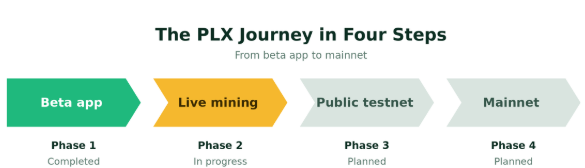
The journey in one line:
Beta app → Live mining → Public testnet → Mainnet
PLX Network Four Phases Explained
Phase 1: Foundation and Early Community
This phase aimed to prove the idea with a working beta app and a first group of believers. It ended on 30 April 2026.
The team launched the mining app in beta and onboarded 1,000 early users. Everyone who joined before 1 May 2026 locked in the highest base rate the project will ever offer, 7.36 PLX per hour. The core engine runs on Proof-of-Participation, and the technology page explains how.
PLX Network Phase 2 Mining Phase and Ecosystem Setup
This is the current stage. The goal is to run mining reliably, grow a healthy miner base and build the first parts of the ecosystem.
PLX Network mining opened on 1 May 2026. The team has already delivered base-rate decay, referrals, teams, daily check-ins and a grace period for inactive sessions.
The next items on the list are shown below.
Item | What it is |
STABLE release | The app moves out of beta, with system tuning |
PLX Social and Creator Hub | Creators earn PLX for sharing project content |
PLX Wallet release | Balance and history in one place inside the app |
PLX 2× Boost | A temporary rate boost |
PLX app PIN lock security | An extra layer of account protection |
Human verification | Anti-abuse checks, one real person per account |
PLX Chain and PLX-20 | Design and early development |
Partnerships | Real users and tools join the ecosystem |
Phase 3: Blockchain and Utility
Here the PLX token begins to move from an in-app balance toward a working network. New features are tested in public before they go live.
Planned items include a public testnet with a block explorer and independent security reviews of wallet and chain parts. PLX Network staking and a validator program are also planned, starting on the testnet.
Identity verification (KYC) is planned in stages. The project says it will give advance notice and update its Privacy Policy before collecting any data. Peer-to-peer transfers and PLX Gift will be tested before release. Developers should see APIs, microservices and the first PLX Studio tools, while PLX Market pilots begin with merchant partners.
Phase 4: Mainnet and Real-World Integration
The last phase aims to launch the PLX Chain mainnet and finish the four-year mining stage. It starts only after testnet results and security reviews look good.
Other goals include final mining figures, dApps with developer API access, and wider apps such as PLX Market, Drive, VPN and Connect. Token withdrawals and exchange listings are also on the list, but only where legally and technically possible.
PLX Roadmap Milestones and Project Timeline: How Progress Is Measured
Dates alone don’t show growth, so each phase carries a community target.
Phase | AIM target |
Phase 2 | 10,000 miners first, then 100,000 AIM |
Phase 3 | 1,000,000+ AIM |
Phase 4 | 10,000,000+ AIM |
These are goals. The roadmap does not claim they have been reached.
PLX Roadmap Milestones and Project Timeline: Why Dates Can Move
The official page states that roadmap items are goals, not guarantees. Dates can change, and transfers or listings depend on legal, technical and market factors outside the team’s control.
That honesty is a good sign. It also sets a rule for readers: plan around what is delivered today, and treat later phases as possibilities. The tokenomics page holds the supply numbers, and the security and trust page covers data protection.
Final Thoughts
The PLX Network Roadmap reads like a real project plan. The first stage is done, the second is under way, and the later ones have clear goals but honest limits. A sensible reader follows progress on the official site and the full official whitepaper.
Disclaimer: This article is for information only and is not financial, investment or legal advice. Facts come from the official PLX Network roadmap and whitepaper, last updated October 2026. Plans and dates may change. Crypto carries real risk, so readers should do their own research.