Polygon October Revenue Hits $2.17M: The $70K Daily Earnings Story


Polygon October Revenue: $2.17M Income and the $70K Daily Average
A busy blockchain payments chain has just posted a clear monthly earnings figure.
In its official update, the network reported $2.17 million in chain income for the month, and its day-by-day graphic marks an average near $70,000.

This guide explains the Polygon October revenue numbers, how to read the chart, and what the figure does and does not tell you in simple language.

Source: BSC News on X
Key Figures at a Glance
The official graphic shows one bar for each day from October 1 to October 31, plus a dashed line for the average.
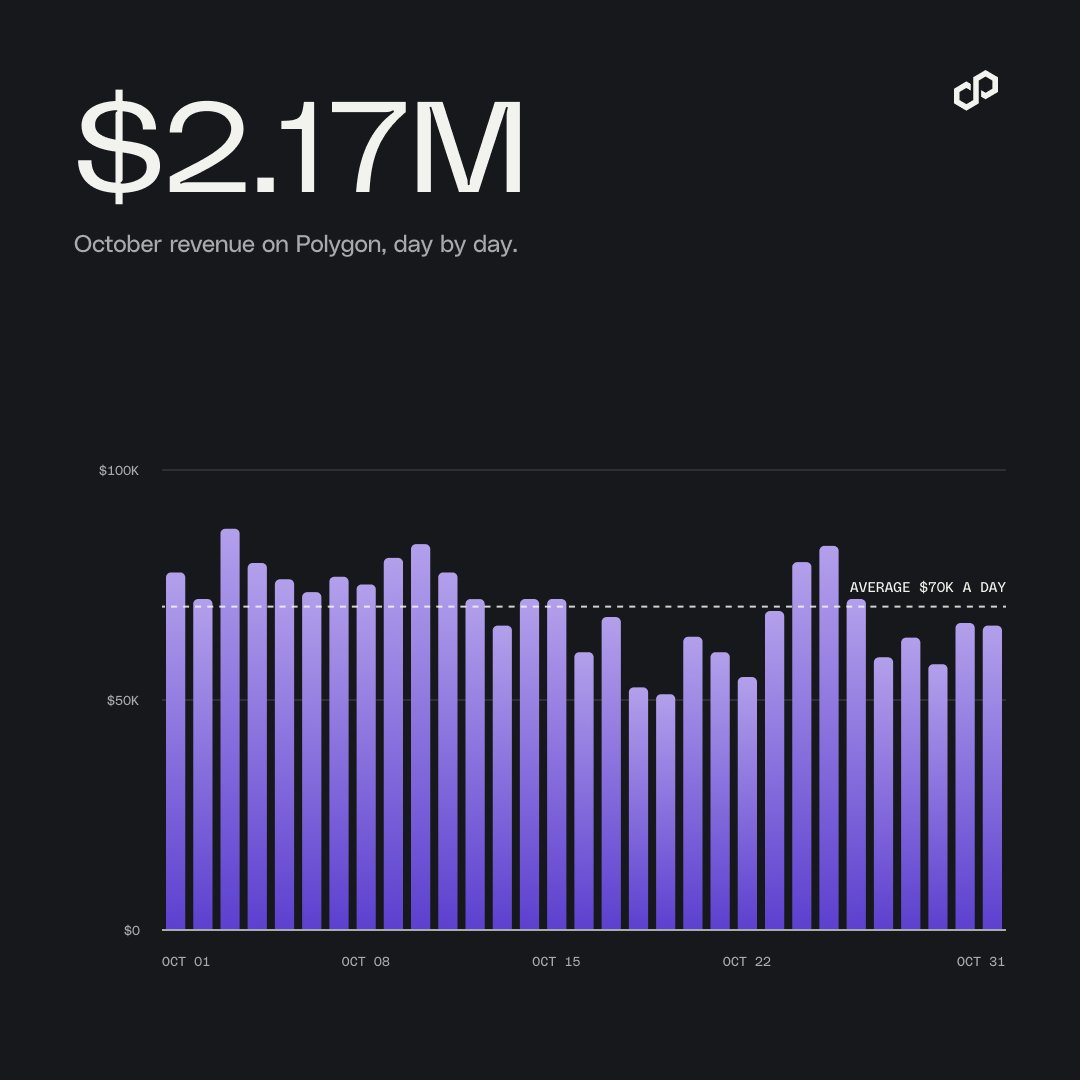
Dividing $2.17 million by 31 days gives about $70,000, so the headline total and the stated average match.
| Metric | Figure |
| Monthly total | $2.17 million |
| Period | October 1 to 31, 2026 |
| Daily average | About $70,000 |
| Strongest day (chart estimate) | About $87,000, around Oct 3 |
| Weakest day (chart estimate) | About $51,000, around Oct 19 |
| Typical range | Roughly $50,000 to $90,000 |
No day appears to cross the $100,000 gridline. These numbers come straight from the official graphic, not from any outside dashboard.
Reading the Chart: Steady Earnings With a Mid-Month Dip
The chart tells a simple story. Income started the month above average, softened in the middle, and recovered late.
Estimated from the bars:
-
Oct 1 to 10: most days sit between $72,000 and $87,000, averaging roughly $78,000
-
Oct 16 to 22: the weakest stretch, with several days near $51,000 to $60,000
-
Oct 24 and 25: a rebound to roughly $80,000 to $84,000
-
Oct 27 to 31: a calmer finish between about $58,000 and $67,000
For readers new to this, the main takeaway is stability. Income moved within a fairly narrow band rather than depending on a single spike.
That makes the Polygon October Revenue total look like a product of steady, repeated use.
What Chain Revenue Means Under the Fee Model
The post does not spell out its exact calculation, so it helps to understand the fee structure.
According to the network documentation, every transaction pays a base fee, which is set by network demand and burned, plus an optional priority fee offered to the validator.
The governance forum adds detail on where those fees go:
-
Base fees are burned, which removes tokens from circulation
-
Priority fees go to block producers (26%) and validators (74%) under PIP-65
-
A later proposal, PIP-82, is described as redirecting base fees to subsidize gas for agent-to-agent transactions
Why the Number Matters, and Its Limits
Chain income shows how much users are willing to pay to use a network, which is a stronger signal than headlines about activity alone.
A steady $70,000 a day suggests regular demand across the month. Think of it as a monthly receipt: each transaction pays a small fee, and the sum of many small payments over thirty-one days becomes the headline figure.
Small fees multiplied by high usage is what turns a payments network into a measurable income stream.
Still, a few limits apply:
-
Not profit: income is not the same as earnings after costs
-
Token price effect: fees are paid in the native token, so dollar totals also reflect its price
-
Unverified comparisons: claims that this beats other chains were not confirmed by the official sources used here
-
One month only: a single month does not prove a trend
What to Watch Next
The most useful follow-up is the next monthly figure. If the range of roughly $50,000 to $90,000 holds, the October result will look like a new baseline.
If it drops sharply, the mid-month dip may have been an early signal.
Anyone tracking Polygon October Revenue as a benchmark should record each month’s total and its range side by side, so changes in level and consistency are both visible.
Also watch for any update that clarifies how the income is calculated, since consistent methods make comparisons fair.
Governance changes to fee routing, such as the proposals above, could change how future figures should be read.
Conclusion
The Polygon October Revenue figure of $2.17 million, with a daily average near $70,000, shows steady fee-driven income through the month.
The chart supports that picture, though the exact method behind the number is not detailed in the post.
Read it as a useful data point, not a verdict, and wait for November’s update before judging the trend.
Disclaimer
This article is for educational and informational purposes only and is not financial or investment advice. Crypto assets are high risk, their prices can be very volatile, and you can lose some or all of your money. Always do your own research and consider speaking with a licensed financial advisor before making investment decisions.






