Clarity Act Delayed to September: Bitcoin, Ethereum, XRP Price Impact


The Clarity Act delayed vote has become the biggest talking point in crypto today. Senate Majority Leader John Thune confirmed the chamber will not hold a floor vote on the Crypto Clarity Act until next month.
Lawmakers left for summer recess on Monday. The Senate is not expected back in Washington until around September 14.
Once senators return, any floor test on the bill will need 60 votes to invoke cloture. That is a high bar, and it means the wait is not over yet.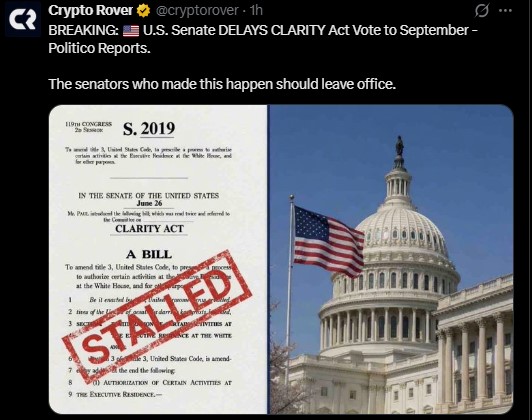
What is the Clarity Act and why does it matter?
The Clarity Act is a market-structure bill. It already passed the House.
Its main job is simple. It tries to draw a clear line between the SEC and the CFTC over who regulates which digital assets.
Right now, that line is blurry. Many crypto firms have said this lack of clarity has kept big investors on the sidelines.
Why was the Clarity Act vote delayed?
According to Politico, the delay is being described as a scheduling issue. It is not a formal withdrawal of the bill.
This matters. A scheduling delay is very different from a bill losing support or getting pulled from consideration.
The Act has already gone further than any other market-structure bill in U.S. history. It cleared committee, made it onto the calendar, and has bipartisan backing.
September is simply the next stop, not the end of the road.
How did the market react to the Clarity Act delay?
Crypto markets slipped after the news broke. The total crypto market cap dropped by 0.55%, moving toward $2.19 trillion.
Traders often price in good news ahead of time. When that news gets pushed back, some of those bets get unwound. That appears to be part of what happened here.
Asset | Price Move | Level |
Total Market Cap | -0.55% | $2.19 trillion |
Bitcoin (BTC) | -0.76% | Near $64,000 |
Ethereum (ETH) | -0.60% | Below $1,900 |
XRP | -2.40% | Near $1.00 |
Bitcoin Price Prediction: Will BTC price cross above $65,000?
Bitcoin is holding a bearish near-term bias. Price is stuck below the 50-day EMA at $64,575.
It also remains well under the 100-day EMA at $66,924 and the 200-day EMA at $72,408. Those longer averages show the broader trend is still tilted down.
The MACD line sits just below its signal line. That points to fading downside momentum, not a strong reversal.
RSI is hovering near 51. That is a neutral reading. It does not point strongly toward buyers or sellers right now.
If BTC closes the week above $65,000, a move toward $74,000 becomes possible.
If BTC closes below $60,000, a drop toward $50,000 could follow.
Ethereum Price Prediction: Will ETH hold above $1,900?
Ethereum slipped almost 0.60% and fell below $1,900 at the time of writing. It was rejected again near $1,925, close to its 100-day EMA.
The Clarity Act delay added extra pressure on top of that technical rejection.
ETH has been range-bound for a few weeks now. As long as the $1,850 support zone holds, a bounce back toward $2,000 is still on the table.
If ETH loses the $1,850 level, the next zone to watch drops much lower, potentially in the $1,300 to $1,090 range over time.
XRP Price Prediction: Will XRP hold the $1.00 level?
XRP broke down from a symmetric triangle pattern. Combined with the Clarity Act delay headline, the token fell 2.40% and is trading near $1.01.
This $1.00 mark is a psychological line in the sand for many XRP holders.
A drop below $1.00 opens the door to $0.80, and possibly $0.62 after that if selling continues.
If XRP holds $1.00, then $1.05 becomes the next level to watch, with $1.10 as the upside target.
Key levels to watch this week
Coin | Support | Resistance | Bullish Trigger | Bearish Trigger |
Bitcoin | $60,000 | $65,000 | Weekly close above $65,000 → $74,000 | Close below $60,000 → $50,000 |
Ethereum | $1,850 | $1,925 | Hold $1,850 → $2,000 | Lose $1,850 → $1,300-$1,090 |
XRP | $1.00 | $1.05 / $1.10 | Hold $1.00 → $1.05, then $1.10 | Lose $1.00 → $0.80, then $0.62 |
Bottom line on the Clarity Act delay
The delay is a setback for timing, not necessarily for the bill itself. Scheduling issues pushed the vote to September, and markets reacted with a mild pullback across BTC, ETH, and XRP.
Traders now have a new date to watch: around September 14, when the Senate returns and a cloture vote would need 60 yes votes.
Until then, price action across major coins will likely keep tracking these technical levels alongside any fresh regulatory headlines.
Disclaimer
This article is for informational purposes only and does not constitute financial, investment, or legal advice. Past performance is not indicative of future results. Always conduct your own research and consult a licensed financial advisor before making any investment decisions.