Hunter Biden's $LAPTOP Coin Crashes Minutes After Launch: Here's Why


Hunter Biden's Laptop token just had a rough first day. The memecoin, launched on the Base network on September 9, shot up to $199.51 within minutes of going live.
Then it fell apart.
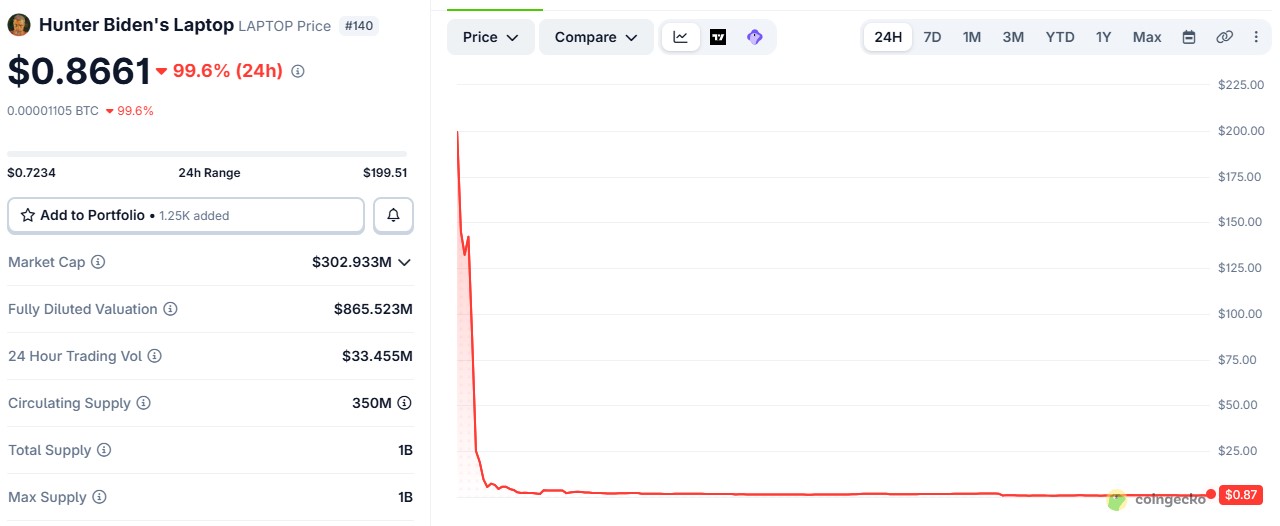
Hunter Biden's Laptop, trading under the ticker $LAPTOP, dropped as low as $0.72 within hours. That's a loss of more than 99% from its peak. As of the latest check, the token sits around $0.8661, down 99.6% on the day.
The crash has traders asking a simple question. Is the LAPTOP coin rug pull talk fair, or was this just a wild memecoin launch gone wrong?
What Is Hunter Biden's Laptop Crypto Coin?
Hunter Biden's Laptop ($LAPTOP) is a memecoin he co-launched on the Base network on September 9, 2025, named after the personal laptop he left at a Delaware repair shop in 2019.
That laptop's leaked contents became a flashpoint in the 2020 presidential election. Biden said the token was his way of taking the symbol back.
In posts on X, he said the project was about helping people recover, not about making himself richer. He also took a jab at the Trump family's crypto ventures, calling the $TRUMP token a "grift."
"I also want to make some money," Biden told Bloomberg, a more candid line than his public posts.
Why Did the LAPTOP Token Crash So Fast?
LAPTOP crashed because a thin $48,000 liquidity pool could not absorb heavy selling from insiders and market makers who received large token allocations before launch.
Blockchain data from Arkham showed a project wallet got 100 million tokens, or 10% of the total supply, a week before launch. That wallet sold 42.5 million tokens once trading opened.
Market maker GSR also received a large pre-launch allocation. It sold much of that allocation right away too.
Here's the real problem. The liquidity pool backing LAPTOP trades held only about $48,000 at its peak. That's a tiny amount of real money supporting a token that briefly touched a fully diluted value near $144 billion on paper, according to on-chain data.
CoinGecko's own tracker shows a lower, still-large fully diluted valuation of $865.5 million. The gap between the two figures comes down to which price snapshot and supply assumptions each source used during the first chaotic minutes of trading, and it's a reminder that FDV numbers on brand-new tokens can swing wildly within the same hour.
When big holders sell into a pool that small, the price has nowhere to go but down. CoinGecko data also shows the token's full 24-hour range ran from $0.7234 up to $199.51, illustrating just how violent the swing was in a single day.
Metric | Value |
All-time high | $199.51 |
Post-crash low | $0.72 |
Current price | ~$0.87 |
24h change | -99.6% |
Market cap | ~$302.9M |
24h volume | $33.46M |
Circulating supply | 350M |
Total/max supply | 1B |
Who Made Money on Hunter Biden's Laptop Coin?
A handful of early buyers and market makers walked away with six-figure profits, while more than 15,000 wallets lost money on the token, according to Bubblemaps.
The chaos created a few big winners and a lot of losers.
Analytics platform Bubblemaps said more than 15,000 wallets lost money on the token. It called the launch a "bloodbath."
One trader turned heads by spending just 900 USDC to grab tokens at $0.40 each. That trader later sold for over $250,000, a 278x return.
Another wallet linked to a user called FloB_Safe claimed tokens through the airdrop and cashed out more than $647,000.
Not everyone was so lucky. One buyer spent $200,000 near the top, buying tokens at $218 each. That stake shrank to roughly $3,000 within hours.
A dip buyer wasn't spared either. After the first crash, this person spent $170,000 to buy the dip near $5.97. That position has since dropped another 87%, now worth about $21,000.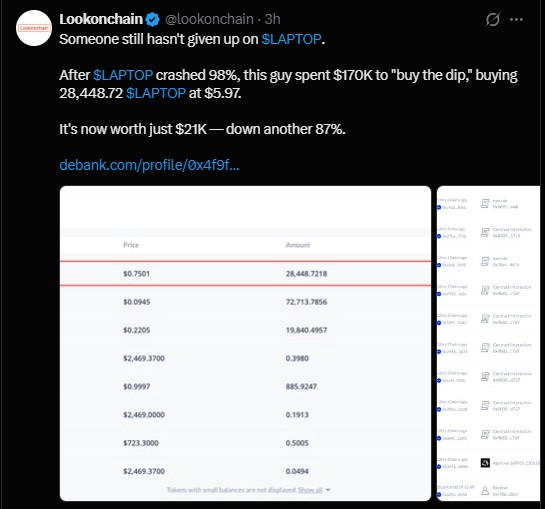
Market maker Wintermute also received a large token allocation from the project team and has been steadily selling on-chain.
What Is the Price Prediction for Hunter Biden's Laptop Coin?
Technical charts point to $0.70-$0.80 as near-term support, with resistance at $1.00-$1.20 and a stronger bullish case only above $1.50-$2.00 on rising volume.
Reading the chart, LAPTOP shows a classic parabolic launch followed by a sharp capitulation. That pattern often leads to a bottoming or consolidation phase rather than an instant recovery.
The $0.70 to $0.80 zone looks like the main support area right now. Holding above that range could set up a relief bounce.
The first resistance sits around $1.00 to $1.20. A move above that level, especially on rising volume, would be an early sign of bullish momentum.
Beyond that, $1.50 to $2.00 is the next test. Clearing it with strong volume could open a path toward the $3.00 to $5.00 range, though that would need real buying interest, not just short-term hype.
On the downside, a break below $0.70 would hurt the setup. That could expose the token to $0.50 or lower.
The old $199.51 peak isn't a realistic near-term target based on current volume and liquidity. These are technical scenarios based on chart structure, not promises about where the price will actually go.
How Is the LAPTOP Token Supply Allocated?
Founders, including Biden, hold 30% of the one billion token supply, locked for six months and vesting over two years, according to The Wall Street Journal.
The Wall Street Journal reported that founders, including Biden, hold 30% of the coin's one billion token supply. Those tokens are locked for six months and vest over two years.
Another 20% of the supply went to wallets that lost money on Trump's memecoin, along with Biden's Substack subscribers. A separate portion was set aside for a mailing list tied to video journalist Andrew Callaghan, who says he has no role in the project.
Bottom Line
Hunter Biden's Laptop launched with a clear message about resilience and community. The market reaction, though, has been driven mostly by thin liquidity and fast insider selling.
Anyone checking the LAPTOP crypto price today will see a token still finding its footing, well off its opening spike. Whether it can build back trust and volume will likely decide if it holds its current support zone or slides further.
Disclaimer: This article is for informational purposes only and does not constitute financial advice. Cryptocurrency markets, especially memecoins, are highly volatile and speculative. Prices can lose most or all of their value quickly. Always do your own research and consult a licensed financial advisor before making investment decisions.