SpaceX Stock Price Prediction Today: SPCX Forecast and Key Levels


SpaceX stock price closed the week in the red after a bullish start to August. The pullback comes even after another clean launch of 27 new satellites.
The stock ended Friday at $136.97, up close to 2.22% on the day. That keeps it just above its IPO price of $135.
Investors are watching closely because the company just went through its first and second unlock. A third unlock is already on the calendar for September, and that tends to add selling pressure.
What is the stock price right now?
Shares have spent the last few sessions stuck between $134 and $140. Earlier in the week, price touched a high of $149.80 before sliding down to $130.
On the hourly chart, price is sitting right on top of its 20, 50, 100, and 200 EMAs. When moving averages bunch together like that, it usually signals a big move is coming.
A descending trendline near $138 to $140 has capped rallies for weeks. Every attempt to push above it has been met with sellers.
Why does $150 matter for the chart?
The $150.98 level lines up with a 0.382 Fibonacci retracement and also matches a measured move target from a prior swing in the chart.
That level has not been tested yet. Price would need to clear the $138 to $140 resistance zone first before making a real run at $150.
If it does break and hold above $150, the bearish setup mostly falls apart. Traders following that pattern would then start looking toward $160 to $180 as the next zone.
A rejection below $150 points the other way. The same chart structure suggests a slide back toward $130, then $120, and possibly $100 if selling accelerates.
SPCX Price Prediction: Support and resistance levels to watch
Level | Price | What it means |
Major resistance | $150–152 | Bull/bear decision point |
First support break | $120–130 | Confirms downside if $150 rejects |
Mid support | $100–105 | Key floor from prior low |
Acceleration zone | $80–85 | Only if $100 breaks |
Deep bear target | ~$75 | Theoretical chart low |
The deeper bearish target sits near $75, based on a Fibonacci extension and a repeat of the drop pattern seen after the prior all-time low of $104.85. That would be roughly a 45% drop from current levels.
That outcome is not confirmed. It would need a retest of the old low, a bounce, a rejection, and then a fresh lower low, and none of those steps have played out so far.
What is driving revenue growth?
Second quarter earnings for 2026 showed SpaceX's revenue jumped 92% year over year to $7.8 billion. Starlink alone brought in $4.3 billion of that total, up 32% from the prior quarter.
Deutsche Bank analyst Edison Yu believes the annualized revenue run rate could triple by the end of 2026, moving from around $31.3 billion toward $100 billion.
Analyst Shay Boloor broke the estimate down further, expecting Neocloud to contribute $48 billion, Starlink to add $13 billion, and core space and launch to bring in $7 billion.
Some traders argue that number is still low. The company's Neocloud deals with Google, Anthropic, and Reflection AI already run near $2.3 billion a month combined, and all three go fully active by October.
If planned compute capacity gets rented out at the $30 to $50 billion per gigawatt rate Elon Musk has mentioned, the AI infrastructure side alone could add tens of billions more in annual revenue by year-end.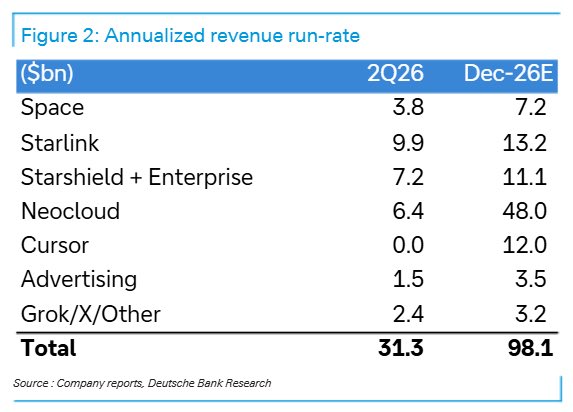
How does Deutsche Bank break down the $98 billion forecast?
Deutsche Bank's research note breaks the revenue down segment by segment, comparing the second quarter of 2026 against its December 2026 estimate.
Segment ($bn) | 2Q26 | Dec-26E |
Space | 3.8 | 7.2 |
Starlink | 9.9 | 13.2 |
Starshield + Enterprise | 7.2 | 11.1 |
Neocloud | 6.4 | 48.0 |
Cursor | 0.0 | 12.0 |
Advertising | 1.5 | 3.5 |
Grok/X/Other | 2.4 | 3.2 |
Total | 31.3 | 98.1 |
Neocloud is the standout line, projected to jump from $6.4 billion to $48 billion in annualized revenue by year-end. Cursor also goes from zero to a $12 billion run rate, since that business only started contributing recently.
Did Donald Trump buy the stock?
A financial disclosure filed on August 22, 2026 shows President Donald Trump purchased between $15,001 and $50,000 worth of SPCX shares on June 23, 2026.
The roughly two-month gap between the trade date and the disclosure is common for federal stock trade filings, which allow a reporting window under existing ethics rules. The filing does not explain the reasoning behind the purchase.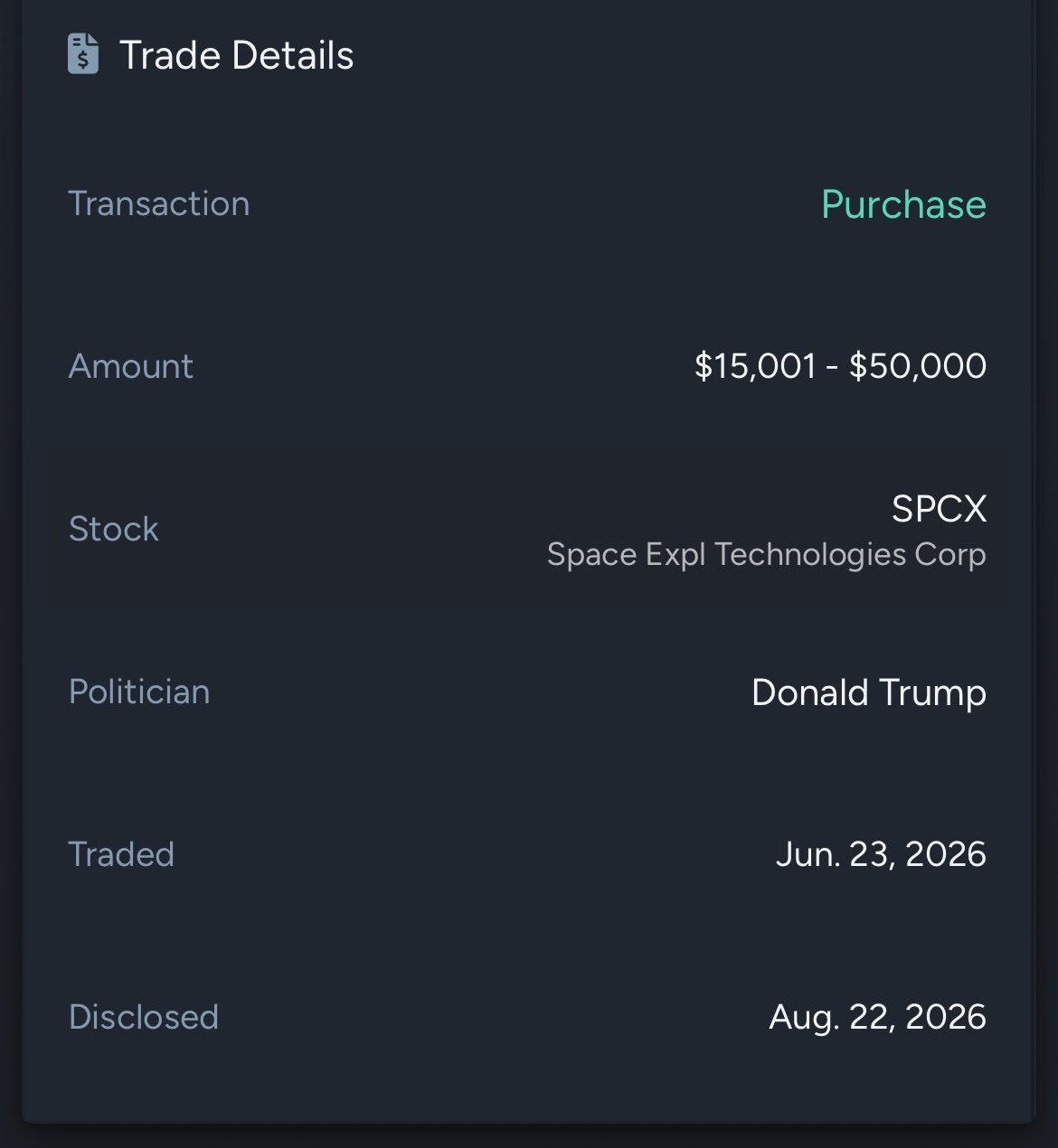
What are the biggest risks right now?
Bernstein analyst Douglas Harned flagged a separate concern around the planned mobile phone service, noting that many smartphones may struggle with battery drain from the power needed to connect directly to satellites.
Bernstein still holds a $248 price target on the stock, citing strength in the space and AI segments despite the mobile hurdle. Management is targeting the end of 2027 for that mobile service to launch.
Share unlocks remain the more immediate risk. With 319 million shares becoming eligible for sale this month and another batch in September, added supply could weigh on the price near term regardless of the revenue story.
The bottom line
The SpaceX stock price is caught between a strong revenue story and near-term resistance at $138 to $150. A close above that zone opens the door toward $160 and beyond, while a rejection could send it back toward $120 or lower.
Longer term, AI infrastructure growth and Starlink's expansion give bulls a reason to stay patient, but share unlocks and mobile service delays remain real headwinds.
Disclaimer
This article is for informational purposes only and does not constitute financial, investment, or trading advice. Past performance and analyst projections do not guarantee future results. Always do your own research and consult a licensed financial advisor before making any investment decisions.
Also read:










.webp)




