Quack AI Q Margin vs Spot: How Do KuCoin Trading Risks Differ?

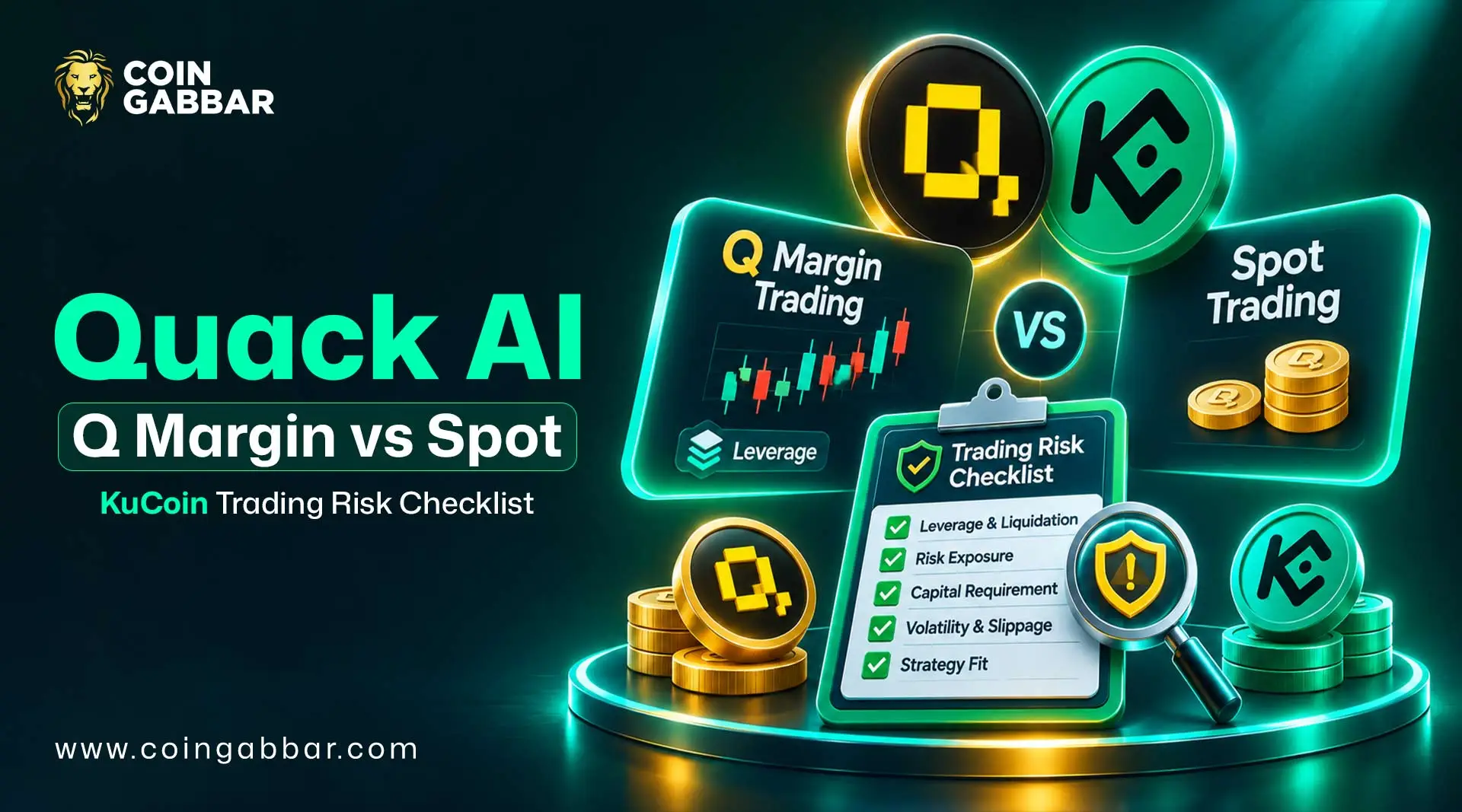
How Quack AI Q Margin vs Spot Changes Risk on Kucoin
On 5 November 2026, KuCoin added Quack AI (Q) to Isolated Margin Trading. That move put the Quack AI Q margin vs spot choice in front of a much wider group of traders.
Spot trading means buying the token outright with the trader's own funds. Margin trading means borrowing money to hold a bigger position, which adds interest and liquidation rules.
What Is Quack AI (Q) and What Does the Token Do?
Quack AI builds AI-assisted governance tools and Q402, a gasless payment protocol designed for AI agents. Its documentation calls the project an infrastructure layer, not a standalone voting app.
Q is the Quack AI governance token. Per the project's docs, voting in the Quack AI DAO is open to Q holders, and the maximum supply is fixed at 10 billion tokens.
The utility table, last dated 27 October 2026, lists AI agent delegation as under development. New staking deposits have been paused since 19 October 2026, and the docs say no protocol revenue goes to Q holders.
For any Quack AI Q margin vs spot decision, that gap matters. When live utility is limited, price may lean more on market mood than on product usage. This is an analyst reading, not a confirmed fact.
How Does Spot Trading Work for Q on KuCoin?
Spot trading is the simpler side of Quack AI Q margin vs spot. A trader pays USDT and receives Q at the market price on the KuCoin exchange listing. No loan is involved, so no debt level can force a sale.
The main risk is plain price movement. If Q falls 30%, the position loses 30% of its value and stays open until the holder sells.
Market data showed Q near $0.0247 on 11 November 2026, after a fall of about 9% a day earlier as other AI crypto tokens weakened.
In the Quack AI Q margin vs spot comparison, spot carries the cleaner risk profile. Losses can be large, yet borrowed money never multiplies them.
How Does KuCoin's Isolated Margin Shape Quack AI Q Margin vs Spot Risk?
Margin trading lets a trader post collateral and borrow more. KuCoin's announcement lists Q as both a margin asset and a borrowable asset, with a new Q/USDT pair. It also sets a 4% forced liquidation fee for Q and 0% for USDT.
The same notice gives Q a margin coefficient of 0.97. KuCoin says the coefficient multiplies a token's value when it counts as margin, so Q is treated as worth 97% of market value in debt ratio math.
Isolated margin keeps risk inside one trading pair. In KuCoin's comparison of isolated and cross margin, a liquidation in one isolated account does not touch the others.
Leverage is capped too. KuCoin's help pages say isolated margin supports up to 10x, but the ceiling differs by pair. The announcement does not state the maximum for Q/USDT, so that figure stays unconfirmed.
What Does the Debt Ratio Mean in Practice?
Debt ratio is borrowed funds plus interest divided by total account assets. KuCoin's margin introduction says forced liquidation starts at a 95% debt ratio. It lists an initial ratio of 90% for isolated margin at full leverage.
Here is a simple illustration that ignores interest and fees. A position opened at full 10x starts at 90%. A fall of roughly 5% in asset value pushes it to 95%. The 0.97 coefficient could narrow that cushion further.
In the Quack AI Q margin vs spot debate, that is the key gap: Q's one-day fall of about 9% sits well above that cushion. These numbers are basic arithmetic, not a KuCoin forecast. Live thresholds can change, so the platform's margin page decides.
Quack AI Q Margin vs Spot: Side-by-Side Risk Table
| Factor | Spot | Isolated Margin |
| Capital used | Trader's own funds | Own collateral plus borrowed funds |
| Forced closing | None | Yes, at the platform's debt ratio limit |
| Extra costs | Trading fees | Trading fees, interest, and a 4% liquidation fee on Q |
| Leverage | None | Up to 10x, varies by pair |
| Time pressure | Low | High, since interest builds daily |
The Quack AI Q margin vs spot table shows one pattern. Spot risk is mostly about price. Margin risk adds a trigger and a clock, because interest builds while the position stays open and a forced sale can land at a bad moment.
That is the core of the Quack AI Q margin vs spot difference on KuCoin.
Why Do Q Tokenomics Add Pressure to Quack AI Q Margin vs Spot Trades?
Quack AI's published token allocation sets total supply at 10 billion Q across Ethereum and BNB Chain. The release schedule puts circulating supply at about 16.16% at launch, with a full unlock after 37 months.
| Allocation | Share | Unlock Schedule |
| Community | 30% | 1-month cliff, 36-month linear |
| Ecosystem and Partnerships | 15% | 2.26% at launch, 36-month linear |
| Airdrop | 12% | 3% at launch, 4-month linear |
| Treasury | 11% | 4% at launch, 36-month linear |
| Investors and Advisors | 11% | 12-month cliff, 24-month linear |
| Core Team | 10% | 12-month cliff, 24-month linear |
| Marketing and Growth | 6% | 1.9% at launch, 5-month linear |
| Liquidity | 5% | 100% at launch |
Token vesting is the schedule that controls when tokens become available. Monthly unlocks can add steady selling pressure. In Quack AI Q margin vs spot terms, margin traders feel this most, since a slow drift lower can still trigger a liquidation.
A token vesting schedule needs matching against the calendar.
Market cap and fully diluted value are different measures. At about $0.0247, the 10 billion maximum supply implies a diluted value near $247 million, which is multiplication, not market cap.
Which Quack AI Q Margin vs Spot Risks Differ Most?
Spot Risks
-
Full exposure to price drops, with no leverage to blame
-
No automatic exit, so losses continue until the holder acts
-
Supply pressure as vesting tranches unlock
Margin Risks
-
Forced liquidation once the debt ratio reaches the platform limit
-
Interest on borrowed funds, charged while the position is open
-
A 4% liquidation fee that applies to Q
-
Rule changes, since KuCoin adjusts margin coefficients as risk parameters shift
What Should Traders Check Before Choosing a Route?
A short checklist helps separate confirmed data from assumptions in any Quack AI Q margin vs spot plan:
-
The live leverage ceiling for Q/USDT on the margin page
-
Current borrowing rates and crypto margin trading limits
-
The margin coefficient, which KuCoin can change at any time
-
Vesting dates against the current calendar
-
Utility status in the project's documentation
The available data suggests the margin side of Quack AI Q margin vs spot leaves little room for error on a token that can move 9% in a day. That is an interpretation, not a recommendation.
Conclusion
Quack AI builds AI governance tools and the Q402 payment protocol, and Q is its governance token. In the Quack AI Q margin vs spot choice, spot keeps the risk to price alone, while KuCoin's isolated margin adds borrowed funds, interest, and forced liquidation.
The leverage cap for Q/USDT is unconfirmed, KuCoin can change margin rules, and key features such as AI agent delegation are still in development.
Next, checks for any Quack AI Q margin vs spot plan are simple: the live margin page, the vesting calendar, and the utility status in the official docs.
Disclaimer:
This article is for information only and is not financial advice. Crypto and margin trading carry a high risk of loss, and borrowed funds can be liquidated quickly. Traders should verify all data on official pages and research independently before making any decision.
















