What Is DoubleZero (2Z)? The $114M Unlock Explained

What Is DoubleZero (2Z) and How Does It Work?
DoubleZero is a DePIN project, short for decentralized physical infrastructure network, where many independent operators own the real hardware behind one shared service.
Contributors add spare fiber links and networking gear, and the project says they earn token rewards for it. Validators, the computers that confirm blockchain transactions, connect to the network as its first users, according to the official documentation.
Put simply, contributors add capacity, validators connect, and $2Z moves value between them, which keeps the DoubleZero network running as one system.
Turns out, the public internet is the only other option today. But the project argues that its more direct routes cut jitter, which is the uneven delay between two points.
Mainnet-beta, the live but still growing version, started on Solana on October 2, 2025.
Key Features of the DoubleZero Blockchain Infrastructure
What Is DoubleZero (2Z) offering that older networking options don’t? The documentation lists these main features.
Contributor network: independent operators supply fiber and hardware.
Direct routing: messages take faster paths than the public internet.
Edge filtering: a planned shared filter for spam and duplicate transactions, which the documentation says isn’t working yet.
Validator focus: validators come first, with other ecosystems planned.
Token incentives: 2Z rewards contributors and pays for services inside the network.
What Is DoubleZero (2Z) Token Utility, Step by Step?
It is an SPL token, the standard token format on Solana. Maximum supply is 10 billion, and roughly 3.47 billion were circulating at launch.
According to the project’s published tokenomics disclosure, the token does five jobs:
Network payments: users pay for services such as Edge subscriptions in USDC, and the network converts that into 2Z.
Contributor rewards: operators who add capacity earn 2Z.
Validator rewards: validators that use the network can earn $2Z too.
Delegation: holders stake $2Z to back network operators.
Governance: voting rights are still being shaped, so this step is unfinished.
Basically, token demand should follow real network use. That’s the claim, and it still needs proof.
Steps one to three form the core loop, since fees come in, operators get paid, and validators benefit. Steps four and five add extra layers that depend on community growth.
DoubleZero Tokenomics: Who Holds the Supply?
Allocation | Share | Locking schedule |
Foundation and Ecosystem | 29% | Unlocked |
Jump Crypto | 28% | 5% unlocked, the rest locked |
Malbec Labs | 14% | Standard lockup |
Institutions | 12% | Standard lockup |
Team | 10% | Standard lockup |
Contributors | 4% | Standard lockup |
Builders | 2% | Standard lockup |
Validators | 1% | 0.7% unlocked at launch |
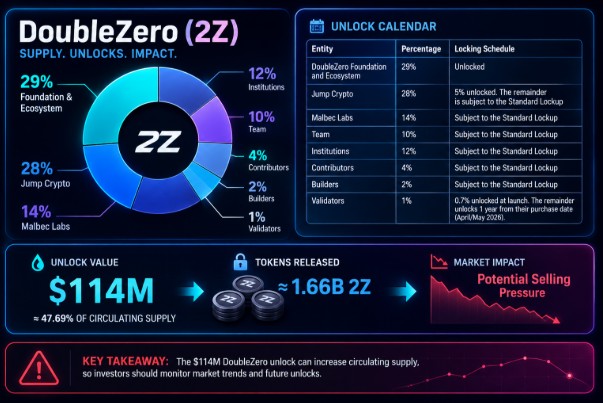
These are launch figures, so they don’t show the October 2026 release alone. Vesting is the schedule that decides when locked tokens become available, and with a few large holders, it matters a lot.
Market cap counts only circulating tokens. Fully diluted valuation, or FDV, assumes all 10 billion exist.
The $114M Unlock Explained: What Happened on October 2?
October 2, 2026, was unlock day. About 1.66 billion are left in the lockup. Tracker data valued it near $113.23M, which explains the $114M headline.
That equaled roughly 47.69% of the circulating supply before the event. The cause was a cliff, a date-based lock that frees a large batch at once, landing exactly one year after launch.
Trackers now report linear vesting, with smaller releases on a steady schedule. As of November 17, 2026, about 31.14 million 2Z are released weekly, and the next scheduled release on December 2, 2026, is estimated to be near 135.4 million tokens.
Any 2Z token unlock changes how much supply traders can act on. But unlocked tokens don’t go straight to exchanges, since holders may keep, stake, or sell them.
Trackers also report that Jump Crypto got the largest share, though official records should confirm that.
What Does the DoubleZero Roadmap Include, Step by Step?
No dated timetable was found in the sources reviewed, so the steps below follow what the project has already said.
Mainnet-beta launch: done on October 2, 2025, with validators as the first users.
Token live: 2Z started trading with the launch.
Edge filtering: planned, and not working yet, per the documentation.
Edge subscriptions: payments in USDC, converted into 2Z.
More ecosystems: support beyond Solana is planned.
Governance: still being finalized.
What is DoubleZero (2Z) aiming for next? Steps three and five carry the most weight, because filtering and new ecosystems would decide whether the DoubleZero network grows past its first users.
For the latest update, the project’s official X account is the best place to check.
Expert Take: What Should Readers Watch?
At first, the $114M figure seemed like the main story. On closer reading, the 47.69% supply jump matters more, because a dollar value moves with price while a share of supply shows dilution.
The stronger signal is adoption, since launch data showed about a quarter of Solana's stake on the network. But the main concern is supply, and the near-term setup leans bearish while releases continue and fee demand remains unproven.
The product has real users, which most new tokens can’t claim. Still, usage and token price don’t move in lockstep, and a large supply increase can outweigh good news for a while.
And one question hangs over all of it. How much of the new supply will reach exchanges?
Dilution: scheduled releases keep adding tokens.
Adoption: real fee demand is still unproven.
Volatility: prices often swing near unlock dates.
Data gaps: trackers disagree on cliffs versus gradual releases.
Past debate: the 2025 launch drew questions about circulating supply.
Conclusion
What Is DoubleZero (2Z) in the End? A DePIN project building shared fiber for blockchains, with paying and rewarding the network. The unlock was large, weekly releases continue, and usage still has to catch up with the new supply.
Readers should always compare tracker data with the official disclosures before repeating any single figure.
Disclaimer
This article is for informational purposes only and isn’t financial advice. Crypto assets are volatile and high risk, and past data doesn’t predict results. Readers should research independently and consult a licensed advisor.