Remittix Presale: 8 Days to Launch! Can RTX Still Hit $0.46 in 2026?

The Remittix Presale is being close to its scheduled launch date of November 24, 2026, the RTX token price, PayFi rollout, and exchange arrangements are all in the spotlight. The project has raised around $33 million of its $36 million fundraising goal and has more than 40,000 participants.
Progress may be eye-catching, but a market rally can't be assured by the launch countdown alone. Buyers still need clear information about the active token price, verified contract, exchange trading pairs and claim process.
What Is Remittix Building?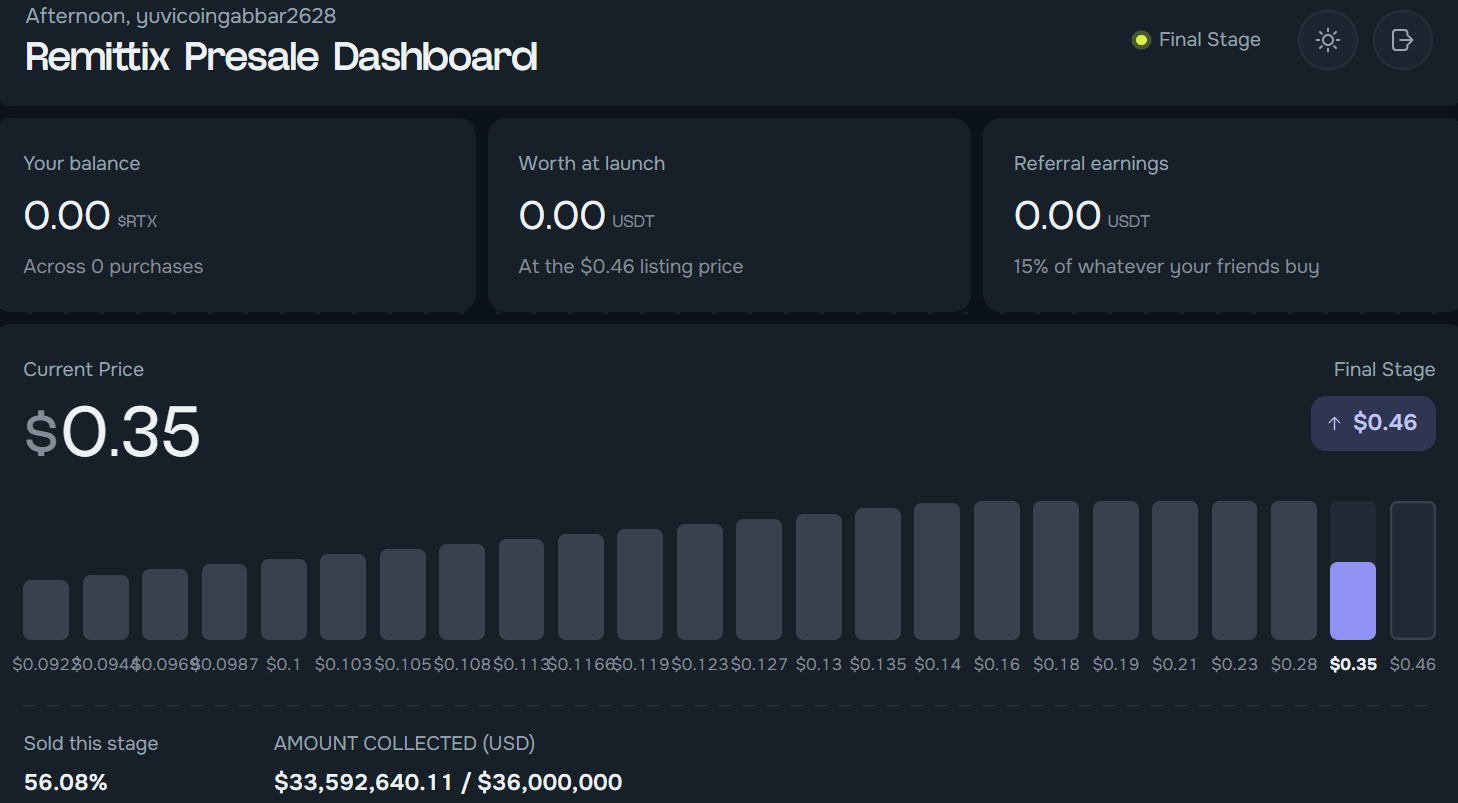
Remittix is developing a PayFi ecosystem designed to connect cryptocurrency with traditional banking. Its main goal is to let users send supported digital assets while eligible recipients receive fiat currency through supported bank-payment routes.
The wider ecosystem includes:
-
Remittix PayFi: Crypto-to-fiat and fiat-to-crypto payment services.
-
Remittix Wallet: A wallet designed to manage supported digital assets.
-
Remittix Markets: A platform intended to provide perpetual futures trading.
-
Remittix Earn: A yield product being tested with a limited group of users.
The project has reported testing PayFi with invited users and announced an expansion involving 41 additional fiat currencies.
However, announced currency support does not prove that every route is publicly available or that transfers are operating successfully at scale. Actual transaction records, settlement times and user adoption will matter.
Remittix Launch Date and RTX Exchange Listing
The issuer has announced November 24, 2026, as the scheduled RTX launch date. This is an important milestone, but an issuer-announced launch date is not the same as an exchange-confirmed trading schedule.
A confirmed exchange listing should identify the exchange, trading pair, token contract, deposit arrangements and opening time.
Until those details are published by the exchanges themselves, buyers should treat the exact trading arrangements as unconfirmed.
The token claim process also deserves attention. Published terms describe claims beginning five days after launch, subject to the final applicable instructions.
If the November 24 schedule and those terms remain unchanged, that would point to approximately November 29. It is a conditional estimate, not a separately confirmed claim date.
Remittix Tokenomics: Supply and Allocation
The published token allocation document describes a maximum supply of 1.5 billion RTX, with 750 million tokens assigned to the presale.
| Allocation | Share |
| Presale | 50% |
| Marketing | 15% |
| Exchange listings | 12% |
| Ecosystem reserves | 10% |
| Team | 9% |
| Rewards | 4% |
These figures reflect the supplied token allocation document. Other project-linked materials have shown different allocation details, so the operative tokenomics and contract should be checked before relying on this table.
Another important element is the claiming schedule. If there is a big presale allocation claimable shortly after launch, some holders may choose to sell. There may be volatility, especially if the exchange has low liquidity.
Remittix Price Prediction: Can RTX Reach $0.46?
The RTX price prediction depends on more than the presale's fundraising progress. The project has previously publicized $0.28 as a presale price and $0.46 as a final-stage reference.
A separate project-branded page has displayed a different quote, so these figures should not be presented as one verified live price.
Using $0.28 only as a comparison baseline, here are illustrative price scenarios:
| RTX Price Scenario | Change From $0.28 |
| $0.14 | -50% |
| $0.28 | Reference |
| $0.35 | +25% |
| $0.46 | +64.3% |
These are mathematical scenarios, not guaranteed targets. At the stated 1.5 billion maximum supply, an RTX price of $0.35 would imply a fully diluted valuation of $525 million. At $0.46, the implied valuation would be $690 million.
To maintain a higher market price, RTX would need real buyers, enough trading liquidity and measurable demand for its payment ecosystem.
A thin market or a heavy sell-off after tokens are claimed could see the price drop below presale reference levels.
What Could Drive or Weaken RTX After Launch?
Potential bullish factors:
-
Confirmed exchange listings and accessible trading pairs.
-
Successful PayFi transfers and growing user adoption.
-
Strong liquidity and sustained demand for RTX.
-
Clear token utility across the Remittix ecosystem.
Risks to watch:
-
Conflicting published token prices and contract details.
-
Delays in exchange trading or token claims.
-
Presale holder selling after tokens become available.
-
Limited evidence of completed payments at scale.
Expert View: The Launch Needs More Than a Countdown
Remittix has a fixed launch target and a strong PayFi proposition. But the real test now lies in execution. Confirmed exchange support, reliable token claims, transparent contract information and verifiable payment activity can help build confidence.
The $0.46 reference may be an eye-catcher, but the market will determine what the actual trading price of Remittix is. Until we can measure liquidity and adoption, a post-launch rally is still a possibility, not a fact.
Disclaimer: This Remittix Presale article is not financial or investment advice and is for information purposes only. Crypto presales and newly listed tokens are highly risky including complete loss. Please check current prices, token contracts, launch details, and claim instructions from reliable official sources before making any financial decisions.