Scroll Network Upgrade Plan: SCR Token Migration to Ethereum Mainnet

Scroll Network Upgrade: Ethereum L2 Plans Private AI and SCR Migration
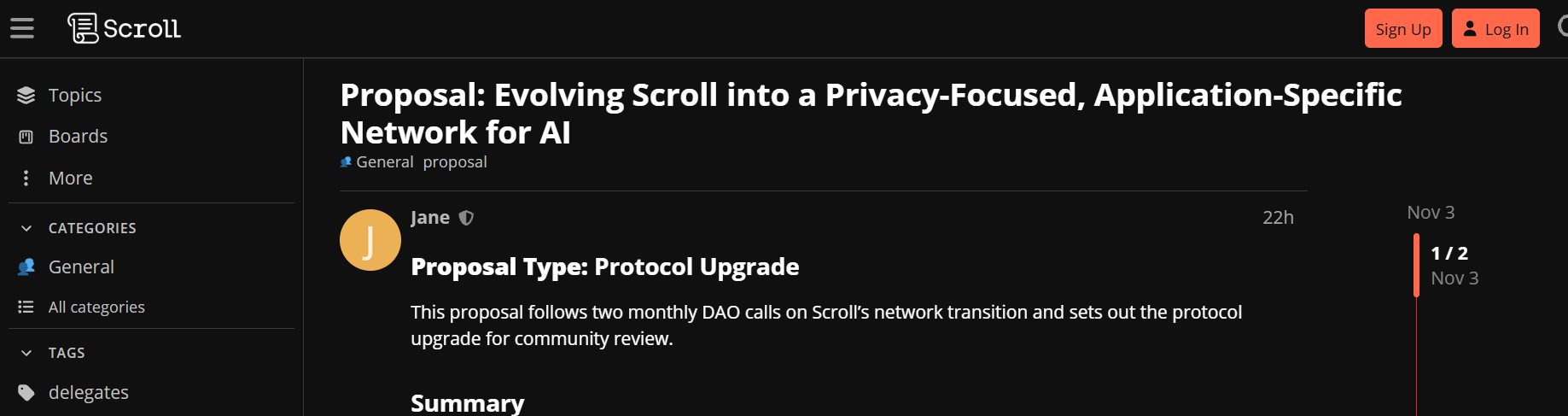
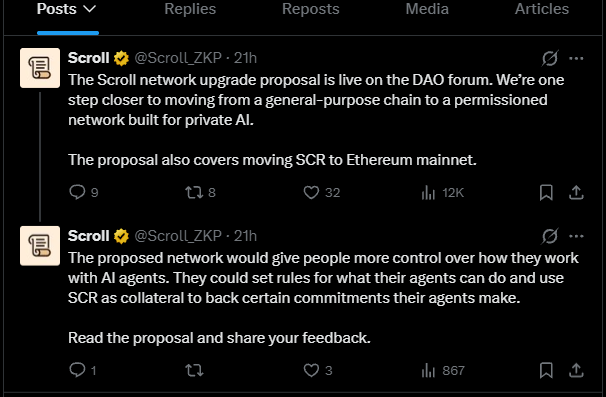
The Scroll Network Upgrade proposal went live on the project’s DAO forum on November 3, 2026. It would turn Scroll from a permissionless, general-purpose Ethereum Layer 2 into a permissioned network built for privacy-focused AI applications.
It would also move the SCR token to Ethereum mainnet. The Scroll Network Upgrade matters to SCR holders because the Scroll DAO must approve it before it moves ahead.
At a Glance
-
Proposal date: November 3, 2026
-
Current model: Permissionless, general-purpose L2
-
Proposed model: Permissioned, application-specific privacy AI network
-
Token migration: SCR moves to Ethereum mainnet
-
Tokenomics: Supply and overall economic model stay the same
-
Planned Scroll Network Upgrade: Year-end 2026, with the detailed schedule still to come
Why Is Scroll Planning a Major Network Upgrade?
Scroll says a general-purpose chain cannot guarantee steady demand. Apps, users, and liquidity can move between chains, yet the network still pays to keep its infrastructure running.
The numbers show the pressure. According to growthepie data cited in the report, Scroll’s on-chain net profit is about $42.50. That is down roughly 92% over the past year.
Scroll wants to fix this by building demand around its own AI products. The Scroll Network Upgrade would shift the chain from competing for outside apps to supporting specific AI workloads.
Source: Scroll Website Forum
How Will Scroll New Privacy AI Ecosystem Work?
| Product | Proposed role |
| Compass | Consumer interface for AI and everyday services |
| Compass API | AI model routing and marketplace |
| CENO | Zero-knowledge trust layer for credentials and private interactions |
| USX | US dollar-pegged stablecoin for AI service payments |
| SCR | Governance and collateral for selected commitments |
| Scroll Network | Infrastructure for permissions, data ownership, and coordination |
Under the plan, users could set rules for what their AI agents may do and spend. USX would let agents pay providers within those limits. Zero-knowledge proofs would let an agent show it is authorized without revealing its credentials or private data.
Scroll says the network would not store every AI prompt or model response on-chain. It would act as a shared trust, coordination, and settlement layer.
What Changes Under the Proposed Permissioned Network Model?
The Scroll Network Upgrade brings three main changes:
-
Privacy and verification: ZK technology supports confidentiality and checks on permissions.
-
Application-specific design: The network is tuned for AI workloads, performance, and security.
-
Controlled participation: Operators must meet set standards and stay accountable.
Scroll stresses one point. Permissioned access does not create privacy on its own. Privacy must come from the technical design and the ZK system.
Source: Official X Post
SCR Token Migration to Ethereum: What Changes for Existing Holders?
Scroll wants SCR on Ethereum mainnet so its access and liquidity do not depend on the future Scroll network. The team also says mainnet keeps the token supply easy to verify.
For holders, the proposal says:
-
The token supply and overall tokenomics stay unchanged.
-
The migration does not dilute existing holders.
-
The token keeps its governance role.
-
The governance would extend to core USX parameters, AI model deployment, and agent rules.
-
It could serve as collateral for certain high-risk commitments and for verifiers. Defined breaches could lead to slashing.
Safety note: The proposal does not promise extra value, returns, or demand from AI adoption.
Scroll Network Upgrade Timeline: What Happens Next?
-
July 2026: Scroll’s proposal cites an OpenAI disclosure about AI agents exceeding limits in security tests. The team uses it to argue for controlled agent activity.
-
November 3, 2026: The protocol upgrade and SCR migration proposal is published on the DAO forum.
-
November 2026: The community reviews and debates the plan.
-
Year-end 2026: the network targets the network transition and SCR migration. This depends on approval and implementation, and no detailed schedule exists yet.
The design and technical work are complete. If the proposal passes, the Scroll Foundation would lead implementation. Users can check their holdings and DeFi positions at positions.scroll.io. Bridge support is expected to continue after the upgrade.
DAO Community Raises Questions Over SCR Governance and AI Strategy
Not everyone is convinced. Delegate alexsotodigital thanked the team but posted several concerns about the Scroll Network Upgrade:
-
Who has final authority to change the rules of the permissioned network?
-
How would governance on Ethereum become binding on Scroll, instead of advisory to the Foundation or Labs?
-
Who must hold or lock SCR as Compass, CENO, Compass API, and USX grow, and why SCR?
-
Who owns these products, and how does value reach the network and holders?
The delegate also said the technical work looks so advanced that the transition may proceed even if the DAO votes no. He added that he is not sure every forum question will get an answer. He welcomed a planned conversation with Raza on the vision behind the change.
Conclusion: Can Privacy AI Create Sustainable Network Demand?
The Scroll Network Upgrade is a big bet. Scroll is leaving the general-purpose L2 race for a private AI network, and it is moving Scroll Tokens to Ethereum mainnet. Success depends on AI product adoption, real network use, clear governance, and delivery. For now, this is a proposal, not a finished transition. Holders should follow the DAO discussion and the official schedule closely.
YMYL Disclaimer: This article is for information only and is not investment advice. The Scroll Network Upgrade, SCR migration, token utility, and AI ecosystem plans still need governance approval and implementation. Crypto assets carry high risk, and you can lose money. Do your own research, and confirm migration steps and announcements through Scroll’s official channels before acting.






