SEC Tokenization Exemption: Do Canton and Ethereum L2s Qualify?

SEC Tokenization Exemption Latest News
This crypto news from the SEC matters for tokenized stocks; the answer decides which blockchains can host legal on-chain trading in the United States.
The SEC tokenization exemption has not settled yet; the SEC has not said if Canton or Ethereum layer-2 networks qualify. It kept its "public and permissionless" test broad; it has not approved any blockchain.
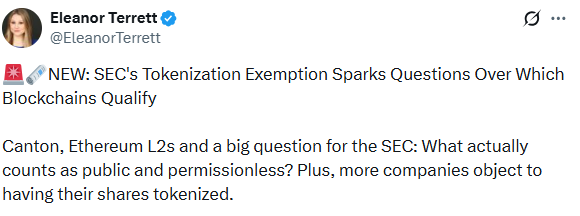
Journalist Eleanor Terrett raised the debate in a post on X. She asked what counts as public and permissionless; she also noted that more companies object to having their shares tokenized.
Meanwhile, three firms plan tokenized stock venues on these networks; public comments and company objections also show a growing split. It runs across the crypto industry and Wall Street.
Key Takeaways
The SEC has not approved or ruled out any blockchain; an SEC official said the test is broad on purpose.
Three firms plan onchain securities venues on Canton Network, X Layer, and Kronos X Public.
Comment letters split: Some want a tighter definition; others want wider access.
As of Friday, 22 of the 62 companies on OKXICE's list had objected to having their shares tokenized.
What Does the SEC Tokenization Exemption Need?
The SEC released the exemption in September; it lets qualifying firms trade blockchain-based U.S. stocks. They do not have to register as traditional securities exchanges; the SEC calls these platforms tokenized securities venues, or TSVs.
The main rules are simple:
Smart contracts must be auditable and public.
They must run on a public permissionless blockchain.
Tokenized shares must carry the same rights as regular shares. So, tokens that only track a price do not qualify.
The relief is temporary; the exemptions end five years after publication.
Which Networks Do the Three Firms Plan to Use?
Three firms told the SEC about their TSV plans; each one chose a different network.
TSV LLC: plans to use Canton Network; this blockchain is built for privacy. One of the firm's founders sits on its foundation board.
OKXICE: plans to use X Layer; it is a joint venture of OKX and ICE.
Kephas Corporation: chose Kronos X Public.
OKXICE and Kephas plan to use Ethereum Layer 2 networks; their own corporate groups built them. However, the SEC gave a warning about its list; being on it does not show that a firm has met the rules.
An SEC official also spoke to Crypto in America; firms can start 30 days after they file notices. They do not have to wait for approval if they meet the rules.
The official added that the order is not a rulemaking; the SEC kept the definition broad so firms can try new ideas.
Why Does the Public and Permissionless Test Split the Industry?
The Solana Policy Institute wants a tighter test; it urged the SEC to look at who controls a network. That means who can check or block transactions; it also means who can change the rules.
Hedera pushed the other way; it asked the SEC to include public but permissioned networks. On these, only approved groups can check transactions.
Others raised a different worry; Omid Malekan of Columbia Business School and securities lawyer Gabriel Shapiro gave a warning. Centralized firms could use the exemption; yet they might not offer the openness and censorship resistance of decentralized networks.
Wall Street group SIFMA also asked for a clearer definition. Better Markets went further; it asked the SEC to pull the exemption and write formal rules.
Why Are Companies Objecting to Tokenized Shares?
Many public companies are pushing back on third-party tokenization. As of Friday, 22 of the 62 companies on OKXICE's first list had objected; that is more than a third of the planned issuers.
The order sets a clear process; a venue must give an issuer 30 days' written notice before it lists tokenized shares.
Trading can start only if the issuer does not object in that time; still, SIFMA asked if companies should give clear consent instead of opting out.
What Happens Next for Tokenized Stock Venues?
The SEC is reading the feedback; it could post more FAQs to answer questions. Bigger changes would need a vote by the full Commission.
Lessons from this short-term plan should shape later formal rules. For now, readers should watch three things:
The first venue launches
More company objections
SEC advice on which blockchain models fit
Crypto Glossary: TSV, Permissionless, and Layer 2
TSV: a blockchain-based securities venue; it trades tokenized stocks under the SEC exemption.
Permissionless blockchain: a network where anyone can check transactions without approval.
Layer 2 (L2): a network built on top of Ethereum; it handles transactions faster and at lower cost.
Conclusion
The SEC tokenization exemption starts a five-year test for tokenized stocks. Still, the question of which blockchains count as public and permissionless is open.
Canton and Ethereum L2s are the first real tests; the answer will depend on SEC advice, public comments, and how many companies refuse to have their shares tokenized.
YMYL Disclaimer: This article is for informational purposes only and is not financial or investment advice. Readers should verify details through official channels and do their own research before making any decision.









