Sible Network Revenue Model: Enterprise Revenue and User Rewards


Sible Network Revenue Model: How the 20% Plan Could Support Liquidity
Most mining projects talk about token rewards. Few explain where the money behind those rewards will come from. Sible Network has now published a proposal, and the Sible Network revenue model ties enterprise sales to token liquidity and user rewards. This guide explains the proposal, checks it against the official roadmap and marks what is confirmed and what is only proposed, using Sible’s website and its latest X post.
Key Takeaways
Sible proposes that for every $100 million of enterprise contract revenue, $20 million would support SIBLE liquidity and user rewards.
The $100 million figure is an example. Sible has not published any actual contract revenue.
The Sible roadmap lists a Revenue Vault for Q4 2026, but a launch has not been confirmed in the sources reviewed.
What Is Sible Network?
Sible Network calls itself “the operating system for the AI world.” It unifies scattered data, runs AI models inside an organization’s own network and turns analysis into action. Its core products are Sentinel, Fabric and Cortex, with an optional layer called Nexus.
A community side runs alongside it. Miners contribute GPUs to train and run models, and organizations pay in SIBLE to use that capacity.
Source: official website.
What Is the Sible Network Revenue Model?
In its official X Account post, Sible says its business model centers on selling technology and data solutions to governments and private enterprises. That is the full Sible Network business model, explained in one line: businesses pay for services, and part of that money flows back to the token ecosystem.
The post connects commercial demand to the token with a simple chain:
Governments and businesses pay for technology and data services.
A portion of that revenue supports token liquidity.
Users who contribute to the network receive rewards.
Sible Network $20 Million per $100 Million Revenue Explained
The post gives one rule: for every $100 million in enterprise contract revenue, $20 million would be allocated to support SIBLE liquidity and user rewards. That is a 20% share.
Enterprise contract revenue | 20% allocation |
$10 million | $2 million |
$50 million | $10 million |
$100 million | $20 million |
$500 million | $100 million |
These amounts are calculated for this article, and only the $100 million row comes from Sible. The post calls this a “proposed model,” and it says the model “could” work this way, so none of it is a promise.
Sible Network 20% Revenue Allocation and the $500M Target
The roadmap sets a $500 million contracted-revenue target for Q2 2027. If all of it were designated, 20% would equal $100 million. The roadmap does not say how much contract revenue would be designated, so that figure is only an upper-bound example.
How Does Sible Network Enterprise Revenue Support Token Liquidity?
Liquidity means how easily a token can be bought or sold without moving its price much. A token with thin liquidity can swing sharply on small trades.
According to the post, a portion of Sible Network enterprise revenue would go toward supporting SIBLE liquidity. The post does not explain the mechanism, such as buybacks or pool funding, and gives no timeline. That detail is worth watching for.
How Are Sible Network User Rewards Funded?
Today’s reward schedule is separate from this proposal. The site lists a starting reward of 0.1 SIBLE per hour that halves every four months.
Era | Reward per hour |
1 (4 months) | 0.1 SIBLE |
2 (4 months) | 0.05 SIBLE |
3 (4 months) | 0.025 SIBLE |
4 (4 months) | 0.0125 SIBLE |
5 (4 months) | 0.00625 SIBLE |
6 (4 months) | 0.003125 SIBLE |
The revenue model would add a second funding source. As enterprise demand grows, the post says the model “could provide an ongoing source of funding for liquidity and user incentives.” Sible Network user rewards would then depend partly on sales, and not only on a fixed emission schedule.
What Is the Sible Revenue Vault and How Does It Work?
The roadmap names a related feature. In Q4 2026, Sible plans to introduce the Sible Revenue Vault, which would give transparency into eligible enterprise contracts. It would also allocate 20% of designated contract revenue to a treasury mechanism that supports the long-term SIBLE ecosystem.
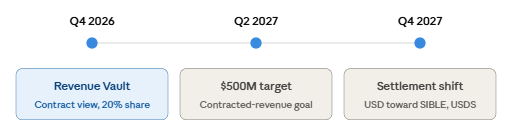
The 20% matches the X post. The wording differs, though. The roadmap says “treasury mechanism,” while the post names “liquidity and user rewards.” Sible has not explained how the two fit together.
Is the Sible Revenue Model Confirmed or Proposed?
Both, in different ways.
Item | Status |
$20M per $100M rule | Proposed, per the X post |
Revenue Vault | Planned for Q4 2026, per the roadmap |
Launch of the Vault | Not confirmed in the sources reviewed |
Actual contract revenue | Not published |
Allocation mechanism | Not explained |
Does Sible Network Have Enterprise Contracts?
No named contract or revenue figure appears in the sources reviewed. The homepage says “Trusted by 1000+ partners” and shows logos for Nvidia, SIPG, Public Health England and Changi, but it gives no case studies or contract details next to them.
That makes the Revenue Vault important. By Sible’s own description, it is meant to provide transparency into eligible contracts. Until it launches and shows real data, the revenue side remains a plan.
A Note on the Ticker
The X post uses $SIB, while the website calls the token SIBLE. This article uses SIBLE, as written on the official site. Readers should confirm the ticker through official channels before searching any market.
Risks and Open Questions
The model depends on enterprise revenue that has not been published.
The mechanism for liquidity support is not described.
The Revenue Vault has no confirmed launch date beyond the quarter.
The $500 million target is a goal, not a result.
Partner logos are claims on the project’s own site.
What to Check Before Relying on the Model
Look for the Revenue Vault launch on the official site and X account.
Look for named contracts and revenue figures inside it.
Compare the vault’s rules with the roadmap’s 20% wording.
Treat any reward or price claim from third parties as unverified.
Conclusion
The Sible Network revenue model links enterprise sales to token liquidity and user rewards with a simple 20% rule. It is clear on paper and consistent with the roadmap’s Revenue Vault.
Proof is still missing. No contract revenue is published, the mechanism is unexplained and the Vault is unconfirmed. Readers should follow Sible’s official channels and judge the model by the data it eventually shows.
Disclaimer: This article is for information only and is not financial, investment, or legal advice. Facts come from Sible Network’s website, roadmap and X post, as seen on 29 October 2026. Proposals and dates may change. Crypto carries real risks, including loss of funds. Readers should do their own research before acting.
















