Sinbad Network KYC Guide: Verification, Migration and User Benefits

Sinbad Network KYC Steps, SNBD Rates and C-GEM Migration Explained
Sinbad Network KYC is the bridge between tokens mined inside the app and tokens held in a personal wallet. It takes three steps, all inside the Sinbad app. It unlocks balance migration, peer-to-peer trading, DAO voting and more. This guide explains each step, the transfer rates and what verified users can do afterward. It uses the official KYC page and homepage. Where the site leaves a detail open, the guide says so.
Key Takeaways
KYC has three steps, found in the Sinbad app under Profile and then KYC.
The first-phase transfer rates are 5% for SNBD and 25% for C-GEM, and they can change.
Verified users unlock migration, Sinbad P2P, DAO voting, partner access and NFT rewards.
What Is Sinbad Network?
Sinbad Network is a community-driven Web3 ecosystem. It combines mobile mining, blockchain gaming, NFTs and an exchange called Sinbadex, and it runs on BNB Chain and Base. Sinbad Network LLC is registered in the United States.
Mobile mining went live on August 17, 2025. Users sign in with an email, tap once a day, and collect SNBD and C-GEM. Those balances stay inside the app until the owner moves them on-chain, and that is where KYC comes in.
Source: official website.
What Is Sinbad Network KYC?
KYC stands for Know Your Customer. The site describes it as the bridge from in-app mining to on-chain ownership. One verification opens several features at once, and it went live in February 2026.
The verified wallet is bound to the user’s profile. That link is what sends later transfers, rewards and NFT drops to the right place.
KYC at a glance | |
Steps | 3, all in the Sinbad app |
Where | Profile, then KYC |
Unlocks | Migration, P2P, DAO, partners, NFTs |
First-phase rates | SNBD 5%, C-GEM 25% |
Why Does Sinbad Network Require KYC?
The official KYC page gives two reasons. The process supports ecosystem integrity, and it enables compliant token distribution. In plain terms, each account gets tied to a verified profile and a registered wallet before tokens leave the app.
Sinbad Network KYC Requirements
The page lists three things a user needs: the email address used to sign up, a wallet address (connected or generated), and any additional verification the app asks for.
It does not name specific documents. It only says extra checks apply “where required,” so the app screen is the final word on what is asked.
Sinbad Network KYC Step by Step
The whole path sits in the app under Profile and then KYC.
Step | Action | What happens |
1 | Email verification | A link arrives at the signup email, and it should be opened on the mining device |
2 | Register wallet | A wallet address is connected or generated and tied to the profile |
3 | Additional verification | Extra checks run where required |
How to Complete Sinbad Network KYC
A few details make this smoother. The email link works best from the same device used for mining. The wallet should be one the user controls, because every future transfer and on-chain reward lands there. The Start verification button on the KYC page jumps straight to the three steps.
Common slips are easy to avoid: opening the link on another device, skipping the extra verification, or treating the rates as fixed. The site also has Support and Contact pages for anyone who gets stuck.
Sinbad Network KYC Verification Status
Verified status is what unlocks the on-chain features. Until then, balances stay in the app.
Before verification | After verification | |
Balance | In-app only | Transfer flow appears in the wallet area |
Wallet | Not bound | Registered to the profile |
P2P, DAO, NFT claims | Locked | Available |
The page does not describe status labels such as pending or rejected.
Sinbad Network KYC Before Migration
The order matters. Migration appears only after verification, so the sequence is email, wallet, extra checks, then transfer. A user who has not finished the steps will not see the transfer option in the wallet area.
Sinbad Network Migration Explained
Migration means moving in-app SNBD and C-GEM to the registered wallet. How much can move depends on the current phase.
Token | First-phase rate |
SNBD | 5% |
C-GEM | 25% |
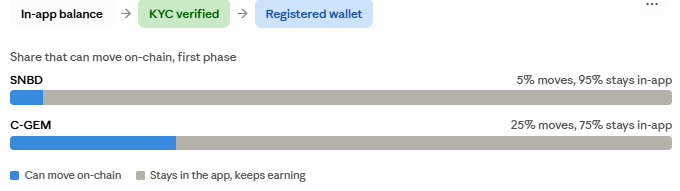
The site calls these rates variable. They are updated periodically based on ecosystem conditions and community feedback, and later phases may raise or adjust them. The picture below shows what the first phase means in practice.
How Does Sinbad Network Migration Work?
Once a user is verified, the transfer flow appears in the wallet area of the app. The user picks how much to move, within the phase rate.
Whatever is not moved stays in the app. It keeps earning mining rewards and can still be spent in games, so migration does not stop anything.
As an illustration only, if a 5% rate applies to 1,000 SNBD, up to 50 SNBD could move on-chain, and the other 950 would stay in the app.
Sinbad Network Wallet Withdrawals
Withdrawals follow the same route. Funds go to the wallet registered during KYC. The page says transfers are intended to launch alongside the P2P marketplace in 2026, and it gives no exact date.
Sinbad Network Verified Users Benefits
Benefit | What it enables |
Balance migration | Move in-app SNBD and C-GEM to the registered wallet |
Sinbad P2P | Trade with other verified members |
DAO voting | Take part in Snapshot governance |
Partner access | Reach partner-program opportunities |
NFT rewards | Claim community NFT drops to the wallet |
All five depend on verified status. One note on voting: the site’s partners page lists Snapshot as planned, so DAO voting may start later than the other features.
Sinbad P2P Priority Access for Verified Users
Sinbad P2P is the peer-to-peer part of Sinbadex exchange, where members trade directly with each other. The KYC page says verified users with on-chain balances can begin trading right away. The project’s news updates also mention a P2P waitlist with priority for verified users, so finishing KYC early could put a user ahead in line.
Is Sinbad Network KYC Safe?
The site says identity data is held securely, used only for ecosystem verification, and handled under the project’s policies and applicable regulations. Its Privacy Policy and Risk Disclosure pages cover the details.
On the user’s side, a few habits help. Start only from inside the Sinbad app. Never share wallet recovery details, and double-check the address before registering it, since it is tied to the profile. Compare token contracts with the official list too, such as SNBD at 0xB13463f0f34BB6F8538ceC30563B4E1F4a6418cF on BscScan.
Final Thoughts
Sinbad Network KYC is the gateway between mining and ownership. Three steps unlock migration, trading, voting and rewards. A user who plans to trade on Sinbad P2P or vote in the DAO has a reason to start early. The rates and launch timing are still moving, so the official KYC page is the best place to check for updates.
Disclaimer: This article is for information only and is not financial advice. Crypto participation involves risk.