SRT Price Prediction 2027: Could Supply Timing Cap the Upside?

No Market Yet: Reading the Token Through a Build Year
No fresh announcement has changed the picture for SRT, the token planned for BNB Smart Chain. The roadmap treats 2027 as a year for contracts, audits and snapshot preparation, so live trading is not the base case.
That turns the outlook into a modelling exercise built on unlock schedules and buying demand, not on chart history. This SRT price prediction 2027 therefore tests how fast supply could arrive and how much demand it would need.
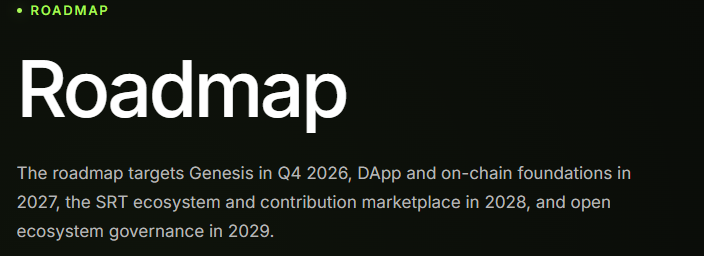
Source: Official Roadmap
SRT Price Prediction 2027 Starts With Release Timing
The whitepaper sets the community mining pool at 3 billion tokens, handed out through Ecosystem Seasons and long-term vesting.
It does not publish the season count or pool sizes in advance. It does give a decay rule for the SST base rate, where each season keeps a fixed share of the last.
This SRT price prediction 2027 borrows that shape for pool sizing as an assumption, not as a published schedule.
Emission Decay Model: How Fast the 3 Billion Pool Could Flow
Each season unlocks a fixed fraction of what remains. Three retention rates show the pattern.
Retention rate | Season 1 | Season 2 | Share out after 3 seasons |
0.9 | 300M | 270M | 27.1% |
0.8 | 600M | 480M | 48.8% |
0.7 | 900M | 630M | 65.7% |
Faster decay front-loads supply. A retention of 0.7 moves about two-thirds of the pool within three seasons, while 0.9 spreads it much wider.
Heavy early unlocks raise early selling risk but leave a thinner tail later. These amounts enter vesting first, so only a fraction would reach open trading.
Demand Absorption: Buying Needed to Match Each Release
Assume holders sell 25% of a season 1 unlock. The table shows the buying, in US dollars, needed to absorb that amount at three assumed values. A fair SRT price prediction 2027 has to weigh this gap.
Retention rate | Tokens sold | At $0.02 | At $0.04 | At $0.08 |
0.9 | 75M | $1.5M | $3M | $6M |
0.8 | 150M | $3M | $6M | $12M |
0.7 | 225M | $4.5M | $9M | $18M |
Read down a column and the required buying triples as decay speeds up. Read across and it scales with value. A fast-decay path at a higher value needs the most outside buying.
Sell share matters as much as value. Holding retention at 0.8 and value at $0.04, the capital required moves like this:
Sell share | Tokens sold | Capital needed |
10% | 60M | $2.4M |
25% | 150M | $6M |
50% | 300M | $12M |
75% | 450M | $18M |
At a 10% sell share the same unlock needs less than half the capital of the 25% case. That is why vesting lock terms can matter as much as decay speed.
Base, Bull and Bear Paths Through the Build Year
Each case pairs a decay rate with a demand assumption. The SRT price prediction 2027 ranges below are model outputs, not targets.
Case | Assumptions | Model reading |
Base | Retention 0.8, 25% sold, audits finish late | Pre-market in 2027; if trading opens, $0.02 to $0.04 needs $3M to $6M of buying |
Bull | Retention 0.9, audits on time, steady demand | $0.04 to $0.08 holds if $3M to $6M of buying appears |
Bear | Retention 0.7, heavy early selling, thin demand | Near $0.02 or lower, with $4.5M needed to hold even that |
Probabilities are not assigned, but the base case carries the most weight because no venue or date has been named.
Data That Could Replace These Assumptions
Several disclosures would tighten any SRT price prediction 2027:
Published season count and pool sizes, which would replace the assumed decay
Vesting lock percentage, cliff and release frequency for mining allocations
Audit reports for the token and vesting contracts
A named venue and order-book depth at the open
A longer lock would cut the sell share and pull every dollar figure down together. A shorter lock does the opposite.
The whitepaper adds that no listing, liquidity or particular level is guaranteed, and the roadmap labels every date a planning target.
The model therefore gives structure, not a quote. Until real terms arrive, the SRT price prediction 2027 stays a range tied to decay speed and demand.
Disclaimer: This article is for informational purposes only and is not financial or investment advice. Crypto assets are volatile and carry risk, so readers should do their own research before making any decision.












Frequently Asked Questions (FAQ)




