Sible Network vs Sirius Network: Mining Apps and Rewards Compared

Sible Network vs Sirius Network: From Daily Mining to Rewards
Free phone-based mining apps keep multiplying. Two of them, Sible and Sirius, now appear side by side in search results. Both let people start without paying, join daily sessions and collect rewards before any token goes live.
The similarity mostly ends there. This Sible Network vs Sirius Network guide explains how each project works, what each plans to build, and where the real gaps are. Every detail comes from official websites, whitepapers and roadmaps, which can change.
Key Takeaways
Sible pitches itself as an enterprise AI platform first. Sirius is built around daily participation from the start.
Sible rewards shrink through scheduled halvings. Sirius shares a fixed seasonal pool and releases tokens through vesting.
Neither token is live on a public chain yet, so every earning idea is a plan, not a promise.
Sible Network: What It Is
This Sible Network review starts with its own pitch. The official website calls it “The Operating System For the AI World.” The platform is built around data, private AI models and automation that run inside an organization’s own security perimeter.
Its core products are Sentinel, Fabric and Cortex. Sentinel fuses live operational data. Fabric connects and governs data sources. Cortex runs language models privately. An optional layer called Nexus links the three, and Relay handles deployment.
The phone app sits on top. Users start a session every day, earn SIB rewards and join the community. The app is listed on Google Play and the Apple App Store, with a web version too. At the time of writing, the site showed more than one million joined users, a figure the project reports itself.
Source: official website.
Is Sible Network a Mining App or an AI Platform?
By its own description, it is an AI platform first. The Sible Network mining app works as the community entry point, while the enterprise products carry the main business pitch. The site also says the token is the fuel of the platform, not its main goal.
Sirius Network: What It Is
Sirius takes a simpler path. The official website describes a mobile-first Web3 project built on contribution mining, with the tagline “Mobile Mining. Powered by Participation.”
The Sirius Network mining app runs on 24-hour cycles. Users join each cycle and collect SST points. No purchase is needed to start. A referral adds a 5% boost, but only when the referral is eligible, active and direct.
Sirius Passport tracks identity and progress across six stages, P0 to P5. Early stages cover identity, activity and trust. Later ones add a connected wallet and personhood checks, and the last stage is for builders. This Sirius Network review suggests reading the stage details on the official site.
Source: official Sirius website.
Sible Network vs Sirius Network at a Glance
Point | Sible Network | Sirius Network |
Main pitch | Enterprise AI and data platform | Contribution mining ecosystem |
Daily activity | Daily session | 24-hour cycle |
Reward unit | SIB rewards | SST points |
Planned token | SIB, 1 billion supply | SRT, 5 billion supply |
Chain | Proof of Intelligence, own AI network planned | BNB Smart Chain, BEP-20 planned |
Referrals | Not stated on homepage | +5% per eligible referral |
Identity | Global KYC planned for 2027 | Sirius Passport, P0 to P5 |
App access | Android, iOS, web | Google Play |
SIB Token Supply vs SRT Token Supply
Sible lists a total supply of 1 billion SIB. Sirius fixes SRT at 5 billion. A bigger number is not better or worse on its own. Allocation, unlock rules and real demand matter far more, and those details sit in the SIBLE whitepaper.
Sible also names a use for its token. Organizations are meant to pay SIB for compute capacity to train and run models. Sirius lists planned uses for SRT instead: missions, validator and node roles, creator and game apps, and governance. Real-world asset use is mentioned only after legal assessment.
Sible Network Halving vs Sirius Network Vesting
The two reward systems work in very different ways.
Sible follows a clock. The first era pays 0.1 SIB per hour. Every four months the rate halves, down to 0.003125 per hour in the sixth era.
Sirius follows a share. Each Ecosystem Season has a fixed community pool. A user’s slice depends on valid points, plus identity, reputation, quality and risk weights. Since the pool is fixed, each season splits the same amount among all eligible users.
In short, Sible’s schedule shrinks with time. Sirius’s slice shrinks as more valid users join.
SST to SRT Conversion
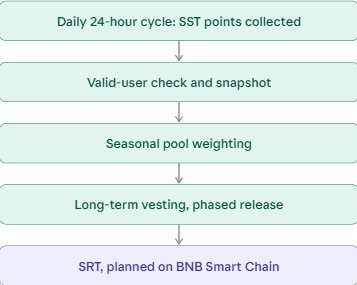
There is no fixed ratio. Having 1,000 points does not mean a set number of tokens. Points are one input into a larger calculation.
Tokens earned this way enter long-term vesting. The locked percentage, cliff and release frequency are left to community governance and audited contracts. One protection is stated clearly: a governance decision cannot retroactively reduce SRT already confirmed in a contract. The whitepaper also notes that routine mining does not automatically generate USDT.
Roadmap 2026 to 2029 Side by Side
Sible publishes a shorter, enterprise-heavy plan that ends in 2027. Sirius runs a longer, token-focused plan that stretches to 2029. Both label these as plans.
Period | Sible Network | Sirius Network |
Q4 2026 | App launch on Android and iOS, AI-training contributions through Sentinel, Ambassador Program, Revenue Vault | Global SST contribution network launches |
2027 | USDS stablecoin, Fabric, enterprise AI marketplace, developer APIs, Nexus and Cortex | Contracts for SRT, vesting, staking, escrow and governance built and audited |
Q3 2027 | Own AI blockchain, global KYC, 1:1 migration of eligible balances to on-chain wallets | Valid users and cumulative points verified |
2028 | Not published | Initial snapshots, on-chain SRT access, audited staking and governance |
Two Sible items deserve a closer look. The Revenue Vault is meant to send 20% of designated enterprise contract revenue to a treasury. The roadmap also lists a $500M contracted-revenue target for Q2 2027. Both are goals, not results.
What to Check Before Joining
Any mobile crypto mining app comparison should treat claims carefully. Readers should keep these points in mind:
Read both whitepapers: Sible and Sirius.
User counts and partner logos are self-reported, not audited.
Download apps only through links on the official websites.
Never pay anything to join a project marked free.
Final Thoughts
The Sible Network vs Sirius Network question has no single winner. Sible suits readers who follow enterprise AI and want a mining app attached to it. Sirius suits those who prefer a plain participation model with points, seasons and vesting.
Both projects are early. Their roadmaps, Sible’s and Sirius’s, are the best place to track real progress.
Disclaimer: This article is for information only and is not financial advice. Crypto is volatile, and token plans can change. Neither SIB nor SRT is promised any price, return or listing. Please read the official whitepapers and do independent research before taking any decision.
















