Synergy Network Tokenomics: Supply, Allocation and Vesting

What Does Synergy Network Tokenomics Reveal About SNRG?
Synergy Network tokenomics is the first thing many presale watchers check, and for good reason. The project is a quantum-resistant Layer-1 blockchain, and SNRG is its native token. Supply, allocation and vesting decide how that token reaches the market.
This guide covers the 12 billion tokens supply, nine allocation buckets and the one vesting schedule the project has published. It also separates confirmed numbers from open questions.
What Is Synergy Network and How Does SNRG Work?
Synergy Network describes itself as a quantum-secure blockchain infrastructure with native cross-chain interoperability. Its official website also points to a consensus design called Proof of Synergy.
SNRG sits at the center of that design. The project lists it for network fees, staking and security, and DAO governance. Because the token is tied to security, the supply plan matters more than it would for a simple payment coin.
What Is the Total Supply of SNRG Tokens?
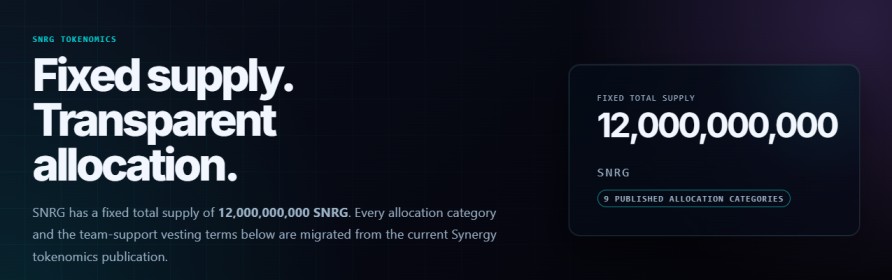
The project's published tokenomics show a fixed total supply of 12,000,000,000 tokens. Reading Synergy Network tokenomics starts there.
No circulating supply figure is listed beside it, which fits a project still in presale. Market cap and FDV can't be calculated yet. Market cap uses circulating supply, FDV uses the full 12 billion, and neither equals the presale price.
How Is the SNRG Token Supply Allocated?
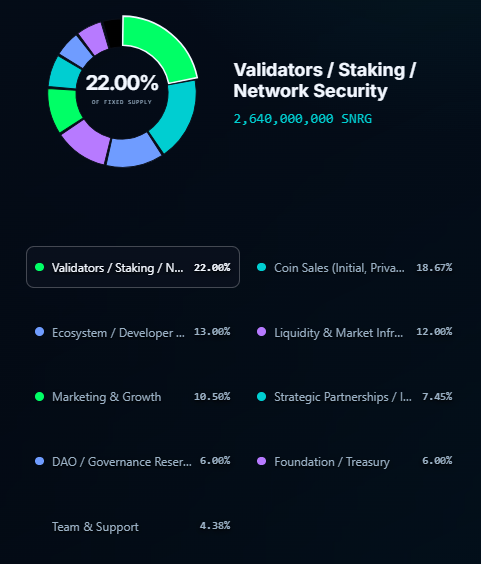
The published tokenomics page splits supply into nine categories. Token amounts below are calculated from the stated percentages.
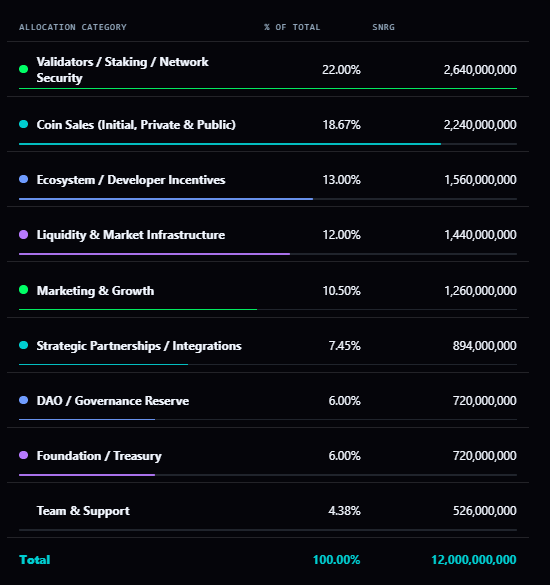
| Allocation | Share | SNRG Amount |
| Validators, staking and security | 22.00% | 2,640,000,000 |
| Token sales | 18.67% | 2,240,000,000 |
| Ecosystem and developer incentives | 13.00% | 1,560,000,000 |
| Liquidity and market infrastructure | 12.00% | 1,440,000,000 |
| Marketing and growth | 10.50% | 1,260,000,000 |
| Partnerships and integrations | 7.45% | 894,000,000 |
| DAO and governance reserve | 6.00% | 720,000,000 |
| Foundation and treasury | 6.00% | 720,000,000 |
| Team and support | 4.38% | 526,000,000 |
Validators and network security take the largest slice. The team gets the smallest, just 4.38%. That shape says a lot, yet allocation alone proves little. What matters in Synergy Network tokenomics is when each bucket reaches circulation.
How Does Presale Pricing Fit Into Synergy Network Tokenomics?
The presale runs in 15 stages. The Synergy Network presale overview lists Stage 1 at $0.0038 per SNRG. The stated rule adds $0.0020 per stage, which would put Stage 2 at $0.0058 and Stage 15 at $0.0318.
Each stage must sell out first. Stage 1 holds 280,000,000 tokens. On October 8, 2026, the counter showed 6,791,718 sold, about 2.4%, as covered in the Stage 1 presale update.
Only Stage 1's size is listed. If all 15 stages matched it, the total would reach 4.2 billion tokens, above the 2.226 billion sale bucket. Later stages are probably smaller, but the project hasn't said.
Buyers receive a claim voucher, an on-chain NFT-based proof of purchase. Tokens aren't sent instantly. The current token price is a sale price, and a listing price remains unconfirmed.
What Is the SNRG Vesting and Unlock Schedule?
Token vesting is the schedule that controls when tokens become available. Synergy Network has published one for the team and support allocation only.
-
Allocation: 4.38%, or 526,000,000 tokens
-
At grant: 20% vests immediately, locked from transfer for 24 months
-
Cliff: 12 months, a waiting period before the rest vests
-
Remaining 80%: 36 monthly vesting events
-
Total length: four years
Those terms look long. The other eight buckets, about 95.5% of supply, have no published vesting. That's the biggest transparency gap in Synergy Network tokenomics today.
What Utility Does SNRG Offer Across the Network?
Utility is the other half of Synergy Network tokenomics.
Network Fees and Deployment
SNRG is meant to pay transaction fees, dApp deployment, and cross-chain fees.
Staking, Validators, and Security
The 22% bucket backs validators and staking. Yields and lock terms haven't been published.
Governance and Identity Modules
SNRG ties into DAO governance, though the governance tooling isn't live yet.
Could SNRG Unlocks Affect Market Supply?
They could, but the effect is hard to size. Circulating supply will grow as buckets unlock, and large releases can add selling pressure.
Unlocks don't automatically mean falling prices. Demand, liquidity and market conditions all matter. With only team vesting disclosed, most of the unlock calendar can't be mapped.
Expert Take: What Stands Out in the Numbers
The team share is small, security gets the biggest allocation and the sale bucket is sizeable at 18.67%. The missing pieces matter just as much. Without vesting for 95.5% of supply, Synergy Network tokenomics is only partly readable. The project whitepaper is where fuller detail would be expected.
What Are the Main Risks in Synergy Network Tokenomics?
-
Partial disclosure: vesting is published for one bucket out of nine
-
Voucher process: tokens arrive after the sale, not at purchase
-
Listing uncertainty: no confirmed exchange listing or launch date
-
Audit status: no audit report naming a firm is listed beside the figures
-
Execution: mainnet, staking, and governance tools are still on the roadmap
As with any crypto presale, the figures describe a plan, not an outcome.
What Could Shape the Future of SNRG Token Economics?
The next chapter of Synergy Network tokenomics depends on adoption, validator participation, ecosystem apps and governance decisions. Presale completion and distribution milestones matter too.
Mainnet and listing dates aren't confirmed, so they stay possible. Fresh updates appear in the daily crypto news today roundup.
What Synergy Network Tokenomics Tells Us About Its Design
The project is building a quantum-resistant Layer-1 around a fixed 12 billion SNRG supply. Allocation leans toward security, and the team holds a modest 4.38%. Vesting is clear for the team and silent elsewhere.
Still uncertain are the unlock schedule for most tokens, later stage sizes, audit details and listing timing. Those are the pieces that would complete Synergy Network tokenomics.
Conclusion
Synergy Network tokenomics shows a fixed supply of 12 billion SNRG, a security-focused allocation and a team share of just 4.38%. The 15-stage presale starts at $0.0038, and buyers receive a Claim Voucher instead of instant tokens.
The picture is only partly complete. Vesting is published for the team bucket alone, which leaves about 95.5% of supply without a visible unlock schedule. Later stage sizes, audit details and a listing date are also still unconfirmed.
Disclaimer: This article is for information only and is not financial advice. Crypto assets and presales carry high risk, including total loss. Figures come from the project's published materials and may change.