Tokenized Structured Notes: Chainlink and UBS Target a $2T Market

Tokenized Structured Notes: Chainlink and UBS Bring $2T Market Onchain
It has built a blockchain solution with UBS to move structured notes onto the blockchain.
Chainlink calls the project a major production milestone for tokenized capital markets.
Source: Chainlink Post
It looks at tokenized structured notes from a basic level up.
What Chainlink and UBS Announced
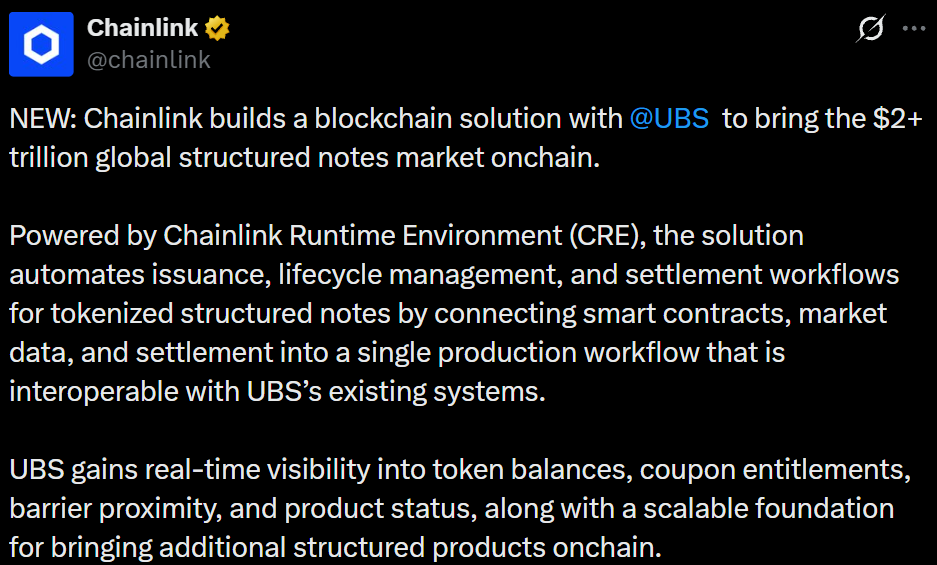
According to Chainlink’s official post, the solution is designed to bring the global structured notes market, which values at more than $2 trillion, onchain.
It is powered by the (chainlink-Runtime-Environment) (CRE). The post says the solution automates three areas:
Issuance: creating the notes
Lifecycle management: handling the events that happen while a note is active
Settlement: completing the final steps of transactions
It says the solution connects smart contracts, market data and settlement into a single production workflow.
It also says the workflow can work with UBS’s existing systems, so the bank does not need to start from zero.
Structured Notes in Simple Words
A structured note is a financial product whose returns depend on how something else performs, such as a share or an index.
Notes like these often include set rules about payments and price levels, so they need careful tracking. That tracking is what this solution aims to automate.
The post highlights four things UBS can now watch in real time:
What UBS can see | What it means in simple terms |
Token balances | How many digital note tokens each holder has |
Coupon entitlements | Who is owed periodic payments, and how much |
Barrier proximity | How close the underlying price is to a level written into the note |
Product status | Where each note stands in its life |
These are general explanations of the terms. It's post itself lists the four items without defining them.
How the Chainlink-Runtime Environment Fits In
it describes CRE as its all-in-one orchestration layer for onchain finance in its SmartCon 2025 recap. You can also read the CRE launch blog.
In the new solution, CRE is the link between three parts that normally sit apart:
Smart contracts, which are programs that run on a blockchain and follow set rules
Market data, which tells the contracts what is happening with prices
Settlement, which completes the transaction
Chainlink says these now run as a single workflow. That matters because structured notes depend heavily on price data.
A payment or a barrier check needs reliable information, and the workflow brings that information into the process.
What UBS Gains From the Solution
For readers following tokenized structured notes, the benefits stated in the post are:
Live visibility: real-time views of balances, coupon entitlements, barrier proximity and product status
Less disruption: the workflow is interoperable with systems UBS-already uses
Room to grow: the post says UBS gets a scalable foundation for bringing additional structured products onchain
The third point is important. The post describes this as a foundation for more than one product, not a one-off test.
The post does not give some details. It does not state how many notes were issued, their size or their value.
It also gives no timeline for new products. Readers should treat the post as the official statement and wait for further updates for those details.
UBS and Chainlink’s Earlier Work Together
This is not the first time the two have worked together. In its 2025 recap, it says UBS-completed the world’s first in-production, end-to-end tokenized fund workflow using the Chainlink-Digital Transfer Agent technical standard.
The same recap says Chainlink also advanced tokenized workflows with UBS using Swift messaging and CRE.
Together, these show a move from funds toward tokenized structured notes, a different type of product.
Structured notes need ongoing tracking of coupons and price levels, which makes them more complex than a simple record of ownership. That is why Chainlink calls this a production milestone.
Conclusion
Chainlink and UBS's have built a solution that aims to automate how structured notes are issued, managed and settled onchain.
The official post stresses live visibility, links to UBS’s current systems and a base for more products.
For tokenized structured notes, the next thing to watch is whether it adds more products and shares more details. Readers should follow Chainlink’s official channels for updates.
Disclaimer
This article is for educational and informational purposes only and is not financial or investment advice. Crypto assets are high risk, their prices can be very volatile, and you can lose some or all of your money. Always do your own research and consider speaking with a licensed financial advisor before making investment decisions.






