TraderTraitor Group: Who Are the Hackers the FBI Blames for $6B+?

TraderTraitor Group and the Rising Crypto Security Risk
Crypto security is now a top worry for exchanges, traders, and everyday holders after a week of major hack news. This article explains what is known, what is still unclear, and what to watch next as of 3 November 2026.
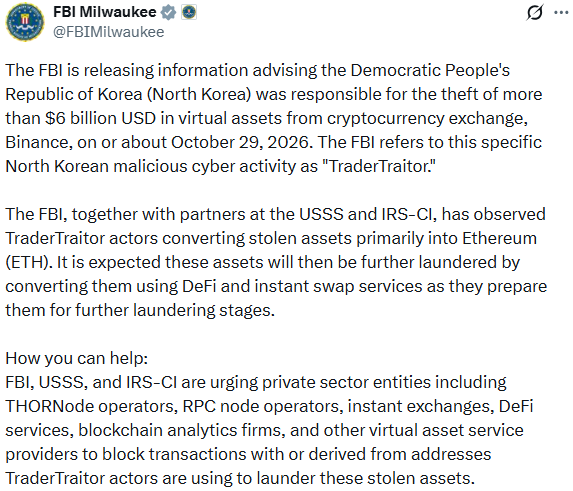
The FBI says the TraderTraitor Group, a hacking team linked to North Korea, stole more than $6 billion in crypto from Binance, based on an alert dated 31 October 2026. This update came from the FBI official X account.
Who Is the TraderTraitor Group?
The TraderTraitor Group is the name the FBI uses for a North Korean cyber team that targets crypto firms and the people who work for them. Security researchers also track the same activity under names such as Jade Sleet and UNC4899.
The US Federal Authorities first used the TraderTraitor label in public after the Bybit theft of about $1.5 billion in February 2025. In that alert, the bureau said the hackers spread trading apps that had been edited to hide malware, which gave them a way into victim systems.
What Did the FBI Say About the Binance Crypto Hack?
The FBI alert says the TraderTraitor Group carried out the Binance theft on or about 29 October 2026. The bureau worked on the alert with the US Secret Service and IRS Criminal Investigation.
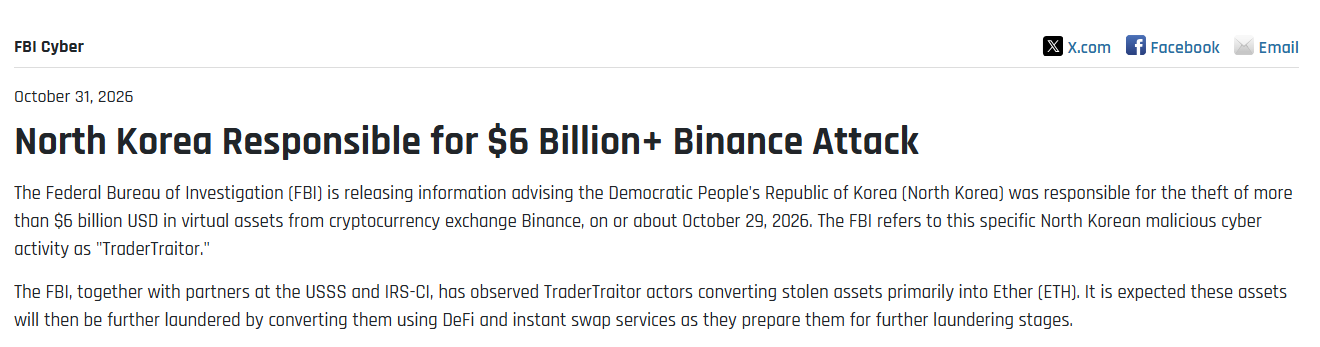
Binance disclosed the breach first and said about $6.3 billion in digital assets was taken. The FBI says the hackers have turned most of the stolen assets into ether, which is easy to move and swap across blockchains.
How Do Hackers Launder Stolen Crypto Through DeFi?
Laundering means moving stolen coins through many wallets and services so the trail becomes hard to follow. The US Federal Authorities expects the hackers to use DeFi platforms, which are apps that run on blockchains without a central company, along with instant swap services.
To slow this down, the bureau published a list of wallet addresses and asked exchanges, node operators, and DeFi platforms to refuse any transfer linked to them. Public blockchains record every move, so investigators can follow funds in real time even when the owners stay hidden.
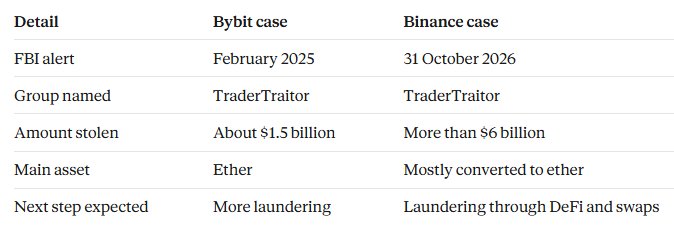
How Does the Binance Hack Compare With the Bybit Case?
This table shows how the two cases line up based on FBI statements.
Why Does the TraderTraitor Group Matter for Crypto Traders?
This case shows that attackers often aim at people and software habits, not only at code. A fake job offer or an edited trading app can be enough to open the door to a company wallet.
Traders can lower their own risk by keeping long-term holdings in a hardware wallet, turning on two-factor login, and never opening files from strangers who offer jobs or trading tools.
Exchanges can also check deposits against the US federal authorities wallet list, which gives them a clear government reference to act on. These are general safety steps and not a view on the finances of any platform.
What Happens Next in the Binance Hack Probe?
Readers can watch three checkpoints in the coming days. The first is any update to the FBI wallet list, the second is news of frozen funds from exchanges or token issuers, and the third is a fresh statement from Binance on its investigation and user funds.
North Korea has denied the claim, according to Yonhap News Agency of South Korea.

We will update this report when official sources share new details about the TraderTraitor Group.
Conclusion
For now, the FBI’s claim against the TraderTraitor Group is an attribution, not a court verdict. So if you hold crypto, the practical lesson is old but still true: keep your savings in a hardware wallet and think twice before opening any file from a stranger, especially one tied to a job offer.
We will update this story as the FBI, Binance, and token issuers share more on the wallet list and any frozen funds.
YMYL Disclaimer: This article is for information only and is not financial advice. Crypto assets are volatile and carry risk. Always check official notices before making a decision.






