Can Verifiable Delay Functions Prove That Time Has Passed?

How Verifiable Delay Functions Prevent Fast-Forwarding
Verifiable delay functions prove that a set number of sequential steps ran. VDFs do not prove that a clock reached a given time. A solver returns an output and a short proof, and a verifier checks the proof much faster than repeating the work. The idea comes from Boneh and co-authors, CRYPTO 2018. Research dated April 2026 shows that hardware speed and attacker profit still limit the trust placed in verifiable delay functions as a clock.
Hardware access is the first weak point. A VDF is only as long as the fastest machine allows, which links the topic to the hidden geography of blockchain nodes.
How Verifiable Delay Functions Work
Ordinary computing tasks split across many processors. A VDF is built so that each step needs the result of the previous step. Extra processors then add little speed.
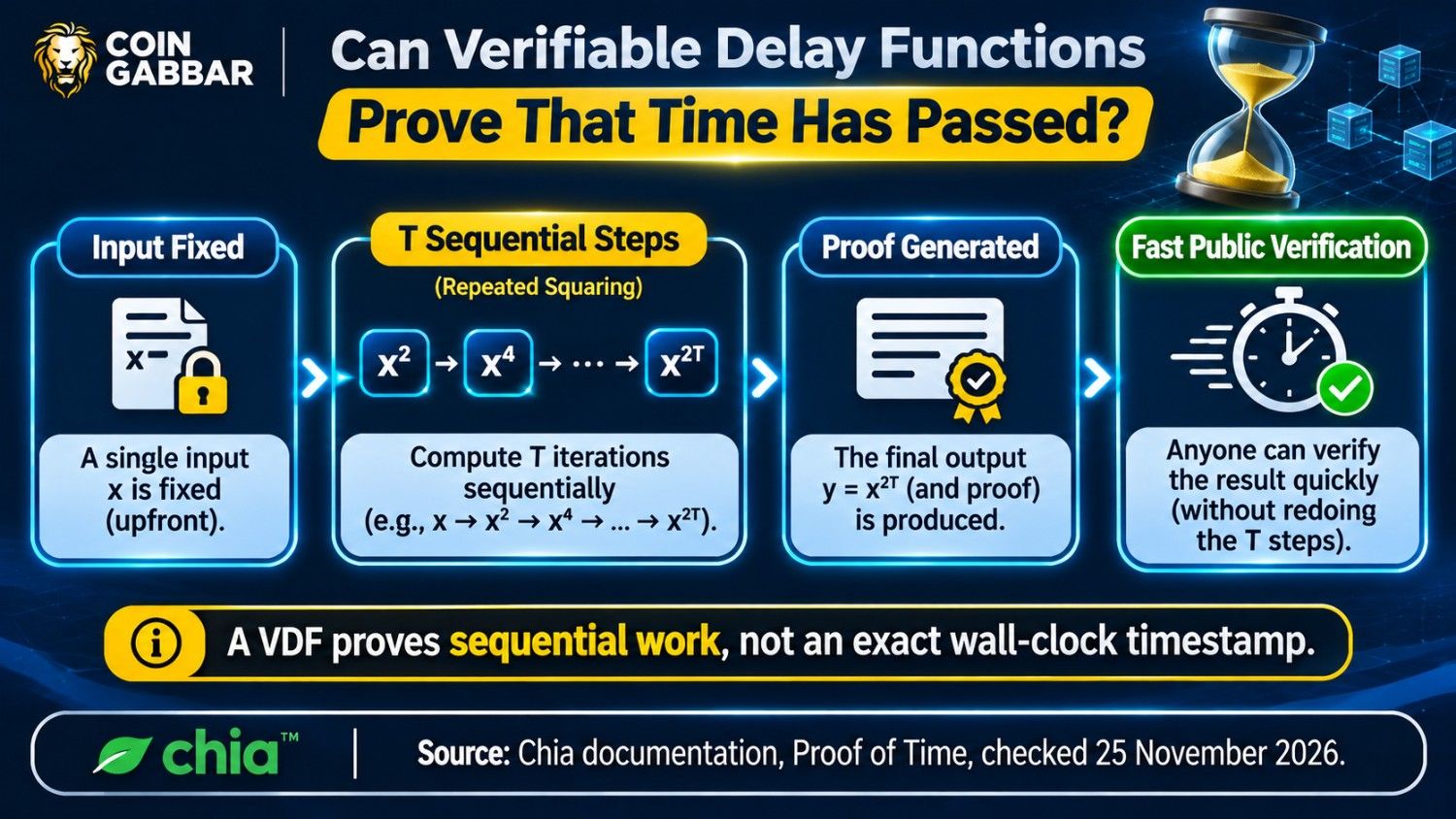
A common design uses repeated squaring in a group of unknown order. Chia documentation describes repeated squaring in a class group of unknown order as its VDF.
Two jobs follow:
Evaluation: the prover performs the sequential steps, which takes time.
Verification: the verifier checks a compact proof without repeating the steps.
Verifiable delay functions therefore do not add a timer to a smart contract. Each proof provides evidence that a defined computation finished under stated assumptions.
Ethereum Gas Costs for Verifiable Delay Functions
A study by Suhyeon Lee, Euisin Gee, and Junghee Lee of Korea University and Tokamak Network tested Pietrzak's VDF proof check inside Ethereum smart contracts. The arXiv preprint was first submitted on 10 May 2024 and last revised on 22 January 2025. Its abstract states that verification can fall from 4 million to 2 million gas. The paper does not define the 4 million baseline, so Table 1 is the safer reference.
RSA key size | Parameter τ | Gas used | Proof data size |
2,048 bits | 20 | 1,817,855 | 5.38 KB |
2,048 bits | 25 | 2,603,753 | 7.25 KB |
3,072 bits | 20 | 3,495,396 | 7.13 KB |
3,072 bits | 25 | 4,958.138 | 9.63 KB |
Source: Lee, Gee, and Lee, Table 1, arXiv version 5 (22 January 2025). Each row uses δ = 9. Values are experimental results, not live gas prices.
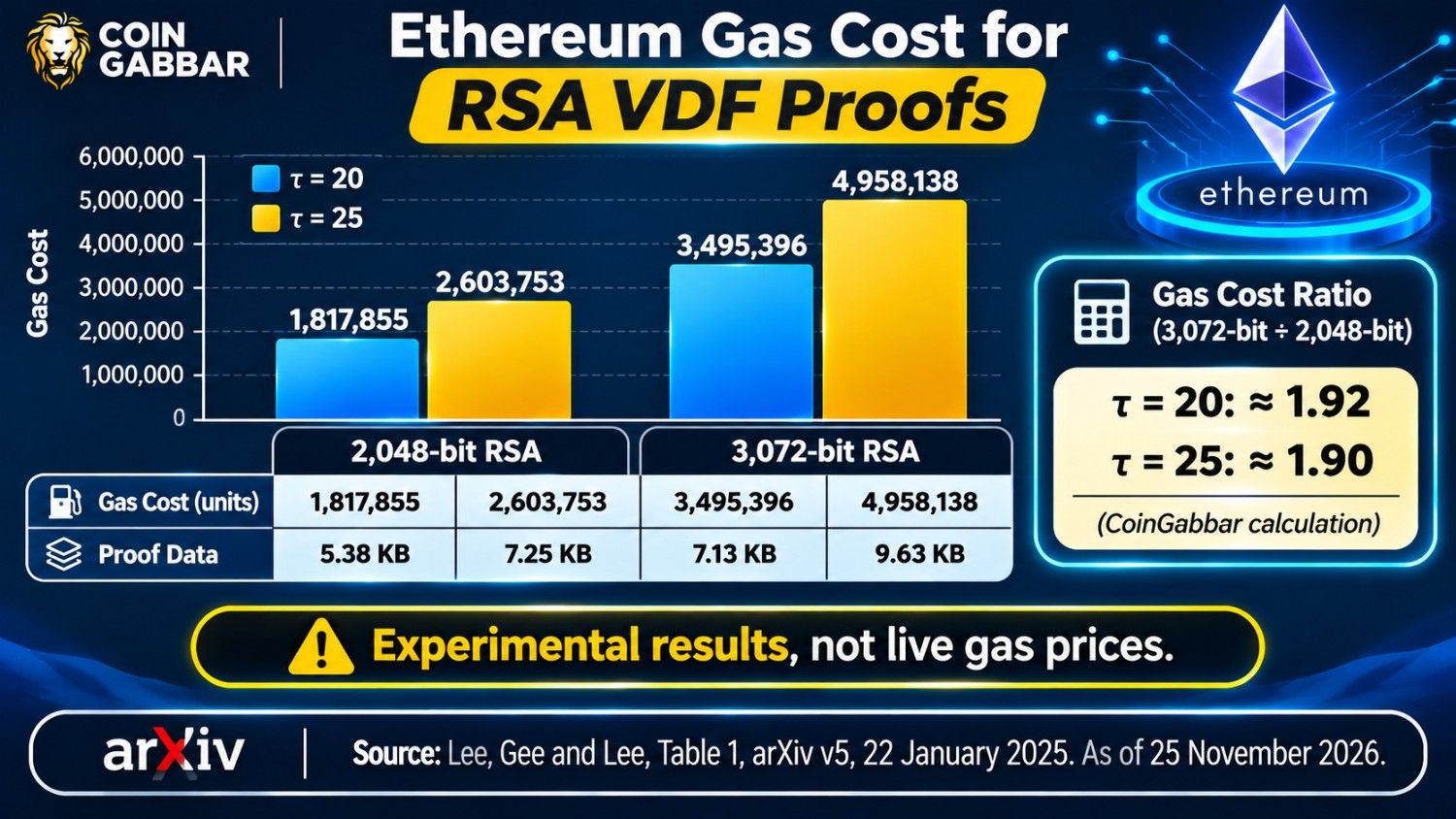
CoinGabbar calculation: dividing 3,072-bit gas by 2,048-bit gas gives about 1.92 at τ = 20 and about 1.90 at τ = 25.
Method and limits: the inputs are the four table values above. The ratio compares only the two tested key sizes. It does not predict gas under future Ethereum rule changes, and it says nothing about dollar cost, which depends on the gas price on the day of use.
The result shows an implementation path. Ethereum mainnet has not adopted a VDF for consensus.
Where Verifiable Delay Functions Run Today
Chia uses veifiable functions, called proofs of time, in its consensus design. Specialized participants named timelords compute the proofs. Chia's documentation states that Chia Network Inc. received its first batch of ASIC time lords in 2023. Custom hardware raises the same concentration concern described above.
Verifiable Functions vs RANDAO, VRFs, and Threshold Beacons
Public randomness has several designs:
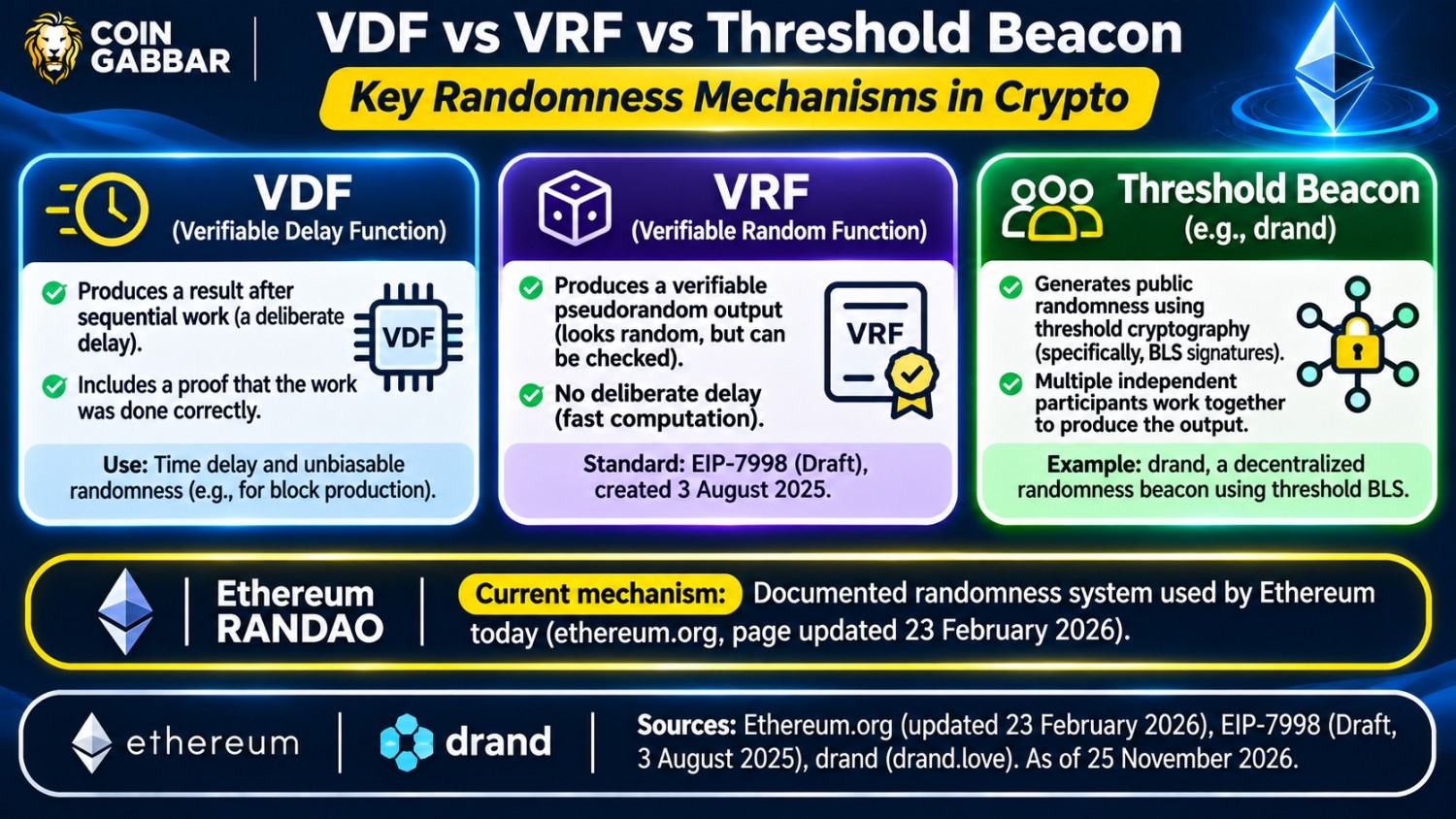
RANDAO: The Ethereum documentation, last updated 23 February 2026, states that RANDAO mixes a hash from each block proposer into a seed. It is not a VDF.
VRF: A verifiable random function gives a checkable pseudorandom output without a deliberate delay. EIP-7998, created 3 August 2025, proposes turning the randao_reveal into a per-slot BLS-based VRF. The EIP carried the draft status when checked on 25 November 2026.
Threshold beacon: Drand combines threshold BLS signatures from a group of nodes. No single node controls the output.
A VDF fits when a sequential delay must pass before an output appears. A 2024 paper by Abram, Roy, and Simkin even argues that randomness beacons do not need VDFs, so the choice depends on the threat.
Whatever the design, validator software shared by most nodes adds client diversity risk.
Dated Research Timeline
Date | Event | Status |
3 August 2025 | EIP-7998 created (VRF proposal) | Draft |
10 January 2026 | C-DAC Pune posts a Verifiable Delay Token Internet Draft. | Draft; the stated expiry date of 14 July 2026 has passed. |
6 April 2026 | Shang and Chen post an economic security paper. | arXiv preprint |
15 April 2026 (07:13:48 UTC) | Hoffmann and Pietrzak submit blind VDFs. | ePrint preprint |
25 to 28 May 2026 | PKC 2026 holds a paper on VDFs from time-lock puzzles. | Conference paper |
Sources are linked in the sections of this article. Dates come from each source page, opened on 25 November 2026. The only time of day found is the ePrint 2026/737 page timestamp of 07:13:48 UTC on 15 April 2026, taken from page metadata. The arXiv and EIP pages show dates only.
What the 2026 Research Changes
Economic security. Shang and Chen, both of the Hong Kong University of Science and Technology, submitted a paper on 6 April 2026. The authors argue that a VDF can be sequentially secure and still be attacked when a rational attacker profits from buying faster hardware, for example, during MEV reward spikes.
Blind computation. Hoffmann and Pietrzak of the Institute of Science and Technology Austria had a paper received on 15 April 2026 and approved on 19 April 2026. It lets a client outsource a VDF to a server without revealing the input. The paper is a preprint, not a deployed service.
Draft token proposal. The C-DAC Pune draft, dated 10 January 2026, proposes tokens that prove a waiting period has passed. The draft carried an expiry date of 14 July 2026. That date has passed as of 25 November 2026, and no later revision was found in this check. It is not an adopted IETF standard.
Limits of Cryptographic Time
Verifiable delay functions prove that a computation finished. A proof of this kind gives no atomic-clock timestamp. Faster hardware shortens the real delay. A VDF also cannot repair a bad input. A lottery that reads a manipulated price feed stays biased, as covered in the guide to crypto oracle risk.
Verifiable delay functions also face the efficiency race seen in Bitcoin mining, where better equipment shifts who wins. Verification cost matters as well. Millions of gas suits, rare security checks, and not frequent base-layer calls. Privacy tools that rely on waiting periods often pair with encrypted computation, covered in the FHE exchange guide.
Developer Checklist and Source Map
Construction: Is the design a peer-reviewed Pietrzak or Wesolowski scheme? Check the original paper.
Hardware: Is the delay set against specialized hardware? Check the vendor's published benchmarks.
Verification cost: Are gas and proof size reported? Check the paper's results table.
Input security: is the input fixed before the delay starts? Check the protocol specification.
Economic incentives: could the reward justify faster hardware? Check the Shang and Chen model.
Final Takeaway
Verifiable delay functions offer verifiable sequential delay, not a perfect clock. Ethereum gas studies show verification is becoming practical, while April 2026 research shows that hardware and profit still decide security.
Disclaimer: This article covers cryptographic research and is not investment advice.












Frequently Asked Questions (FAQ)




