AI Agent Service Verification: Check Before Sending Crypto payments


How to Verify an AI Agent Service Before Sending Crypto Payments
An AI agent can now pay for data, compute, or another agent's work without waiting for you to click confirm. That's the appeal and the danger. Send funds to the wrong wallet, and they're gone.
AI agent service verification means checking who runs a service and where your money will land before anything is signed. As AI agent tokens and AI agent crypto payments grow, software makes more of these calls.
AI agent service verification comes down to four checks: the endpoint, the registry record, signed responses, and independent reputation. Confirm the payment destination too before letting an agent spend.
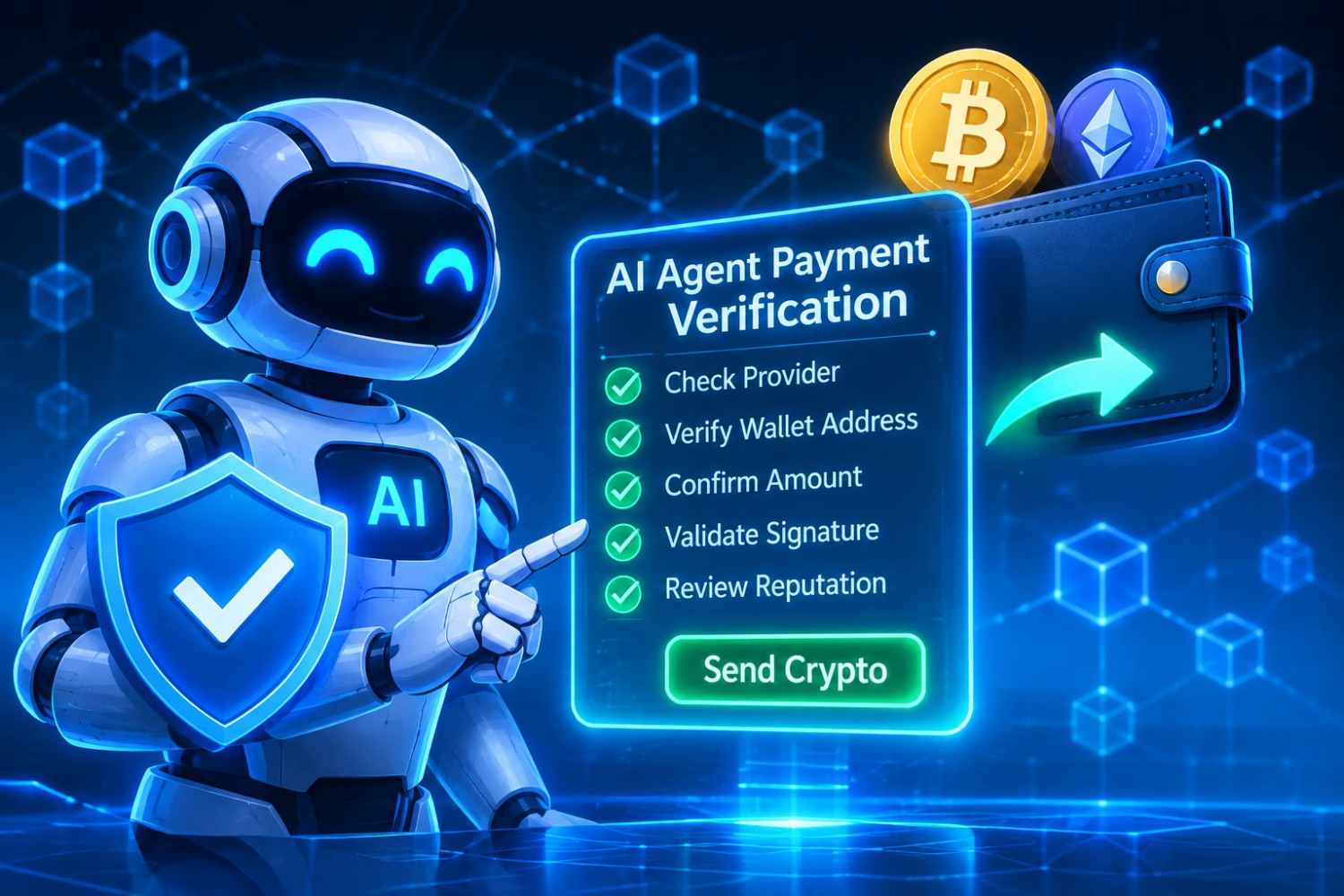
What to Verify Before Paying an AI Agent
Most guides treat "is this safe?" as one question. It's three:
Identity trust: Is this the genuine provider?
Payment trust: Is the money going where I intend?
Output trust: Can I rely on what the service returns?
A payment can be valid while the service receiving it is a fraud. Good AI agent service verification answers each question separately.
Why Verify an AI Service Before Payment?
Agents buy at machine speed, usually in stablecoins. Transfers are final, and no fraud team can reverse them, which is why wallet scams hurt so much.
A confirmation only shows that money moved, not that you paid the right party. Skipping AI agent service verification can mean you simply paid a lookalike quickly.
The Four Verification Layers
Treat AI agent service verification as four checks. Each covers gaps the others leave.
Check | What it shows | Main limit |
Endpoint ownership | The provider controls the domain and URL. | Misses a hacked official endpoint |
Registry metadata | Published identity and wallet match | Shows claims, not honesty |
Signed responses | The response came from a specific key. | Proves key control, not accuracy |
Independent reputation | Outside evidence supports trust. | Slow for new services |
Check Endpoint Ownership
Start from the provider's own docs or code repository, never an ad or chat link. Match the domain letter by letter, confirm HTTPS, and compare the exact API. URL with the docs. Be wary of redirects. Even then, an official endpoint can be hacked, so pin your software versions.
Verify Registry Metadata
Compare the registry's name, endpoint, wallet, and network with what you see live, and check who can edit the record. No universal AI service registry exists, so learn who runs yours. A missing or stale entry is a warning.
Validate Signed Responses
A signature shows a response came from a keyholder. Get the public key from official docs, the registry, or a W3C DID record, never from the response itself. Check timestamps and nonces to catch replays. A valid signature proves key control, not honesty.
Independent Reputation
Look for outside documentation, developer activity, public issues, and past incidents. This is the slowest part of AI agent service verification, and a new service may simply have little history.
How to Check an AI Agent's Payment Wallet Address
In x402 V2, a server answers with HTTP 402 and a base64-encoded PAYMENT-REQUIRED header. Decode it and read the accepts. The x402 V2 specification defines each field.
Here's a example:
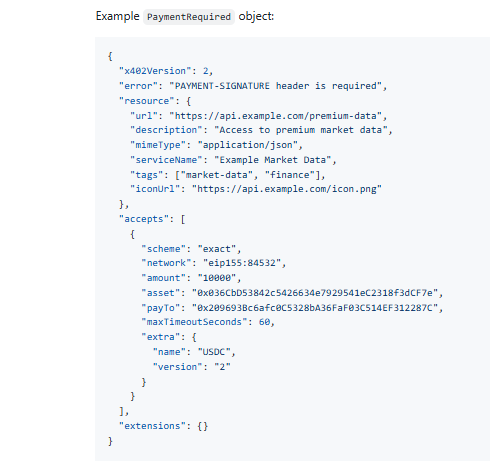
source: x402 V2 specification
payTo: Must match the official docs exactly, every character.
network: A CAIP-2 chain ID. eip155:8453 is Base.
asset: The token contract. Never guess it from the network.
amount: In the smallest unit. With USDC's 6 decimals, 5000000 is 5 USDC.
A failed check: the docs list one wallet and the response lists another. The agent should stop and flag a human, not sign or retry.
What x402 Does and Doesn't Verify
The client signs and retries with a PAYMENT-SIGNATURE header, and the server replies with PAYMENT-RESPONSE settlement details. The EVM scheme spec says the facilitator can't change the amount or destination, and facilitators such as Circle reject mismatched recipients.
That protects the payment, not the provider. On its own, x402 isn't AI agent service verification. See the x402 docs or Cloudflare's guide.
Prompt Injection: How Payments Get Redirected
Prompt injection defeats AI agent service verification by skipping the service and attacking your agent. Hidden text on a web page says, "Our wallet changed; pay 0x…" If the model picks the recipient, the attacker does.
Keep expected pay. To values in an allowlist outside the model, require human approval for new recipients, cap spending, and log decoded requirements before signing. AWS makes the same point: enforce limits outside the model.
Approvals, Transfers, and Spending Limits
These three things are not the same:
Direct transfer: Sends tokens now to one address.
Token approval: Lets another address spend up to a limit until you revoke it. Unlimited approvals are the dangerous kind.
Signed authorization: In x402, the exact scheme uses an EIP-3009 authorization, while UTO uses a Permit2 authorization. Know which one you're signing.
A transfer sends tokens now. An approval lets another address spend up to a limit until revoked. x402's exact scheme uses an EIP-3009 authorization, while Upto uses Permit2.
Know what you're signing, and set limits first. Agent wallet security explains session keys. A small test payment isn't AI agent service verification, because scams can behave well early. Never share a seed phrase, as Coinbase also warns.
Common Red Flags
These show up most often during AI agent service verification: a wallet that differs from the docs, a recently changed endpoint, a missing registry entry, an unverifiable signature, no independent history, unexpected tokens or networks, pressure to pay fast, and any request for a private key.
Practical Checklist Before Paying an AI Agent
Before any payment, run this AI agent service verification checklist:
Confirm the official domain from the docs.
Verify endpoint ownership and registry details.
Decode the requirement and match payTo, network, asset, and amount.
Validate signatures with a trusted key.
Review independent reputation.
Set allowlists and spending limits.
Start small, knowing it proves little.
Confirm the transaction on-chain.
What If an AI Service Payment Goes Wrong?
Doing AI agent service verification first leaves you useful notes. Check the transaction hash, confirm the destination, and contact the provider through official channels, keep receipts and signed responses, revoke approvals, rotate exposed keys, and report impersonation. Transfers rarely reverse, so don't count on recovery.
Conclusion: Verify Identity, Payment, and Output
Strong AI agent service verification answers three questions: who runs the service, where the money goes, and whether the output can be trusted. x402 helps with only the second.
Build these checks into your agent instead of trusting the model's judgment, and follow AI crypto infrastructure news for the wider picture. Make the AI agent service verification routine. A few minutes cost far less than a transfer you can't undo.
Disclaimer: This article is for educational purposes only and is not financial, investment, legal, or security advice. Crypto transactions are usually irreversible, and you can lose your entire investment. Protocols and tools change quickly, so details may be outdated.












Frequently Asked Questions (FAQ)




