Arcium ARX: Confidential Computation, MPC Nodes, and Token Utility

Arcium ARX Explained: Why Private Data Needs Its Own Network
Most blockchains show everything. Balances, trades, and contract inputs sit in public view. Arcium ARX targets that gap. Arcium is a confidential computing network built for Solana apps, and ARX is its native token.
In short, the network uses multi-party computation (MPC) to process encrypted data without exposing it to any single operator. ARX is used for staking, delegation, and governance.
This guide covers the Arcium network, ARX token utility, Arcium tokenomics, the unlock schedule, and the main risks.
What Is Arcium and Why Does Confidential Computation Matter?
Confidential computation means processing data without revealing it. Normal cloud servers must decrypt data before using it, and that moment is the weak spot.
Arcium removes the single trusted server. The network splits work across many independent machines instead. Mainnet Alpha went live on February 2, 2026. Umbra, a private transfer and swap app, was the first to deploy.
Developers write private logic in Arcis, a Rust-based framework. Programs then run inside an MPC execution environment, or MXE. An MXE works like a private virtual machine owned by one app.
How Does the Arcium Network Work Step by Step?
The official explorer describes a four-step flow.
Define: an app publishes a computation definition for a private circuit.
Queue: a client sends encrypted inputs and points to that definition.
Execute: Arx nodes in a cluster run the job together.
Finalize: the result lands on-chain or goes through a callback.
Solana handles coordination and settlement. The encrypted work itself happens off the main chain. Turns out, the hardware side is simple. Clusters are groups of Arx nodes, and each node holds a secret piece of the data.
How Does Multi-Party Computation Protect Data?
MPC splits a secret into shares. Each node holds one share, and no single node can read the full secret. Then the nodes calculate together. Passing partial results, never raw inputs.
According to the project docs, Arcium uses a dishonest majority model. Privacy holds if at least one node in a cluster stays honest.
That's a project claim, not an independent audit result. And the guarantee depends on code quality, key management, and how many operators actually join.
Is Arcium Different From Zero-Knowledge and Other Privacy Tools?
A zero-knowledge proof shows a statement is true without revealing the data behind it. MPC lets several parties compute on hidden data together.
One proves. The other computes.
Technology | Main job | Key difference |
Arcium MPC | Confidential computation | Many nodes compute over encrypted data. |
Zero-knowledge proofs | Private verification | Proves a claim without exposing the data |
Token-2022 confidential transfers | Private token transfers | Hides selected balances and amounts |
Trusted execution environments | Protected computing | Relies on special hardware being trusted |
No option wins on every measure. Each one trades speed, cost, and trust in a different way.
What Is the ARX Token Used For?
ARX is the native token of the Arcium network. It follows the Solana SPL standard, and the project also lists a BNB Smart Chain contract.
Official contract addresses:
Solana: ARXwZkNAtzPfdcoqQiduJn8EPv9fKiDfGn2KyggyDrFs
BNB Smart Chain: 0xd5f6ef5deabe61e6d5cdb49bfb6f156f2c1ca715
Fake tokens often copy popular tickers, so addresses should be matched against the official page.
ARX has two core jobs, based on the official tokenomics page:
Staking: node operators lock ARX as collateral, and more compute means more ARX behind the node.
Governance: a technical track for node operators and a community track for holders who lock ARX.
Supply is fixed at 1 billion ARX. The project says there's no inflation, no minting, and no dilution.
How Are Arcium Network Fees Paid and Shared?
Customers pay computation fees in the chain's native token, such as SOL on Solana. ARX isn't spent on fees.
Each fee is split by a published formula:
Recipient | Share | Role |
Node operators | 70% | Run the computation. |
Recovery nodes | 20% | Hold secret shares for MXE migration. |
Network treasury | 10% | Funds development and resilience |
One early launch report mentioned fee burns and inflation. The official page doesn't support that, so it's left out here.
How Does ARX Staking Work and What Are the Risks?
Holders can delegate ARX to node operators to raise the capacity an operator offers. Operators may keep a commission on shared fees.
The protocol doesn't promise any return to delegators. Operators set their own terms. Delegated ARX is also subject to slashing, which is a penalty for node misbehavior. It can be partly or fully lost.
The official site also lists "Run a node" as coming soon. Operator numbers may stay small for a while.
What Are Arcium Tokenomics? Look like what?
At launch, about 208.8 million ARX (20.88%) was unlocked. The other 79.12% is locked.
Group | Share | Vesting |
Community Sale | 2.0% | Fully liquid |
Angels | 5.6% | 12-month cliff, 18-month linear |
Early Backers | 27.1% | 12-month cliff, 24-month linear |
Core Contributors | 21.1% | 12-month cliff, 27-month linear |
Ecosystem and R&D | 20.4% | 42.8% unlocked at launch, then a 12-month cliff, 42-month linear |
Validators | 5.3% | 12-month cliff, 24-month linear |
Community | 18.5% | 54.7% unlocked at launch, then cliff and 42-month linear |
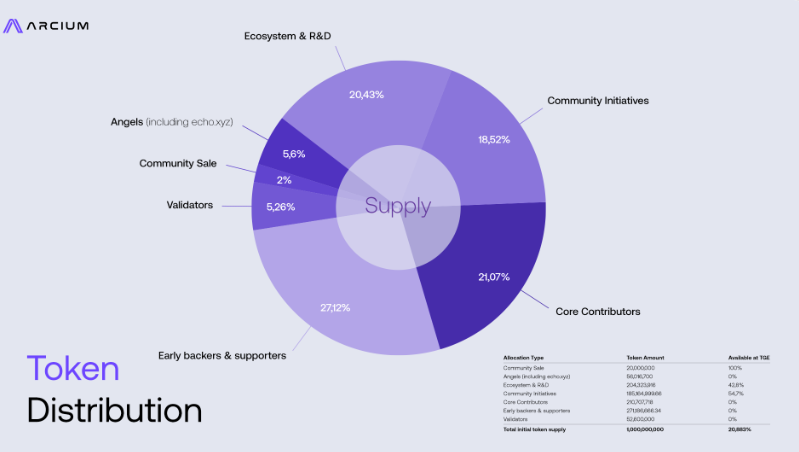
A cliff is a waiting period before releases begin. Vesting is the schedule that releases tokens afterward.
Market cap uses circulating supply. FDV, or fully diluted valuation, uses all 1 billion tokens.
What Is the ARX Token Unlock Schedule?
The token launched on June 22, 2026. Counting from that date, the 12-month cliffs for investor, contributor, and validator pools end around June 2027.
Estimated full unlock dates, calculated from launch:
Angels: around December 2028
Early Backers and Validators: around June 2029
Core Contributors: around September 2029
Ecosystem and Community: around December 2030
So what happens when the first big cliff ends? That's the date worth marking.
What Applications Use Arcium Today?
Umbra offers shielded transfers and encrypted swaps. ZINC is another live app, reported among the top Solana apps by fee revenue.
Arcium announced on June 9, 2026, that the mainnet had passed 1 million confidential computations. One report counted 801,863 of them from ZINC alone. That's strong activity. But it's also concentrated in one app.
Mid-2026 coverage counted 12 apps live or in development. Confidential token transfers use C-SPL, the project's private token standard.
What Does the Data Say About Arcium ARX?
Verified facts. The official pages confirm the fixed supply, fee split, staking role, vesting terms, and contract addresses.
Market data. ARX hit an all-time high near $0.47 on June 22, 2026. A low near $0.10 followed on August 17. Fresh price and supply data should be checked before any decision.
Editorial view. The product evidence is stronger than the token evidence. A mainnet milestone report shows real usage.
But fees are paid in SOL, so ARX demand mostly depends on staking and delegation. And about 79% of supply is still locked. That sounds harsh. Then again, usage is real, and token demand is a separate question.
What Are the Main Risks and Limits of the Arcium Network?
Security evidence: no independent audit report was found during research. Readers should check the docs and GitHub.
Node concentration: a report counted only 14 nodes at the mainnet launch. Fewer operators weaken the privacy promise.
App concentration: one app drove most early computations.
Unlock supply: large cliffs arrive from mid-2027.
Slashing and market risk: delegated ARX can be lost, and prices swing hard.
Competition: other privacy tools chase the same developers.
An audit isn't a guarantee of safety, and a missing one isn't proof of failure.
Conclusion: What Should Readers Take From Arcium ARX?
Arcium ARX pairs a working confidential computing network with a token built for staking and governance. Mainnet has been live since February 2, 2026, and activity passed 1 million computations by June 9, 2026.
But the token story is less settled. Fees are paid in SOL, about 79% of supply was locked at launch, and the first big cliffs end around June 2027. No independent audit report was found either.
Readers should check the official tokenomics page, the live explorer, and the unlock dates before forming a view.
Disclaimer
This article is for informational purposes only and isn't financial advice. Crypto assets carry high risk, and prices can fall sharply. Readers should research independently before making any decision.