What Is Bittensor? TAO, Subnets, and the Upbit Effect

Why Is Bittensor (TAO) Getting Attention?
What Is Bittensor is a question that keeps popping up in crypto searches. The short answer: it's a decentralized network that pays people in its own token, $TAO, for useful digital work like AI services. No single company owns the machines, the models, or the rewards. That's what makes it stand out.
$TAO also stays in the news because of exchange activity. Traders talk about an "Upbit Effect," meaning a jump in volume and interest after a listing on South Korea's biggest exchange. This crypto market update covers $TAO, subnets, and the wider Bittensor ecosystem as of November 17, 2026. Figures may change.
What Is Bittensor and How Does It Work?
Bittensor is a blockchain called the Subtensor Chain. It keeps track of useful work done off the chain and pays for it. Per the official documentation, a new block arrives every 12 seconds. Each block records who took part and how much $TAO they earned.
Anyone can offer computing power, trained AI models, data, or storage. Other participants rate that work. Better results earn more TAO. Rewards from the blockchain replace contracts and a pricing team, which fits Bittensor's goal of open markets for digital commodities.
Main features of the network:
A substrate-based chain with a new block every 12 seconds
Rewards paid in $TAO for useful, measured work
Separate markets called subnets, each built around one service
Open entry for miners, validators, and stakers
Bittensor decentralized machine learning is a simple way to describe it. Models compete for rewards instead of sitting inside one lab.
What Are Bittensor Subnets and Why Do They Matter?
A Bittensor subnet is its own small market. Each one has an owner, miners, and validators, and the official documentation gives every subnet a number. The owner picks the task and sets the scoring rules that decide who gets paid.
Miners do the actual work, such as AI inference, model training, storage, or computing. Validators score them. At the end of each cycle, a system called Yuma Consensus mixes those scores, weighted by validator stake, to set each person's share of rewards.
Competition is built in. A default subnet has room for 256 participants, so a new miner can replace the weakest one. And rewards follow measured performance, not reputation.
Variety helps too. One subnet may focus on text generation while another handles storage. The network doesn't rely on a single use case. That spreads risk, since one weak market doesn't sink the rest.
What Is the TAO Token, and What Is Its Utility?
TAO is Bittensor's native cryptocurrency, and the TAO token utility covers three jobs. It pays contributors. It can be staked to back validators and subnets. And it works as the base currency for every subnet token. Since February 14, 2025, each subnet has had its own token, called alpha, which trades against TAO in a liquidity pool.
Staking TAO into a subnet swaps it into that subnet's alpha at the pool price. More TAO flowing in usually means a bigger share of emissions and the new tokens released as rewards. Stakers, in effect, vote with their money on which subnets deserve resources.
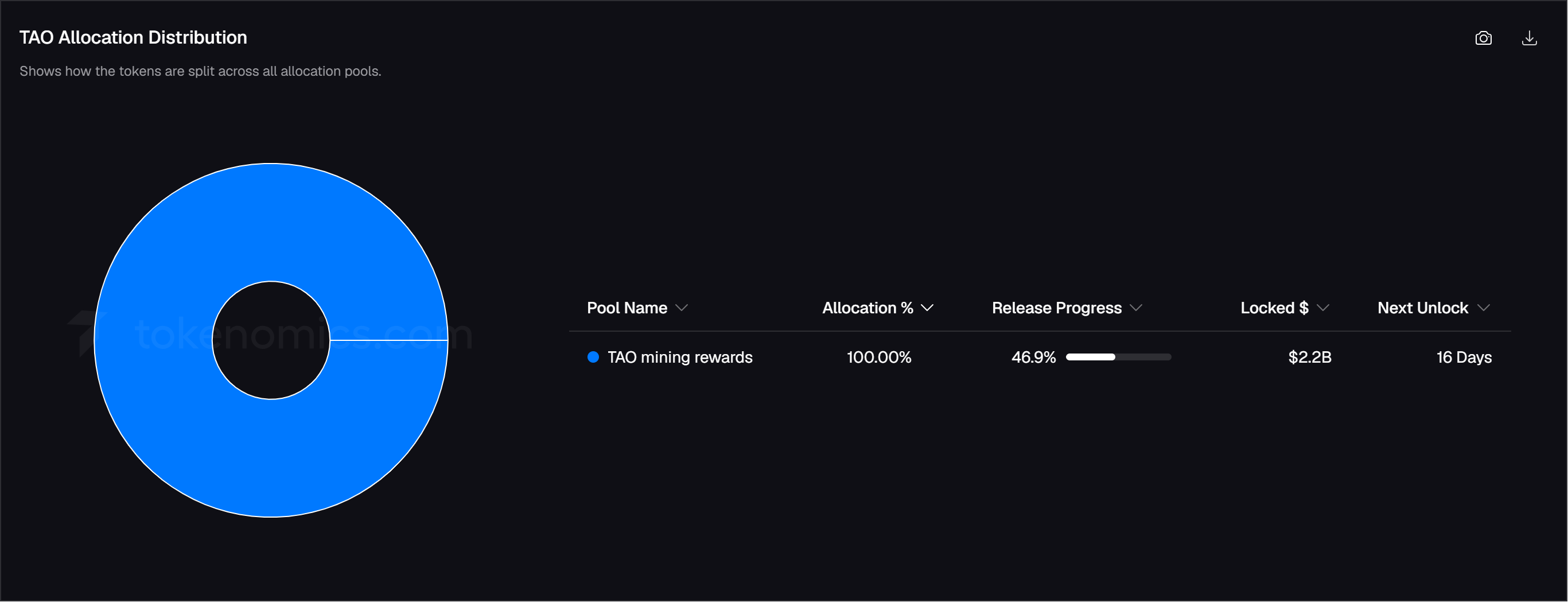
Bittensor tokenomics follow a Bitcoin-style plan. Maximum supply is 21 million TAO. A public tokenomics tracker lists all of it as mining rewards with no ICO, and it showed release progress of 46.9% when checked for this article.
The first halving happened on December 14, 2025. Daily issuance fell from 7,200 to 3,600 TAO. The next halving is projected for around 2029.
What Is the Upbit Effect on Bittensor (TAO)?
What is Bittensor’s relationship with Upbit? The term "upbit effect" refers to a surge in trading volume and prices following a token listing, as demand in Korean won is expected to be strong. Upbit listed TAO on February 16, 2026, and included trading pairs in KRW, BTC, and USDT.
Reports tied a Bittensor TAO price surge to the listing, with the token near $189 at the time. A listing widens access and liquidity. But Korean demand can fade fast too.
Did the listing create that demand, or did it just meet demand already there?
The careful answer is correlation. A price move after a listing doesn't prove the listing caused it. Rising interest in decentralized AI, subnet growth, and the wider market may all have played a part.
How Does Bittensor Compare With Traditional AI Crypto Projects?
What is Bittensor next to centralized AI platforms? Those platforms run on hardware the company owns. Bittensor lets independent participants compete in open markets and pays for measured results. That can attract specialist teams that a single company might never hire.
Openness and variety are the strengths. The limits are just as real. Output quality is hard to measure, emissions follow capital as well as usefulness, and many subnets still earn little outside revenue.
One documented case involved subnet 28, which drew extra emissions through concentrated stake rather than strong AI output.
What Are the Main Risks of Investing in TAO?
What is the most apparent disadvantage of Bittensor? The list of possible weaknesses includes
The pricing fluctuation and speculative trading expectations, in accordance with the news about exchanges.
Unpredicted and uncertain subnet operations and rewards because earnings depend on rankings.
Competition from other decentralized AI projects and from large organizations.
Emission and supply risks, including the concentration of staking and unlock timing.
Regulatory and exchange uncertainty because of the rapid changes of listing rules.
A listing can be either limited or canceled, negatively impacting liquidity. Therefore, it makes perfect sense to verify the facts in the official whitepaper and the official documentation of the project first.
What Could Influence Bittensor's Future Growth?
Different variables may play a role in determining what will be next for Bittensor:
Rising demand for decentralized AI
More new subnets, greater reach
More attractive network rewards
Institutional and exchange interest
Actual demand for subnet capabilities
The most telling sign will come from paying customers. Emissions can reward activity, but only outside demand proves a subnet offers something people want. Progress will take time, and results may vary by subnet.
Conclusion: Is Bittensor More Than an AI Crypto Trend?
What Is Bittensor, in short? A blockchain platform that compensates independent teams in exchange for their production of AI and other digital services, with payments made via TAO in the form of subnets.
With TAO's fixed supply and halving process, it has been given a useful economic function. More important than the promotional excitement around the token on exchanges is the fact that subnets are already gaining traction.
Also, the Upbit Effect is merely a correlation and not evidence of the sustained interest in TAO. Thus there are both chances and risks involved.
Disclaimer
This article is for informational purposes only and is not financial advice. Crypto assets are volatile and carry a high risk of loss, so readers should research independently and consult a licensed advisor before making decisions.