What Is the Dollar Index (DXY) and Which Currencies Does It Track?


What Is the Dollar Index (DXY) and Which Currencies Does It Track?
The dollar gained. On the same day, crypto fell.
Most market reports now name the dollar index (DXY) somewhere. Few explain it. Traders check what is the dollar index before judging Bitcoin's next move, so let's start there.
Here's the twist for Indian readers. Your rupee price of BTC feels the dollar in two ways. The index covers one. The rupee covers the other.
What is the dollar index (DXY), and which currencies does it track?
So, what is the dollar index? It measures the US dollar against a basket of six major currencies. ICE (Intercontinental Exchange) runs it. A rising DXY means the dollar is gaining on those six. A falling one means it's losing ground.
The euro has the biggest weight by far. Per ICE's index data page, the mix changed only once, in January 1999, when the euro launched. The old European currencies' share stayed fixed at 57.6%. That makes the DXY a euro story at heart. When the euro slips, the index typically climbs.
Currency | Weight |
Euro | 57.6% |
Japanese yen | 13.6% |
British pound | 11.9% |
Canadian dollar | 9.1% |
Swedish krona | 4.2% |
Swiss franc | 3.6% |
Source: ICE methodology; euro-area share checked on ICE's page, 13 November 2026.
The rupee isn't in the basket. Neither is any crypto. So the dollar index can't see your rupee price.
Why does a strong dollar pressure Bitcoin and other altcoins?
Three channels do most of the work: liquidity, interest rates, and risk appetite. Our Bitcoin crash reasons guide lists rate moves and Fed minutes among the pressures in an October sell-off.
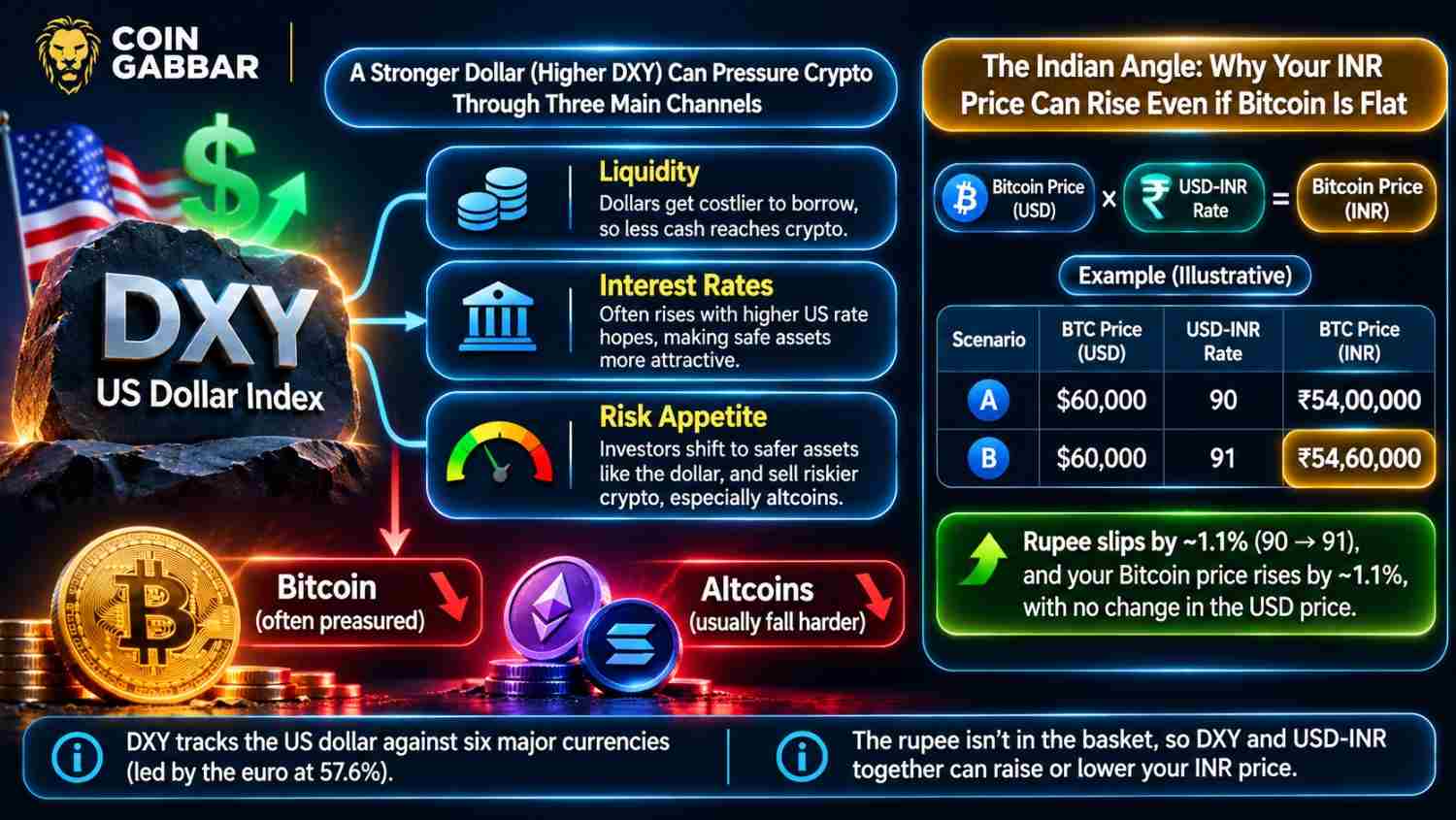
Liquidity first. A big share of global debt is in dollars. When the dollar rises, dollars get costlier to borrow. Less spare cash reaches risky assets like crypto.
Rates next. A strong dollar often goes with higher US rate hopes. Safe assets then pay more. Bitcoin pays nothing, so it looks less tempting.
Then mood. When investors want safety, they buy dollars and sell risk. Altcoins (coins other than Bitcoin) usually fall harder because they're thinner and riskier.
Leverage adds fuel. CoinGabbar's Rektober 2026 liquidation report shows how fast forced selling spreads. Anyone asking what is the dollar index should also ask what it does to borrowing costs.
Is the DXY and BTC link always negative in every market?
No. It's a tendency, not a law. CME Group research, published 12 February 2026, found crypto had a negative link with the dollar in 2022 and 2023, at times near -0.4. By 2025 and early 2026, it had weakened toward zero.
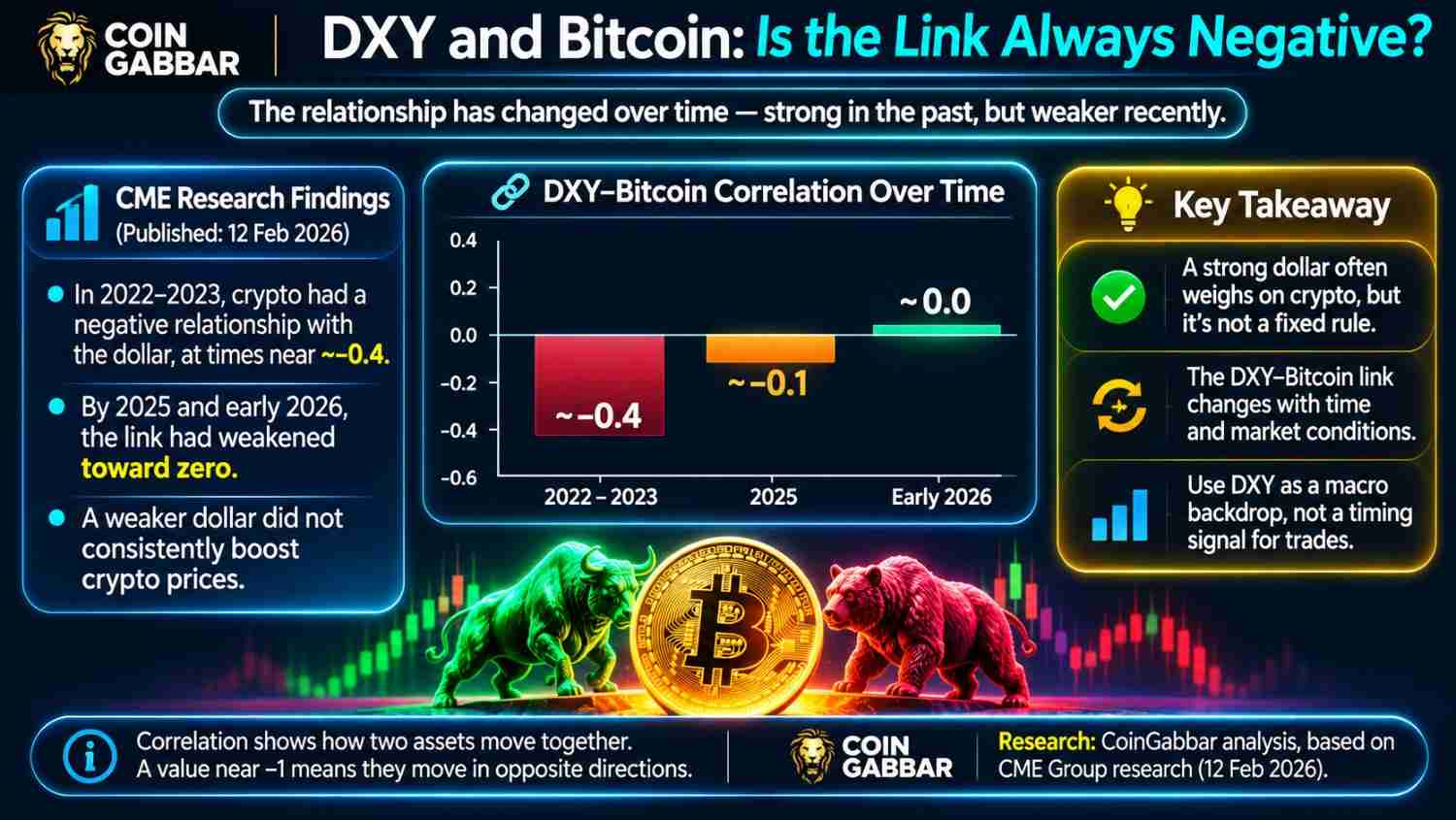
In 2022 and 2023 the link was inverted. By 2025 it had faded. CME measured the dollar its own way, so treat the match with the DXY as close, not exact. Its report also found that a weaker dollar failed to boost crypto prices.
So a falling dollar index isn't a buy signal either. A weak dollar and a weak coin can happen together. Long slumps are nothing new, as our guide to Bitcoin bear market recovery cycles show. Even a clear answer to what the dollar index is can't call the next candle.
How does the dollar index affect Indian crypto buyers and the rupee?
Indian buyers pay in rupees, so what is the dollar index tells only half the story. Two prices matter: Bitcoin in dollars and the dollar-to-rupee (USD-INR) rate.
Roughly, the rupee price is the dollar price times the USD-INR rate.
Take round, made-up numbers. Bitcoin at $60,000 and USD-INR at 90 gives about ₹54,00,000. If the rupee slips to 91 and Bitcoin stays flat, that becomes ₹5,460,000. It's about 1.1% more, with no Bitcoin move at all.
Why Has the Rupee Been Weak, and Does the RBI Set the DXY?
The rupee has been weak. Reports put its record low between 96.90 and 96.96 per dollar on 20 May 2026. Business Today said it had slid about 11% in a year, blaming costly oil, strong dollar demand, and cautious foreign investors.
The RBI (Reserve Bank of India) doesn't set the DXY. Its governor said in December 2025 that it doesn't target any specific rupee level and steps in only to curb excessive volatility.
A firm dollar index and a weak rupee can stack up. Each one adds to your rupee price. Knowing what the dollar index is won't shrink the rupee's swings. Gains in rupees also carry tax, which our India crypto handbook 2026 covers.
How can traders track the dollar index alongside crypto charts?
Yahoo Finance's DXY page lists the index under the ticker DX-Y.NYB. The page displays the live level and the 52-week range.
On TradingView, search DXY. Then open a Bitcoin pair priced in dollars in a second pane. Use the same time frame on both. Check the time stamp before you compare.
Mark the 52-week high and low as reference levels. Add dates too. Watch US inflation data and the Fed's December meeting on 8 and 9 December. The rate decision lands on 9 December.
Levels are guides, not signals. A move through one doesn't tell you what Bitcoin does next. Check both charts before you act, and practice on live charts before you learn what the dollar index is the hard way.
Expert Opinion: How Reliable Is the DXY as a Bitcoin Signal?
CoinGabbar analysis suggests the dollar index is a useful macro gauge. But the link shifts over time, and it is not a timing tool.
Use it as one input. Set it beside rates, exchange-traded fund (ETF) flows, and liquidation data.
The safest read is a backdrop. It tells you the weather, not the hour a storm lands. Knowing what is the dollar index is step one, and judgment is step two.
What is the main takeaway on the DXY and Bitcoin link?
Rates drive both the dollar and Bitcoin. That's why they often move in opposite ways and why they sometimes don't.
For Indian buyers, the rupee adds a second layer. Watch the Fed's December decision on 9 December.
Treat each DXY move as context, and check what Bitcoin does around it. If you remember one thing about what the dollar index is, make it this: it's a backdrop, not a trigger.
Disclaimer: This article is for information only. It isn't financial advice. Crypto is volatile and carries risk. Prices can fall fast. Nothing here is promised or assured. Check sources before you trade, and ask a licensed adviser about your own case.
















