Synergy Network Review: Is This Crypto Project Worth Watching

What Is Synergy Network and Why Is It Getting Attention
Synergy Network is a Layer-1 blockchain that says it’s built to survive quantum computers. Layer-1 simply means it runs its own base network instead of sitting on top of another chain.
Its SNRG token sale has been popping up in crypto news lately, which is why so many readers are searching for it.
Most of them ask the same things. What does this crypto project do, how does the token work, and does the plan hold up? This guide answers those using official project material checked on 22 October 2026.
What Is a Synergy Network and Why Does It Matter?
Synergy Network is built by Synergy Blockchain Labs, Inc. The team describes it as a quantum-resistant network with cross-chain tools built in. The idea is easy to follow. Quantum computers might one day crack the codes that protect most blockchains, so the project wants a chain designed for that risk from the start.
Turns out, that’s a small niche. But it’s a real one, and older chains weren’t made with it in mind.
How Does Synergy Network Work?
Here’s the thing: the design has a lot of moving parts. Consensus is the way a network’s computers agree on which transactions are real, and the project’s version is called Proof of Synergy, or PoSy. The team says it rewards validators for working together. Validators are the computers that confirm transactions.
Main features, per the project:
ETDAG: puts transactions in order and, according to the project, lets many run in parallel
Aegis: a security engine built for post-quantum threats, covering transactions, messaging, and storage
SynQ and AIVM: a toolkit for writing smart contracts and the engine meant to run them
Relay Protocol: a tool for moving assets between different blockchains without middlemen
Atlas, Forge, and Synergy Wallet: the explorer, the developer tools, and the wallet
The developer portal still marks Testnet v3 as prelaunch, and it says the full path from contract to final confirmation isn’t proven yet.
What Is the SNRG Token Used For?
SNRG is the native token. Total supply is fixed at 12,000,000,000. The project says it pays for staking rewards computers that finish tasks, settles transactions, powers governance votes, and feeds a fee-burn system that takes tokens out of circulation.
But uses on paper aren’t the same as demand in real life. Presale buyers get claim vouchers, and the project says each one swaps 1:1 for mainnet SNRG at launch. Until the mainnet goes live, those uses are just plans.
How Is the Synergy Network Token Supply Split?
Allocation | Share | SNRG Amount |
Validators, Staking, and Network Security | 22.00% | 2,640,000,000 |
Token Sales | 18.67% | 2,240,000,000 |
Ecosystem and Developer Incentives | 13.00% | 1,560,000,000 |
Liquidity and Market Infrastructure | 12.00% | 1,440,000,000 |
Marketing and Growth | 10.50% | 1,260,000,000 |
Strategic Partnerships and Integrations | 7.45% | 894,000,000 |
DAO and Governance Reserve | 6.00% | 720,000,000 |
Foundation and Treasury | 6.00% | 720,000,000 |
Team and Support | 4.38% | 526,000,000 |
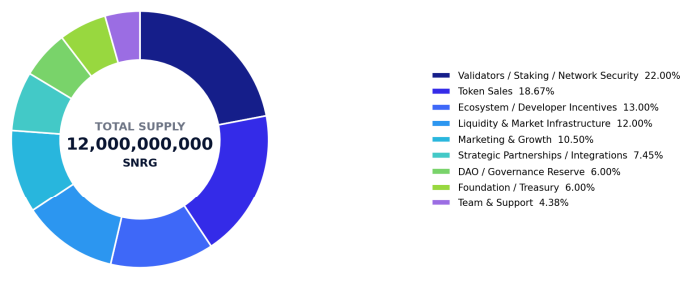
Validators and network security get the biggest slice at 22%. Token sales come next at 18.67%. The team and support share is only 4.38%, which is small next to the buckets meant for the community.
Vesting is the schedule that decides when locked tokens can be sold. Public vesting details turned up only for the team share, so nobody can say yet when the rest unlocks. And that matters, because a sudden unlock can push a token’s price down.
One more thing needs clearing up. Multiply 12 billion tokens by the $0.0038 presale price, and the result is about $45.6 million. That’s the fully diluted valuation (FDV), meaning the value of every token, even ones not released yet. It isn’t the market cap.
What Does the Synergy Network Presale Show Right Now?
The presale runs on the project’s own website and has 15 stages. Stage 1 costs $0.0038 per SNRG and holds 280,000,000 tokens. As of 17 October 2026, 2.43% of that stage was sold.
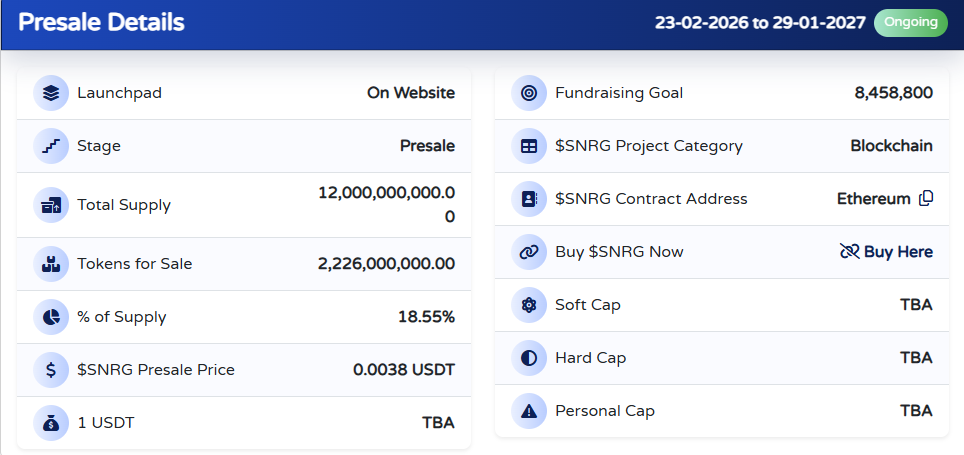
No mainnet date, crypto listing, or post-presale price is confirmed. No crypto airdrop has been announced either, in the sources checked. And the crypto price of $0.0038 is a presale price, not a market price, because SNRG doesn’t trade anywhere yet.
Anyone following crypto news on this should check every number against the official presale page.
What Is the Synergy Network Roadmap, Step by Step?
The roadmap follows a familiar order. Every date below is an earlier target, not a promise.
Devnet and presale start (target 1 December 2025): The presale is live.
Public testnet (target 1 February 2026): Testnet v3 is running, and the project says its wallet works there.
Mainnet beta (target 1 July 2026): The date passed, and project updates still call it preparation.
DEX and exchange phases (target August to December 2026): No confirmed dates yet.
Full mainnet (target 1 January 2027): No confirmed date either.
Public testing is the one big stage that’s clearly done. That’s real progress. But a working testnet doesn’t guarantee a smooth mainnet.
What Risks Should Readers Weigh Before Following This Project?
Schedule slips: The mainnet beta missed its target, so later dates could move too
Dependencies: The mainnet needs PoSy, validator clusters, and Aegis and AIVM to all work together
Voucher risk: Presale vouchers only pay off if the mainnet actually launches
Missing details: Vesting for most allocations and audit status weren’t confirmed
Price confusion: A presale price isn’t a future market price
Competition: Other Layer-1 networks also chase security and cross-chain use
An audit isn’t a safety guarantee. And a partnership announcement doesn’t guarantee anyone will use the product.
What Does the Data Say About Synergy Network?
The stronger signal is the allocation. A 22% share for security and a 4.38% team share point to a design that favors running the network over rewarding insiders. Then again, a big staking pool means little before validators exist.
The main worry is delivery. A missed mainnet beta date is a red flag for now, and the setup leans cautious until the full system runs in public. So what happens if the next target slips too?
Conclusion
Synergy Network wants to build a quantum-resistant Layer-1 with cross-chain tools and the SNRG token. The fixed supply and working testnet stand out.
Until delivery catches up with the whitepaper, the project is still more promise than proof. Mainnet timing, vesting details, audits, and listing plans remain unconfirmed, and those are next things worth checking.
Readers should check the presale page, roadmap, whitepaper, and explorer themselves before trusting any figure.
Disclaimer
This article is for information only and isn’t financial advice. Crypto assets, especially presale tokens, carry high risk, and outcomes aren’t guaranteed. Readers should research independently before making any decision.