What Is XE Network? Features, Use Cases and Testnet Explained


How Does XE Network Support AI Agents and Machine Payments?
Most blockchains were built for people. XE was built for software, such as AI agents. On October 23, 2026, the project posted on X that its testnet is live and open to anyone. This guide covers the basics and the update. It uses only the official website and that post. Anything the project has not shared is marked as unknown.
Key Takeaways
XE is described as a network where machines hold their own accounts, pay each other and talk directly.
The website lists five building blocks: identity, discovery, payment, compute and messaging.
The testnet is live, but the website still says full details will be revealed soon.
XE Network Explained for Beginners
Software agents are starting to handle money and work. The website points to a gap. The systems they run on were built for a person with a card, a bank account and a signature. Each action waits for a human to approve it. The site calls this setup the machine economy.
XE aims to remove that wait. Every machine gets its own account, a way to find other machines and a way to pay at machine speed. The site sums it up as no card, no bank and no human in the loop.
Source: official website.
Today | On XE |
Cloud needs a card and a signature | Every machine has its own account |
Payments go through a bank | Pays per second, settled in under a second |
Agents run until a person turns them off | Finds capacity and talks to other machines |
Compute, identity and messaging sit in separate stacks | All five primitives in one network |
What Is an Agent-Native Network?
An agent is a program that acts on its own. An agent-native network treats that program as the main user, not as a guest. The website calls XE the world’s first agent-native network, built for trusted autonomous execution. That is the project’s own description. It has not been checked by an outside party.
How Does XE Network Work?
Most networks put every transaction in one shared line. Each one waits for the next block, and fees climb as people bid for a place. The website says this makes micro-payments hard.
XE takes another route. Each account settles on its own chain, in parallel. The site says that takes 300 milliseconds and costs nothing, and that capacity grows as more participants join.
Legacy networks | XE | |
Structure | One shared queue | Every wallet has its own chain |
Settlement | Next block | 300 ms, per the site |
Fees | Bidding for a place | None, per the site |
XE Network Five Primitives
The website says these five pieces are everything agents need. The picture below shows them side by side.
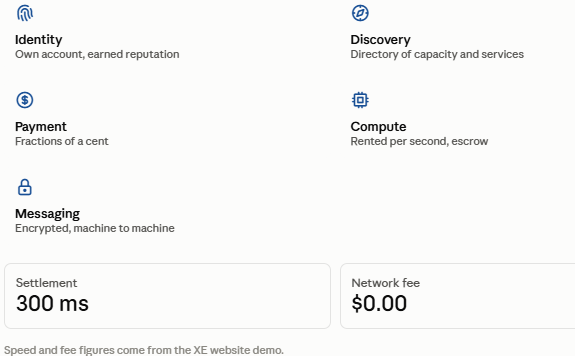
Discovery is the one piece without its own section below. It is a directory where machines find capacity and agents find services.
XE Network Identity and Payments for AI Agents
Each machine gets its own account and history. Reputation is earned by work. The site says there is no signup and no KYC.
Payments run in fractions of a cent. One example on the site shows an agent paying $0.0002 per call to an inference API.
XE Network Zero Fee Payments
Every account has its own chain, so there is no queue and no fee auction. The site’s demo shows a network fee of $0.00 and final settlement in 300 ms. Both figures come from the site itself, not from an outside test.
XE Network Compute Rental per Second
Machines can be rented for seconds or months. Payment goes into escrow per second. It is released when the work is done. The site’s demo shows a 24 GB GPU in São Paulo rented this way.
XE Network Machine to Machine Messaging
Messages between machines are encrypted. The site says nothing sits in the middle, which means no platform between the two accounts. The X post adds that accounts can message each other peer to peer.
Who Can Use XE?
Group | What the site says they can do |
Builders | Write contracts for jobs like RPC and monitoring, publish images, run private nets, list GPUs |
Agents | Prove identity, find services, pay per call, rent compute, message other machines |
Node operators | Install the software, pick jobs and get paid in new XE when each job finishes |
Node operators are paid per second into escrow. If a job fails, no payment is made. The site adds that nothing has to be bought first.
Four Ways to Build on XE
Product | What it is |
XE Machines | A whole CPU or GPU machine with root access, paid by the second |
XE Contracts | A job defined in code, with the pay set, which operators opt into |
XE Images (Beta) | Ready-made setups launched in one click |
XE Nets (Beta) | A private version of the network on a user’s own machines |
A Real Example: Edge Network
The website presents Edge Network as a decentralized cloud built on XE. It lists more than 3,000 paying customers and more than 5,000 independent machines in 988 locations. Its products include CDN, compute, storage, DNS and Shield. These numbers are self-reported, so they show what the project claims rather than what an outside audit found. The case study is the only live product the site details at length.
XE Network Testnet Explained
XE’s testnet is a test version of the network, where people can try its features first-hand. According to the official X Account post, it is now live. It went up on October 23, 2026, and anyone can use it. The post says it is built for machines and lists four things users can do:
Give an agent its own wallet.
Send XE in seconds with zero fees.
Message other accounts peer to peer.
Watch every action on the explorer.
How to Create an XE Identity and Wallet on the Testnet
The official X Account post shows the first step. Based on it, the flow looks like this:
Open the testnet from an official XE link.
Choose to create an XE identity and wallet.
Save the 24-word phrase. The video says to keep it offline.
Finish creating the wallet.
XE Network Testnet Wallet Setup: What to Check First
The 24-word phrase controls the wallet, so it should never be shared. Losing it can mean losing access.
Check the link too. The post names xe.network. The Testnet button on the homepage points to test.network. Readers should confirm the right address on the official X account, @xeinternet, before creating anything.
Final Thoughts
XE is an early project with a clear idea: give machines their own accounts, payments and messages. The testnet lets anyone try that idea today. A beginner can start with the five primitives, then try the testnet and watch the explorer. Until more details arrive, the project is best read as a work in progress.
Disclaimer: This article is for information only and is not financial advice. Crypto participation involves risk.