Wire Network Overview: Key Features, Roadmap and WIRE Token TGE

How Is Wire Network Building a Connected Blockchain Ecosystem?
Moving crypto between blockchains is still messy. Wallets differ, addresses differ and bridges can fail. Wire Network says it can fix that with one shared layer for all of them. This guide covers what Wire Network is, how it works and who is behind it, and it includes the latest TGE update. It uses official documentation and project announcements.
Key Takeaways
Wire Network is building a Universal Transaction Layer that lets assets and wallets from different chains use smart contracts in one place.
Its documentation says transactions are not subject to protocol gas fees.
The WIRE TGE moved from 27 October to the second half of November, and the team says it is a strategic decision, not a technical delay.
What Is Wire Network?
Wire Network calls itself the first Universal Transaction Layer, or UTL. In its own words, it lets all crypto assets and wallets interact with smart contracts on a single blockchain.
It is a blockchain project and has no link to the messaging app of the same name. It combines a high-performance Layer 1 chain, a name service and a new address protocol. That is the short answer to what Wire Network is and how it works, and the next sections explain each part.
Source: official website.
Why Wire Network Matters: The Problem It Targets
Web3 is split into separate chains. A user on Ethereum cannot simply act on Solana without extra steps, and the usual fix is a bridge, which moves tokens between chains.
Problem | Wire Network’s approach |
Many chains, many wallets | One layer that works with existing wallets |
Bridges move assets and can fail | Assets stay put, only ownership moves |
Long, confusing addresses | Human-readable names |
Gas fees on each chain | No protocol gas fees, per the documentation |
Wire Network Explained: How the UTL Works
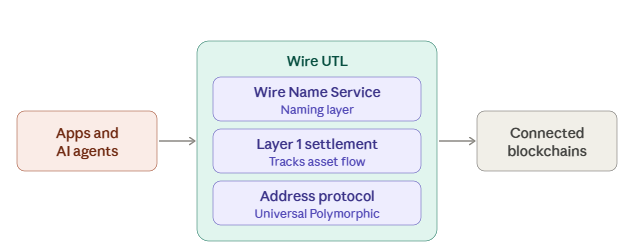
A research explainer describes the UTL as having three core parts.
The first is the Universal Polymorphic Address Protocol (UPAP). It derives a Wire address from a user’s existing wallet, such as an Ethereum or Solana keypair. So a user does not need to create a new wallet to use Wire apps.
The second is the Settlement Layer, the base chain where the system moves ownership rights at speed. The third is the name service, which turns external addresses into readable names.
The project also lists a Universal Wallet and Crypto Single Sign-On, which are meant to make Web3 access simpler.
How Ownership Moves Without Bridges
Wire’s idea is that interoperability should come from making ownership portable, and not from moving assets around.
User’s existing wallet → UPAP derives a Wire address → Ownership rights swap on the Settlement Layer → Assets stay locked on their native chain
Because the assets never leave their home chain, the explainer says Wire avoids breaking each chain’s own consensus. That removes the main weak point of bridges.
Wire Network Gas-Free Transactions Explained
The official documentation states that in the UTL, transactions are not subject to protocol gas fees. Gas is the fee users normally pay to a network for processing a transaction.
This is the project’s claim, and its documentation is where to read how it works. Gas-free at the protocol level does not mean every service on top will be free, so users should check each app’s terms.
Design Rules Behind Wire Network
Wire’s documentation sets out several rules for builders.
The system should be secure and decentralized, in the way Bitcoin is.
It must always have a path to scale for more users.
All apps on the network must be non-custodial, so users keep control of their funds.
All apps must use the UTXO model, which treats each transaction as a clear, checkable record.
The non-custodial rule matters most for everyday users. It means apps built on Wire are not allowed to hold user funds.
Wire Network for AI Agents
The project aims at more than human users. Its press material says the UTL is built for the decentralized AI economy. The CEO describes it as a “financial control plane” for the autonomous economy.
In simple terms, AI agents may one day need to move value across chains on their own. Wire says it offers explicit outcomes and recovery-aware reliability, so machines can use it safely. This is a stated goal and not yet a proven use.
Who Is Behind Wire Network
Person | Role |
Ken DiCross | Co-founder and CEO |
Jaime Rogozinski | Chief Strategy Officer, founder of WallStreetBets |
Nick Greenawalt | Chief Marketing Officer |
Gavin Gillas | Head of Strategic Partnerships |
The names come from the project’s press releases. For people who want to check them, the CEO also keeps a public bio and social profiles.
The WIRE Token
WIRE is the token tied to the network. The project’s recent post calls its launch “one of the most important milestones in our history.”
Details such as total supply, allocation and use cases were not in the sources reviewed. Readers should check the official channels for the current token details.
WIRE Token Generation Event: What It Means
A token generation event, or TGE, is the moment a token is first created and released. For many projects it marks the start of trading and distribution.
Wire Network TGE Update: Why the Launch Moved
Wire’s team has changed the date. The WIRE token generation event will now take place in the second half of November, and not on 27 October.

The team gives these reasons:
It is finalizing relationships with top-tier exchanges, market makers and strategic partners, and arranging liquidity for the launch.
Key ecosystem partners asked for more time to prepare their integrations.
The post is clear on one point: this is not a technical delay. It is a strategic decision to bring the right partners, infrastructure and liquidity together. The team also promises more announcements about financing, ecosystem partnerships and the teams helping bring Wire to market.
No exact date has been given, so readers should treat the timeline as open. The project says it has spent nearly six years in development.
What to Keep in Mind
Most claims here, including gas-free transactions and bridge-free swaps, come from the project’s own documents.
The TGE has no confirmed date beyond the second half of November.
The post names no exchanges, so any listing claim from other sources should be treated as unverified.
Official channels are the only place to confirm token details and launch news.
Conclusion
Wire Network aims to make Web3 feel like one system, with existing wallets, readable names and ownership swaps in place of bridges. Its design rules, such as non-custodial apps and no protocol gas fees, are clear on paper.
The proof will come after launch. The TGE is now set for the second half of November, with no fixed date, so readers should follow the official announcements and judge Wire Network by what it delivers.
Disclaimer: This article is for information only and is not financial, investment, or legal advice. Facts come from Wire Network’s official documentation, announcements and public sources, as seen on the date of writing. Plans and dates may change. Crypto carries real risks, including loss of funds. Readers should do their own research before acting.
















