Zebra 7.1.0 Fixes 10 Security Advisories in Zcash Node Software


Zebra 7.1.0 Update: Who Must Upgrade and What to Know
The Zcash Foundation released Zebra 7.1.0 on November 16, 2026. This security update fixes ten advisories in its Zcash full node. Node operators, miners, and mining pools should upgrade now. Regular ZEC holders and wallet users have nothing to do, the foundation said.
Moving from 7.0.0 to Zebra 7.1.0 needs no resync or data migration, because both use the same state format, the GitHub release notes say. Operators on 6.x should read the 7.0.0 notes first, since that version changed the database format.
Who | Action |
Node operators, miners, pools | Upgrade now. |
Wallet, exchange, lightwalletd operators | Upgrade now. |
Rust library developers | Upgrade crates together. |
ZEC holders, wallet users | No action |
The foundation’s announcement post sorts the groups the same way.
Ten Advisories Target Sync Stalls, Memory and Mempool Work
For readers following Zcash security news, the ten fixes fall into three groups.
Group | Count | Ratings | Main effect |
Sync | 6 | 4 High, 2 Moderate | Stalled or restarted sync |
Memory | 2 | 2 High | Out-of-memory crashes |
Mempool | 2 | 2 Moderate | Wasted verification work |
Six cover sync. A peer, meaning another computer on the network, could stall a node that is catching up. In GHSA-m44m-9r8r-r64j, forged blocks halted initial sync at the switch from checkpoints to full validation. Zebra 7.1.0 now rejects them and bans the sender.
Two cover memory. Blocks packed with transparent outputs made every chain fork copy large indexes, so a node could crash again after each restart, according to GHSA-j8gf-c4rj-6jv5. Foundry Digital was credited with the report.
Many balance requests at once, sent directly or through lightwalletd, could also drain memory. The mempool, where unconfirmed transactions wait, also ran costly checks before cheap ones. It now runs the cheap ones first. None of the ten advisories affects consensus rules or directly puts user funds at risk, the release notes say.
New Memory Cap Changes How Nodes Handle Dense Blocks
Zebra 7.1.0 keeps up to 1,000 recent blocks in memory so it can follow a chain reorganization, which is a switch to a competing branch. Their indexes are now capped at 6,200,000 entries on Mainnet and 2,000,000 on test networks. Normal blocks stay under the cap, the foundation said.
If very dense blocks do reach the cap, the node keeps at least 100 recent blocks. Until they are finalized, it cannot follow a deeper reorganization. The Foundation recommends at least 16 GB of RAM. The release notes put the cap at about 5 to 7 GB, with up to 4 GB more during initial sync.
Peer recovery now happens on its own. A node with no outbound peers retries its DNS seeders, which are servers that list peer addresses, and its saved peers, up to once every five minutes. It no longer waits for a restart. New metrics show why sync restarts or stalls.
Elasticsearch Removal and the December 10 Support Cutoff
The Elasticsearch feature is gone. A config that still lists elasticsearch_url or related keys under [state] will not load, so delete them first. Official builds never had the feature, the foundation said.
The support window is short. Zebra 7.1.0 is supported for 24 days instead of eight weeks, the release notes say. Warnings start about December 3, and the zebrad stops itself around December 10, 2026. Plan the next upgrade before then.
Rust developers face breaking changes. Nearly every library crate gets a new major version, so upgrade them together.
Release Arrives Ten Days After NU7 Went Live on Mainnet
The Zcash NU7 upgrade was activated on Mainnet on November 6 at height 3,543,405. Zebra 7.1.0 follows ten days later and makes no consensus changes.
The foundation’s engineering update thanked operators who upgraded to Zebra 7.0.0 in time.
This reads as hardening against bad peers, not a fix for anything that could alter balances. For crypto miners, the practical risk is uptime: a stalled or crashed node stops serving block templates, per the release notes.
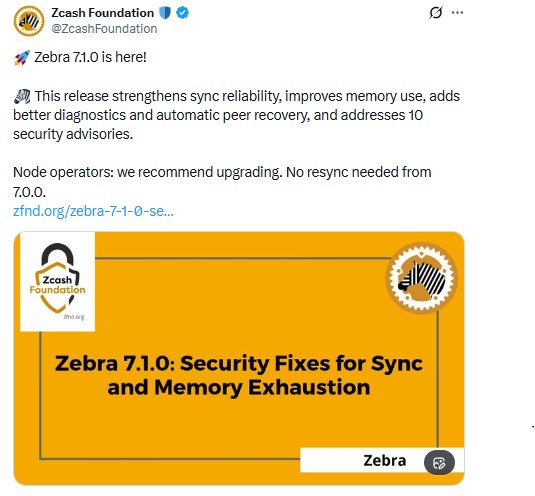
The foundation also announced the release on X, urging upgrades and noting no resync is needed from 7.0.0. Operators can confirm they run Zebra 7.1.0 before December 10.
Disclaimer: This article is for information only and is not financial advice. Crypto assets are volatile, so verify details with official sources before acting.






