Zenora Network Ecosystem: Wallet, DEX and dApps Explained

Zenora Network Ecosystem: How Its Wallet, DEX and dApps Connect
Most crypto projects introduce a token first and explain the technology later. Zenora Network took the opposite route. The community app came first, the chain follows, and the supporting tools arrive stage by stage.
This guide walks through the Zenora Network ecosystem one part at a time. It also keeps a clear line between what exists today and what is still a plan.
Key Takeaways
Zenora is an EVM compatible Layer-1 built with Polygon CDK, designed to work with existing Ethereum wallets and tools.
Only the community app and an early wallet are live today. The explorer, exchange, swaps and dApps are planned.
ZNR has a fixed supply of 1,000,000,000 tokens and five defined roles inside the network.
What Is Zenora Network?
Zenora Network is a Layer-1 blockchain built together with its community. Its official website describes a network that people can watch being built, from the first line of code to a live mainnet.
The whitepaper is a working draft, last revised in November 2026 (v1.2.0). It states plainly that no live chain, consensus or token exists yet.
Source: official website.
Why an EVM-Compatible Layer-1 Matters
Zenora runs the Ethereum Virtual Machine instead of inventing a new one. Developers can write contracts in Solidity or Vyper, and accounts follow the Ethereum format.
The chain itself is built with Polygon CDK, an open-source framework already used by production networks. This lets the team spend its energy on economics, security and community.
For everyday users, MetaMask compatibility is the practical gain. Zenora is meant to be added as a network, so no new wallet needs to be learned. Details such as the chain ID and RPC endpoint will be published with the public testnet.
What Is the Zenora Network Ecosystem?
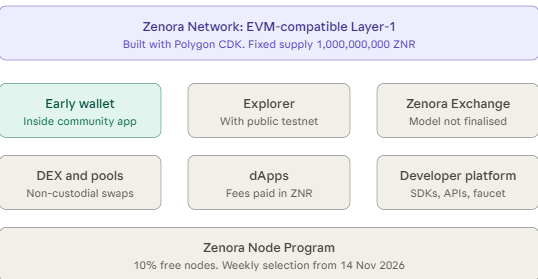
The ecosystem is the set of tools built around the chain: a wallet, an explorer, an exchange, swaps, apps and developer resources. The map below shows each piece and its current status.
The Core Building Blocks
Zenora Network Wallet
The planned wallet is self-custodial, which means users hold their own keys. An early version already sends, receives and tracks ZNR inside the community app. The full wallet will extend this to the live chain.
Zenora Network Explorer
An explorer lets anyone check a transaction without trusting a third party. The Zenora Network explorer is planned alongside the public testnet, the third roadmap stage.
Zenora Exchange
This is meant to be a first-party trading venue. Its exact model has not been decided. It also differs from third-party listings, where independent exchanges choose to list ZNR on their own.
Zenora DEX and Liquidity Pools
Swaps and pools will let people trade ZNR without a central venue. The liquidity allocation supports this. It makes up 7% of supply, or 70,000,000 ZNR, fully unlocked at token generation.
Zenora dApps and the Developer Platform
Zenora dApps will pay their fees in ZNR by default. Every app then shares one economic base instead of inventing its own fee token.
The Zenora developer platform is planned to include SDKs, APIs, documentation, smart contract tooling, grants, and a testnet with a faucet. Since the contract model is Ethereum’s, audited libraries such as OpenZeppelin can be deployed without changes.
Grants come from a dedicated pool. The ecosystem and grants allocation is 18% of supply, or 180,000,000 ZNR, vesting over 36 months.
How Will ZNR Be Used in the Zenora Ecosystem?
ZNR is the only token in the network. There is no separate gas, staking or governance token. The ZNR token utility covers five functions.
Role | How ZNR is used |
Gas fees | Pays for every transaction and contract call |
Staking | Validators bond ZNR to secure the network |
Governance | Stake-weighted votes on upgrades and treasury |
App premium tier | Optional upgrade inside the community app |
dApp fees | Default currency for apps built on Zenora |
The total supply is fixed at 1 billion ZNR, with no additional tokens minted after genesis. Validator rewards come from a pre-allocated pool instead of new issuance.
Community, ecosystem and staking together hold 58% of supply. The design aims to reward people who use and secure the network more than people who only hold the token.
Zenora Node Program
This is where the ecosystem reaches ordinary users. Ten percent of all nodes are free and go to active Zenora Miner users, on a server that Zenora provides. No hardware is needed. The total node supply has not been announced.
These nodes are not a token allocation. The 1 billion supply and its percentages stay unchanged.
Step | Detail |
Activity Level Points | Earned through mining sessions, tasks and genuine referrals |
Eligibility | 100 points, which does not guarantee a node |
Selection | From 14 November 2026, up to 200 people each week |
KYC window | 7 days to finish, or the place is lost |
Before mainnet, node holders get a mining boost of up to +100%, wallet-to-wallet transfers and first access to the mobile apps. After mainnet, planned benefits include validation rewards, a DePIN role, DAO voting, a special NFT and Web3 withdrawals.
One naming point deserves attention. Zenora Miner does not perform real mining. It is a contribution-tracking tool, and the mining section of the official site explains how it works.
Live Today or Still Planned?
Live today: the community app and its early wallet. Everything else in this guide is a design target.
The site also states that ZNR is not yet listed or tradable. No price, return or listing date is promised anywhere.
Final Thoughts
The Zenora Network ecosystem follows a deliberate order: community first, then protocol, testnet and mainnet. The roadmap shows status instead of fixed dates, which keeps progress easy to verify.
Readers who want the full technical detail can start with the whitepaper. Every “will” in it describes a plan, not a promise.
Disclaimer: This article is for information only. It is based on the Zenora Network whitepaper and the official website, both of which can change. Features described here are planned design targets, not guarantees. Please read the official whitepaper and conduct your own research before making any decisions.
















