SEC Crypto News: 3 New Answers Could Change How DeFi Tokens Vote


SEC Crypto News: Can Voting Alone Centralize a Network?
As of November 3, 2026, SEC crypto news today is about control, not ballots. SEC Corporation Finance staff updated their official FAQ page on November 2, 2026, adding answers on governance and decentralization.
The update expands the SEC interpretive release and tests how the SEC central party test applies to DeFi regulation.
SEC Crypto FAQs Corporation Finance Explained
The page calls its answers SEC staff guidance, not a rule, with no legal force. This SEC crypto news still shows how staff read the March framework.
Date | Event |
March 17, 2026 | Interpretive release issued |
September 25, 2026 | FAQ page first issued |
November 2, 2026 | Governance entries added |
SEC New Crypto Guidance Explained: What Are the Three Points?
AshCrypto also covered this SEC crypto news in its tweet on X, summing up the SEC DeFi guidance token holder voting position in three points.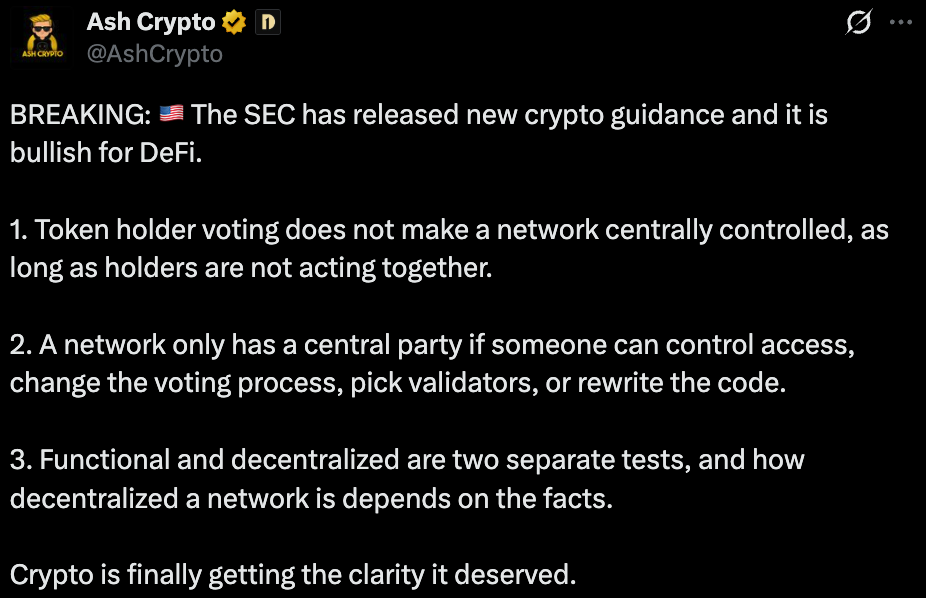
Holder votes alone do not create central control, if holders do not act together.
A central party exists when someone can control access, change the voting process, pick validators, or rewrite the code.
Functional and decentralized are separate tests, and decentralization depends on the facts.
Does Token Voting Make a Crypto Network Centralized?
Not by itself, according to the post. DAO token voting by unaffiliated holders does not automatically point to one controlling group.
That matters for DeFi protocol governance, where holders of DeFi governance tokens vote on upgrades.
What Is a Central Party in Crypto? SEC Staff Explain
The interpretive release defines a central party as a person, entity, or group with operational, economic, or voting control of a system.
Control over access, validators, or code can signal a central party, the post notes.
SEC Functional vs Decentralized Crypto Explained
Test | Question |
Functional | Can the native token be used as intended? |
Decentralized | Does anyone hold control? |
A functional crypto system can still be centralized. A decentralized network, per the release, runs autonomously with no person, entity, or group in control.
How Does SEC Decide if a Crypto Network Is Decentralized?
Facts decide, per the post. The release links a digital commodity to a functional system, so digital commodity vs security questions turn on control.
A non-security crypto asset may still be tied to an investment contract crypto arrangement, so the Howey test crypto analysis can apply. For Howey test DeFi tokens 2026, the staff view stays fact-specific.
Is DeFi Governance Token a Security? SEC Staff Say It Depends
The post says decentralization depends on the facts, so no single answer fits every project. Each token needs its own review of who holds access, voting, validator, and code powers.
What Does SEC Crypto Guidance Mean for DeFi?
For SEC crypto rules DeFi 2026 watchers, this reads as a crypto regulation update on governance design. Teams planning crypto compliance 2026 may need to document who holds each power.
The SEC crypto guidance September 2026 answers already said that once a functional system has no central party, issuer statements likely would not create a new investment contract.
Expert View: What Could Come Next?
Analysts may read the update as design guidance, not a safe harbor. Staff views can change, and the proposed Regulation Crypto Assets release of August 18, 2026 is the next SEC crypto news item to watch. Price impact, if any, stays uncertain.
Disclaimer: This article is for information only and is not financial, legal, or investment advice. Digital assets are volatile, and you can lose money. Verify details with official sources before making any decision.






