Are Privacy Coins Legal? The Truth About Zcash Rules


Zcash (ZEC) is a crypto coin that was launched in 2016; it lets users pick a public address or a hidden address. The hidden option uses a tool called zk-SNARK proofs.
Hidden activity can be shared on request with a viewing key, so rule makers often see Zcash as safer for compliance than coins that hide everything, and that is why its place among privacy coins legal debates is stronger than that of coins with no such option.
Privacy coins are crypto coins that hide who sends a payment, who gets it, or how much it is. They use tools like ring signatures, stealth addresses, and zero-knowledge proofs.
Monero, Zcash, and Dash are the best-known examples. Regulators watch them closely, because the same tools that protect money data also make it harder to catch money laundering.
Key Takeaways
Privacy coin legal status depends on the country, because holding is allowed in most places while exchange trading is limited in several regions.
Zcash offers optional shielded payments, which regulators often see as easier to square with compliance than coins that hide every transfer.
The EU Anti-Money Laundering Regulation, which applies from July 10, 2027, is expected to push regulated platforms away from anonymous accounts and privacy assets.
Before buying, moving, or shielding ZEC, holders should look up local law, the exchange’s listing policy, and their own tax duties.
Are Privacy Coins Legal in 2026? Global Status at a Glance
Yes, privacy coins are legal to own in most countries as of 2026, though whether they can be traded depends largely on the country where an exchange holds its license. Japan, South Korea, and Dubai-regulated platforms limit them, and the EU will add tighter rules from July 10, 2027.
No major country treats simple ownership in a personal wallet as a crime. Most rules aim at exchanges and other firms that must follow anti-money laundering and Travel Rule checks.
How Zcash Shielded Transactions Work and Why Regulators Care
Zcash uses proofs called zk-SNARKs, which let the network confirm that a payment is valid without showing the sender, the receiver, or the amount.
Users can pick a transparent address, which works like Bitcoin and stays public. They can also pick a shielded address, which hides those details on the blockchain.
Regulators pay attention to this choice because a shielded address is not a sealed box. The owner can hand a viewing key to an auditor or a tax office and let them see the payment history, while everyone else on the network still sees nothing.
Monero works the other way round, since it hides payments by default, so there is less room for that kind of after-the-fact checking.
Compliance Tips for Holding Privacy Coins
Check the local rules and the exchange listing policy before sending ZEC to or from any platform.
Keep records of buy dates, prices, and transfers so gains can be worked out right even when shielded addresses are used.
Some holders share a viewing key with a trusted accountant, which helps when a bank or tax office asks where the funds came from.
Banks and exchanges tend to flag deposits that arrive from strangers or unclear sources, so holders who buy through licensed platforms and know where their coins came from usually avoid the account reviews and frozen withdrawals that follow.
Follow news from FATF, the European Banking Authority, and local financial regulators at least once every quarter.
Zcash Regulations in the United States
In the United States, no federal law bans owning or trading ZEC. The SEC reportedly closed its review of the Zcash Foundation with no action in early 2026, which removed a legal cloud over the coin.
Even with that clarity, exchanges in the US still have to follow Bank Secrecy Act rules, collect KYC details from customers, and run addresses through OFAC sanctions lists. Some platforms simply skip privacy coins when their compliance teams cannot meet those duties with shielded transfers.
Taxes also apply to ZEC holders. The IRS treats crypto as property, so gains from any sale or swap must be reported, even when a shielded address was used.
Privacy Coins Legal Status in the EU Under AMLR
Europe faces the biggest change for this sector. The EU Anti-Money Laundering Regulation applies from July 10, 2027, and it bans crypto service firms from keeping anonymous accounts or handling assets that cannot be traced well.
Industry experts expect European exchanges to drop or limit privacy coins before that date.
The new rules aim at service firms and do not make self-custody in a private wallet a crime. Holders in EU countries should follow local guidance, since each country will apply the rules through its own regulators.
Privacy Coins Legal Status in Asia and the Middle East
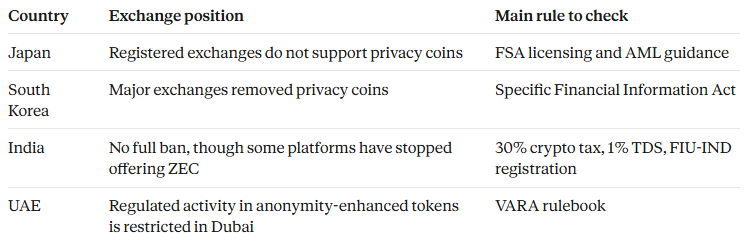
Regulators in Asia and the Gulf have mostly acted through exchange licenses instead of full bans. The table below shows the positions of October 2026.
Source: Financial Action Task Force (FATF)
Rules change fast, so traders in these regions should check the latest position with a licensed advisor and the exchange’s own listing notice.
Exchange Delistings, KYC, and the Travel Rule
Delistings are the most visible result of these rules; Kraken removed privacy coins for Canadian users in 2025, and several Asian exchanges dropped them earlier. Most of them named money laundering risk as the reason, and none said the coins were illegal.
The FATF Travel Rule asks service firms to share sender and receiver details for transfers above set limits. That is hard to do when shielded addresses hide the data, so many compliance teams treat a listing as a risk call.
Decentralized exchanges, cross-chain swaps, and peer-to-peer markets still work in many regions, but they carry their own legal, tax, and trust risks.
Crypto Compliance Glossary
Privacy coin: a crypto coin made to hide the sender, the receiver, or the amount of a payment.
Shielded address: a Zcash address type that keeps payment details off the public blockchain.
Viewing key: a special key that lets one chosen person look at shielded payment details, though it gives no power to spend the funds.
Travel Rule: a FATF guideline under which crypto firms pass identity details about the sender and receiver along with certain transfers.
KYC and AML: the ID checks and money laundering controls that licensed exchanges run on their customers.
Conclusion: Privacy Coins Legal Status Depends on Location
Privacy coin legal status remains a patchwork, since ownership is mostly allowed, exchange access is shrinking in some regions, and the EU rules of 2027 will add more pressure on regulated platforms.
Zcash holds a fairly strong position because of its optional privacy and selective sharing. Even so, holders in every country still carry tax and reporting duties that no tool can remove.
Disclaimer: This article is for learning only and is not legal, tax, or financial advice. Crypto rules change often, so readers should verify details through official channels and do their own research before making any decision.
















