What Is Restaking? How EigenLayer and Restaking Yield Work

What Is Restaking and Why Does It Matter in 2026?
Ethereum staking used to be simple. You lock up ETH, help secure the network, and earn a modest reward.
What is restaking, then? It's the idea of taking that same staked ETH and putting it to work a second time, helping secure other networks and services in exchange for extra rewards.
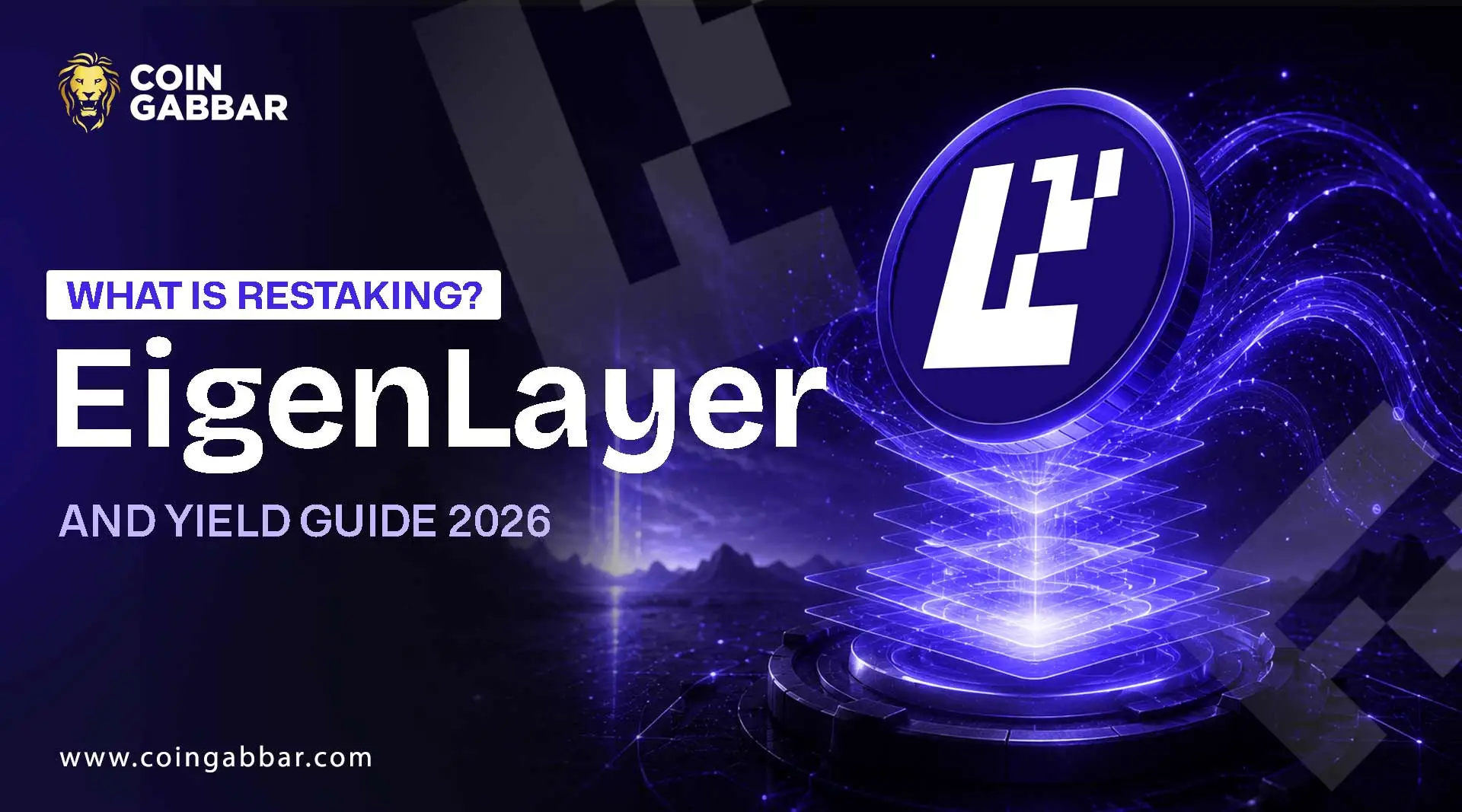
EigenLayer is the protocol that turned this idea into a real market. It built the infrastructure that lets ETH back what are called Actively Validated Services, or AVSs.
This article explains what restaking actually means, how EigenLayer fits in, what the EIGEN token does, and what risks come with chasing this extra yield. It's a fast-moving corner of crypto, so treat specific numbers here as a snapshot rather than a permanent fact.
What Is Restaking and How Does It Work?
Staking is the process of locking crypto, usually ETH, to help validate transactions on a blockchain. In return, stakers earn a base yield, generally in the 3% to 4% range on Ethereum.
Restaking-extends that same staked ETH, or a liquid staking token representing it, to secure additional applications beyond the base Ethereum network.
Those additional applications are called Actively Validated Services. An AVS can be a data availability network, an oracle, a bridge, or a new rollup that needs its own security layer.
Instead of every new project building its own validator set from scratch, it can "rent" security from ETH that's already staked. Restakers opt in, and in exchange, they earn a second stream of rewards on top of base staking yield.
The trade-off is risk. If a validator or operator misbehaves on any service it's securing, restaked funds can be slashed, meaning a portion gets forfeited as a penalty.
What Is EigenLayer and How Does It Enable Restaking?
EigenLayer is the Ethereum protocol that introduced-restaking as a mainstream concept. It was built by EigenLabs, and it launched the mechanism that lets ETH validators redirect their withdrawal credentials into EigenLayer's smart contracts.
According to the project's own communications, EigenLayer has since expanded beyond restaking into what it calls a broader "verifiable cloud" stack, rebranding parts of its ecosystem as EigenCloud. That umbrella now includes EigenDA, a data availability layer used by rollups to store transaction data more cheaply, along with newer services the project describes as EigenAI and EigenCompute.
The project states these newer services moved to mainnet in late 2025, expanding what restaked ETH can actually secure. That's a claim from the project's own materials, and readers should check EigenLayer's official documentation for the current state of each service before relying on it.
Data trackers have reported EigenLayer holding the large majority of the restaking-market by total value locked through 2026, though the exact share moves depending on the source and the date checked. Treat any single TVL figure as a moment-in-time snapshot, not a fixed number.
How Can You Restake ETH?
There are a few routes, each with a different risk profile.
Native restaking: Validators point withdrawal credentials to an EigenLayer contract instead of a standard wallet. Funds stay segregated rather than pooled, but this takes technical know-how.
LST restaking: Holders of liquid staking tokens, the receipt tokens from staking ETH through a provider, can deposit those into EigenLayer without running a validator.
Liquid restaking tokens (LRTs): Third-party protocols handle operator selection and AVS allocation automatically, issuing a liquid receipt token back to the user. It's the easiest entry point, but adds a layer of protocol risk on top.
Each path shifts who controls operator selection and how directly you're exposed to slashing. Liquidity during stress periods still isn't guaranteed on any of them.
What Does the EIGEN Token Do?
EIGEN is the native token tied to the EigenLayer ecosystem. According to the project's published tokenomics documentation, EIGEN serves two main purposes: governance participation and a "universal intersubjective staking" role, where EIGEN itself can be staked to help secure AVSs that need judgment calls a purely cryptographic system can't make on its own.
The documented initial allocation at token generation was split across five buckets:
Allocation | Percentage | Purpose |
Investors | 29.5% | Early funding round participants |
Early Contributors | 25.5% | Team and core contributor allocation |
Stakedrops | 15% | Multi-season distribution to eligible restakers |
R&D and Ecosystem Development | 15% | Managed by the Eigen Foundation |
Future Community Initiatives | 15% | Reserved for later community programs |
Investor and early contributor tokens were documented as locked for a period after the token became transferable, then released gradually rather than all at once. That matters because a one-time unlock adds sudden sell pressure, while a gradual schedule spreads the impact out.
How Much Yield Can Restaking Offer?
Reported annual yields on restaked ETH vary by AVS and by the platform reporting them, generally landing in the mid-single digits on top of base ETH staking rewards. That's meaningfully higher than plain staking, but it's not fixed, and it moves with network activity.
A development multiple sources confirm is that on-chain slashing became active on EigenLayer in early 2026. Before that, slashing risk existed on paper but wasn't fully enforced. Once it went live, the downside became real rather than theoretical.
What Are the Risks of Restaking?
Restaking stacks several risks on top of ordinary staking:
Slashing risk: Misbehavior by an operator on any AVS you're exposed to can cost you funds.
Operator risk: You're trusting whoever runs the validator or manages the AVS allocation.
Smart contract risk: Funds sit in EigenLayer's contracts and, for LRTs, a second protocol's contracts too.
AVS-specific risk: Newer services carry more uncertainty than established ones like data availability layers.
Concentration risk: Restaking the same ETH across multiple services means one bad actor or bug can affect several systems at once.
What Should You Watch in Restaking in 2026?
The stronger signal is genuine, growing adoption. Billions in ETH have been committed to restaking through 2026, and slashing going live shows the system maturing rather than staying experimental.
The main concern is concentration. A large share of restaked ETH securing many services through a small number of operators means one operator failure could ripple across several AVSs at once.
The biggest unknown is how EigenLayer's pivot toward broader cloud-style services, beyond pure restaking, plays out against other restaking-protocols. That shift changes what EIGEN ultimately captures value from.
Conclusion
Restaking lets already-staked ETH secure additional services in exchange for extra yield, and EigenLayer is the protocol that built this market. The EIGEN token adds governance and staking functions on top of that base layer.
The upside is real additional yield; the downside is a stacked risk that is only fully activated in early 2026 with live slashing. Readers should check current TVL, yield, and token supply figures directly from official sources before forming a view.
Disclaimer
This article is for informational purposes only and is not financial advice. Restaking, staking, and holding crypto assets carry risk, including possible loss of funds. Always do your own research before making any financial decision.
Also read: