Zaviron (ZVR) Explained: Is It Legit? 2026 Presale Review

Zaviron Explained: Facts, Claims and Key Questions
Zaviron keeps showing up in crypto search results this year, and most people typing the name want one thing: a straight answer on whether it's worth trusting. Zaviron is a presale project building a commerce ecosystem, with payments, rewards, a marketplace, and a card all tied to its ZVR token.
The project says it wants to fix expensive checkout fees and loyalty points that expire. That pitch sounds familiar, and that's exactly why it deserves a closer look.
This article walks through what's confirmed on Zaviron's own website and whitepaper, what's still just a claim, and what a careful buyer should verify before sending funds. No outside opinions here, just what the official pages actually say, checked line by line.
What Is Zaviron and How Does It Work?
According to the official site, Zaviron is building an integrated commerce platform made of several parts: a marketplace for physical and digital goods, a payment rail called Zaviron Pay, a rewards system, a mobile wallet, and a contactless Touch & Pay card.
The stated idea is simple. Every purchase across these products earns ZVR rewards that don't expire, while merchants get lower fees and faster settlement than traditional payment processors offer.
Right now, none of these products are live. The whitepaper places the wallet beta in Q4 2026, the marketplace and payment rail in Q1 2027, and the card in the following quarter. Today, the only working part of the ecosystem is the token presale itself.
What Is the ZVR Token Used For?
ZVR is described as the token that ties the whole ecosystem together. The project lists its planned functions as payments, staking, governance, and reward distribution across the marketplace and card.
Per the whitepaper, ZVR runs on the ERC-20 standard, with multi-chain expansion "planned." Total supply is fixed at 10,000,000,000 ZVR, and the project says no additional tokens can ever be minted.
That fixed-supply structure is a project claim about future scarcity, not a guarantee of price performance. Utility only becomes real once the wallet, marketplace, and staking features actually launch, and none of those exist yet.
How Is the ZVR Supply Distributed?
This is where the research turns up something buyers should know about. Zaviron's homepage and its own whitepaper show two different breakdowns of the same token supply.
Source | Presale/Public Sale | Liquidity | Development | Marketing | Treasury/Staking | Team & Advisors |
Homepage widget | 50% | 12% | 15% | 5% | 7% | 3% |
Whitepaper (Section 18) | 25% | 20% | 15% | 15% | 15% | 10% |
The available data doesn't explain why these two official pages disagree. It could be an outdated homepage widget, a whitepaper update that wasn't mirrored across the site, or something else entirely.
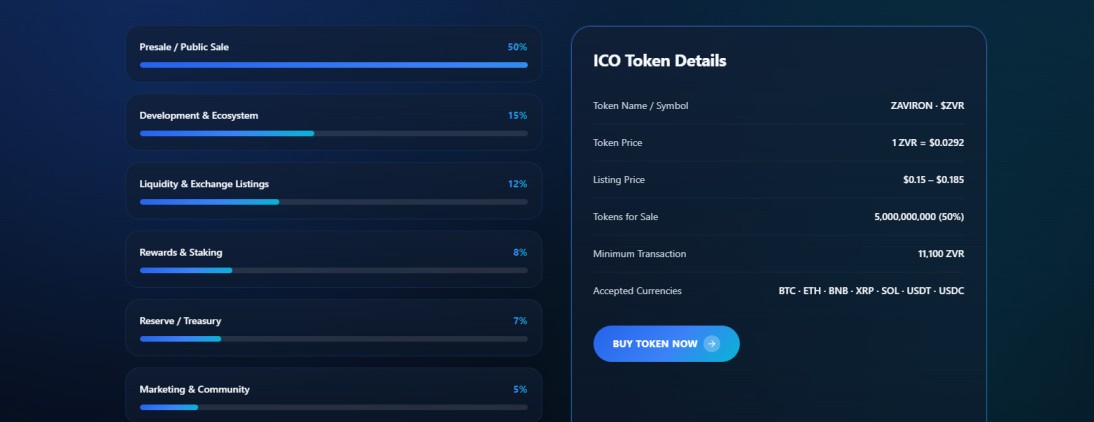
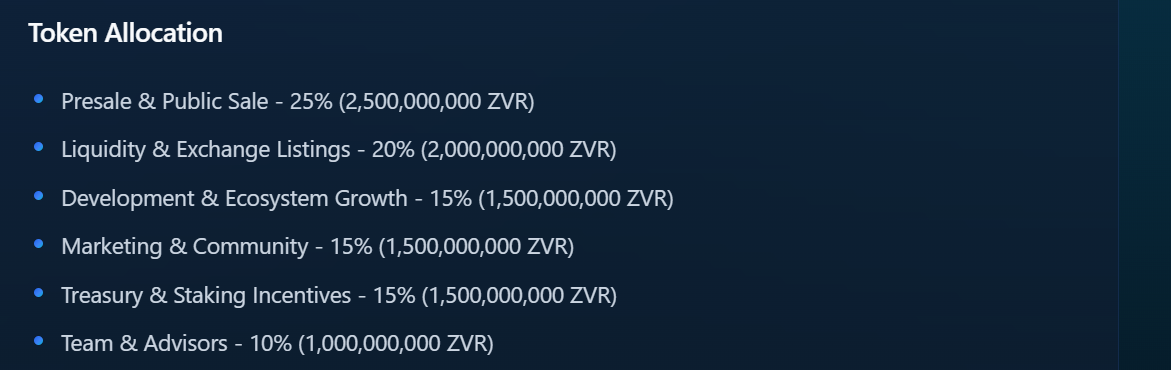
Either way, a presale-stage project should have one tokenomics figure, not two conflicting ones on its own domain. Anyone buying in should check which number the presale dashboard actually uses before contributing.
The whitepaper does confirm one detail clearly: the Team & Advisors allocation follows a 12-month cliff with 48-month linear vesting, which is a fairly standard long-term lock structure.
Is Zaviron Legit? Examining the Evidence
The homepage displays three trust badges: "KYC Verified," "Audited Contract," and "SAFT Compliant." Each one needs to be checked separately rather than taken at face value.
KYC claim: The badge appears prominently, but no certificate, provider name, or verification report is linked anywhere on the site. The claim exists; public proof of it doesn't.
Audit claim: The security page states the ZVR contract "has been reviewed and audited by CertiK" and shows a badge reading "Audited." However, the page provides no contract address, no block explorer link, and no downloadable audit report. A search of CertiK's own public audit and Skynet records does not surface a listed report for Zaviron at the time of this review.
SAFT compliance: A Simple Agreement for Future Tokens typically comes with published terms buyers can read. No such document is linked from the site's legal pages.
Team identity: No founder, executive, or advisor name appears anywhere on the website or whitepaper, and the FAQ only describes the builders in general terms.
None of this proves the project is fraudulent. Audits and KYC checks sometimes happen privately before public listing. But for claims this specific, the normal practice is to link the proof, and that step is currently missing.
What Are the Main Risks to Consider?
No named team: The FAQ describes the builders only as "professionals with backgrounds in blockchain engineering, fintech operations and digital marketing." No founder, executive, or advisor name appears anywhere on the site or whitepaper.
Conflicting tokenomics: The presale allocation percentage differs between the homepage and whitepaper, as shown above.
Unverified audit: The CertiK claim can't currently be confirmed through public audit records.
Product is pre-launch: Every consumer-facing feature, including the wallet, marketplace, card, and staking, remains on the roadmap, not in production.
Regulatory exposure: The whitepaper itself notes that digital asset rules vary by region and can change, which could affect token utility or availability later.
Token price does not equal project valuation, and a presale contribution does not equal a confirmed listing price. The site states a current price of $0.0292 per ZVR against a stated listing target of $0.15 to $0.185, but a target listing price is a projection, not a guarantee of where ZVR will actually trade once, or if it lists on an exchange.
What Does the Data Say About Zaviron?
The stronger signal here is the product vision itself. Combining payments, rewards, and a marketplace under one token is a coherent idea, and the fixed 10 billion supply plus multi-year vesting for insiders are reasonable structural choices on paper.
The main concern is disclosure. A project asking for public funds during a presale stage typically publishes named leadership and a verifiable audit link early, not after the sale is well underway. Zaviron has done neither as of this review.
The biggest unknown remains whether the CertiK audit claim will be backed by a public report, and whether the tokenomics discrepancy gets corrected. Both are easy fixes for a legitimate team and worth watching closely over the coming weeks.
Readers should verify the current presale stage, contract address, and audit status directly on zaviron.io before making any decision, since presale terms can shift from stage to stage.
Is Zaviron Worth Watching in 2026?
Zaviron is a real, functioning presale with a published whitepaper, a clear product roadmap, and a fixed-supply token model. That much is confirmed.
What isn't yet confirmed is the identity of the people running it, a verifiable audit report, or a single consistent tokenomics table. Those gaps don't prove wrongdoing, but they do mean the project is still asking for trust it hasn't fully backed up with evidence.
Conclusion
Zaviron pitches itself as a unified commerce ecosystem powered by the ZVR token, currently in its presale phase with every product feature still on the roadmap. The fixed 10 billion token supply and vesting schedule are clearly documented, but the KYC and audit badges lack public proof, and the tokenomics figures differ across the project's own pages.
Anyone considering the presale should check the live contract address, confirm the audit status independently, and read the current tokenomics page before contributing funds. The outcome for Zaviron, like any early-stage presale, remains uncertain until these gaps close.
Disclaimer:
This article is for informational purposes only and is not financial advice. Crypto presales carry high risk, including possible loss of funds, so always do your own research before investing.