Debitum Network: How Blockchain Is Reshaping SME Trade Finance


Debitum Network: Why On-Chain Token Bonds Are Drawing Attention
Debitum Network is a Bond-as-a-Service protocol that lets crypto projects sell tokens at a discount while releasing them to buyers slowly over time.
Readers searching for the Debitum price are usually trying to sort out two things at once, which are how the protocol works and what its DEB token costs during the sale.
The official documentation calls the system fully on-chain and permissionless, and the token sale page publishes a fixed price schedule.
This article covers the mechanics, the token numbers, the planned features, and the risks that deserve attention.
What Is Debitum Network, and How Does It Work?
According to the documentation, the protocol runs on EVM chains, which are networks that use Ethereum-style smart contracts.
A project deploys a bond contract through a factory contract and then picks the token buyers receive, the token they pay with, the discount, the vesting rules, and the total capacity. Until the project deposits enough tokens into that contract, purchases stay closed.
Buyers then send the payment token, and the contract mints an NFT that records the amount, the start time, and the vesting schedule.
Vesting is a release timetable, so tokens unlock gradually, and buyers claim them whenever they like. Unclaimed tokens stay on-chain with no expiry, and the NFT can move to another wallet along with every remaining claim right.
Key Features That Set the Protocol Apart
The documentation lists three vesting types. Linear vesting unlocks tokens every second, cliff vesting locks everything until a set date, and step vesting pays equal installments on a fixed schedule, such as a quarter of the allocation every three months.
Pricing can be static or oracle-based. An oracle is a data feed that reports a live market price to a smart contract.
With a feed attached, the bond tracks the market and applies the same discount on top, and the docs name Chainlink-style feeds and wrapped Uniswap v3 average prices as supported formats.
Token gates add another layer. A project can require buyers to hold a minimum amount of an ERC20 token or an NFT to unlock a deeper discount, with sample tiers of 3%, 7%, and 12%.
A separate Vesting Distributor tool sends vested tokens to as many as 200 wallets in one transaction.
What Is the DEB Token Used For?
DEB is the token tied to the protocol, and its sale runs on Ethereum mainnet. According to the project, holders will be able to unlock deeper discounts on eligible bonds, but the tiers and participating offers haven’t been published, and the benefits aren’t active yet.
Turns out, that detail matters more than any headline about price. Holding DEB alone doesn’t produce yield, and the project says so directly.
The sale accepts USDC, USDT, ETH, WETH, and WBTC, and tokens reach the buyer’s wallet in the same transaction with no vesting attached.
Planned liquidity pools on Uniswap and Curve are listed as coming soon, though pool addresses and launch dates remain unannounced.
Debitum Network Tokenomics: Supply and Allocation
Allocation | Tokens (DEB) | Share of Supply | Details |
Token sale | 1,000,000 | 10% | Sold through the public sale |
Treasury | 9,000,000 | 90% | Also receives all sale proceeds |
Total supply | 10,000,000 | 100% | Fixed, with no more minting |
DEB has a fixed supply of 10,000,000 tokens, and the project states that no more can be minted. The token sale covers 1,000,000 DEB, which is 10% of supply.
The other 9,000,000 DEB and all token sale proceeds go to a treasury address. But no vesting schedule for that treasury appears in the pages reviewed.
Tokens bought in the token sale reach the buyer’s wallet in the same transaction, with no vesting attached. The sale accepts USDC, USDT, ETH, WETH, and WBTC.
The token sale runs in three stages, priced at $2.00, $4.00, and $5.00 per DEB. At the final stage price, the full 10,000,000 supply implies a fully diluted valuation of $50 million on paper.
That figure isn’t market cap. Market cap counts only circulating tokens, and circulating supply can’t be confirmed until the planned liquidity pools go live.
A treasury holding 90% of supply gives the team heavy control over future circulation. And until a vesting plan is published, the timing of any treasury release stays unknown.
Buyers should confirm the current token sale stage on the official page before treating any price as current.
What Does the Debitum Price Schedule Show?
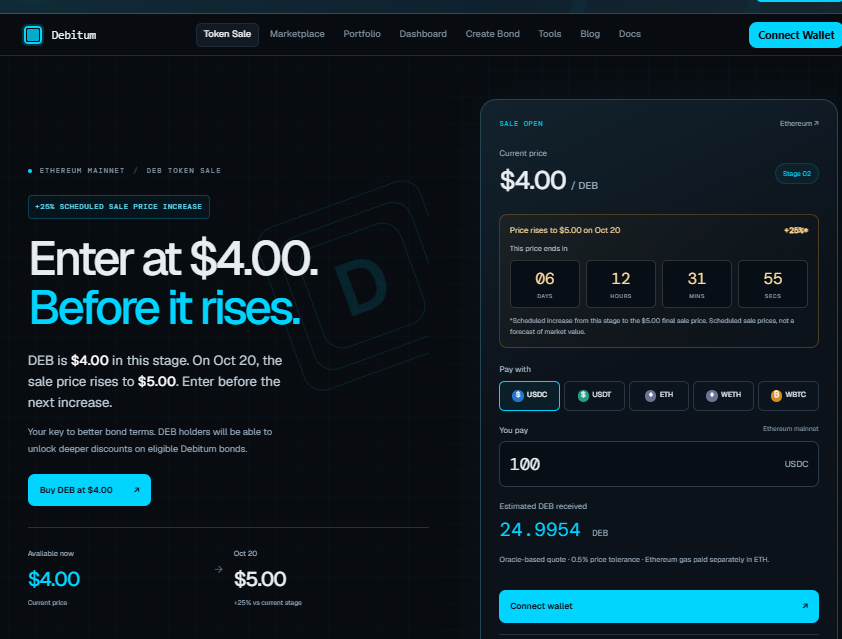
The published sale schedule has three stages: $2.00 per DEB in the opening stage, $4.00 from October 10, 2026, and $5.00 from October 20, 2026.
At $2.00 a $100 purchase buys 50 DEB, while at $5.00 the same amount buys 20. The site labels these as scheduled sale prices and not forecasts of market value.
Simple multiplication adds context. Ten million tokens at $5.00 implies a fully diluted valuation of $50 million on paper, which isn’t the same as market cap, since market cap counts only circulating tokens.
And no open-market price exists yet. Because the sale page ran a live countdown, the current stage should be confirmed on the official page before any figure is treated as current.
How to Buy DEB and Store It Safely
According to the sale page, buyers pick a payment asset on Ethereum mainnet, review an oracle-based quote with a 0.5% price tolerance, and confirm in a wallet, with gas paid separately in ETH.
The page warns that sending funds straight to the treasury address doesn’t buy tokens. That warning matters, because blockchain transfers can’t be reversed.
Storage is a basic wallet matter: a self-custody wallet, a seed phrase kept offline, and contract addresses checked against the official docs before any approval.
Pros, Cons, and Safety Concerns
Pros | Cons |
The contract code is open source and verified on block explorers. | An independent security review is still in progress, so no audit result exists yet. |
Bond terms can’t be changed after deployment. | The token gate module keeps an upgrade path. |
The protocol fee is zero for now. | The factory’s fee settings can change for future bonds. |
Contract addresses are public (Base, Unit Zero, and the Ethereum sale contract). | The treasury holds 90% of the supply, and no vesting schedule for it appears |
Vesting is flexible (linear, cliff, step), and the bond NFT can be transferred. | A discounted bond only pays off if the underlying token holds its value through vesting. |
Oracle-based pricing and token gates allow deeper discount tiers. | DEB holder benefits aren’t active yet, and the tiers haven’t been published. |
Fixed supply of 10,000,000 DEB, with no more minting | No dated roadmap milestones, and liquidity pool launch dates are unannounced. |
What Does the Data Say About the Debitum Network?
The stronger signal is transparency, since contract addresses on Base and Unit Zero are published and the sale contract on Ethereum is public.
The biggest unknown remains the roadmap, because no dated milestones appeared in the official pages reviewed, and the project’s X account couldn’t be accessed during research.
Treasury control, missing audit links, and inactive holder benefits are the three items worth watching.
Conclusion
Debitum Network offers an on-chain way to sell discounted tokens with built-in vesting, and DEB is meant to improve bond terms for holders.
What stands out is the open contract design. What remains uncertain is the audit, the treasury plan, and the launch of trading pools.
Readers can verify those items on the official channels next.
Disclaimer
Crypto assets are high risk, and prices can fall sharply, including to zero. This article is for information only and isn’t financial advice. Anyone interested should research independently and consult a licensed adviser.