Diva Staking Shutdown: Ethereum Mainnet Cancelled as Depositors Exit


Diva Staking Shutdown: Ethereum Project Ends Before Mainnet Launch
A project that wanted to make Ethereum’s validator network more decentralized has quit before it ever went live.
The Diva Staking shutdown was announced on Wednesday, 28 October 2026, when the three-person team said the protocol will not launch on mainnet. Early depositors can already pull their money out.
This guide explains what happened, why the builders stopped, and what stakers should do, in simple words.
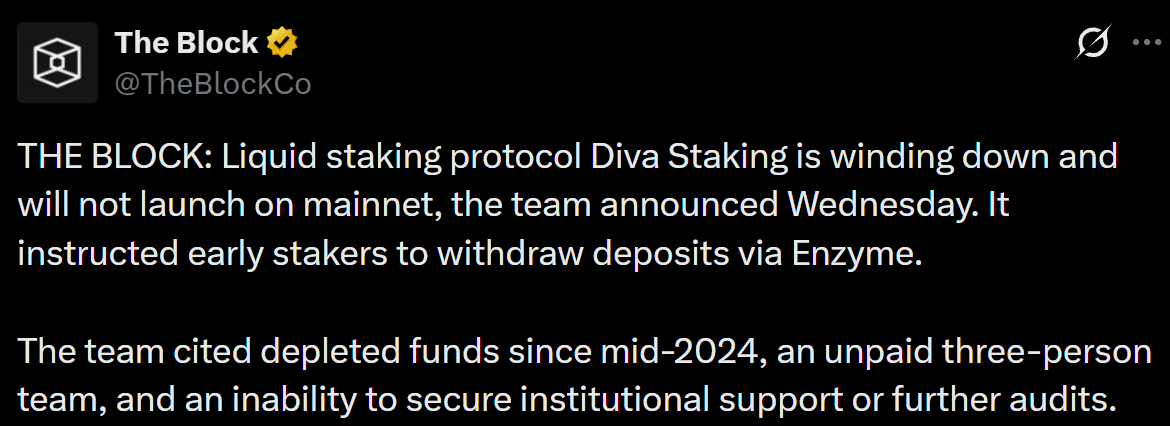
Source: The Block
What the Developers Announced
In an official statement, the developers apologized to everyone who pre-deposited in the Early Staker Vaults and said there is “nothing left to wait for."
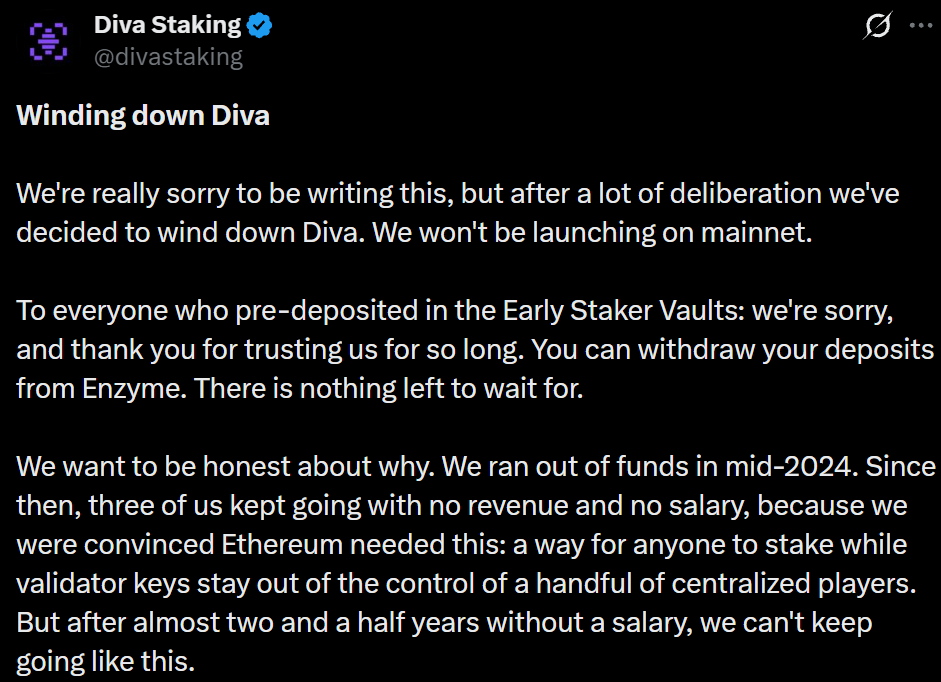
Deposits can be withdrawn through Enzyme, the platform that ran the vaults.
| Detail | Information |
| Announced | 28 October 2026 |
| Mainnet launch | Cancelled |
| Early depositors | Can withdraw via enzyme |
| Team size | Three people, unpaid |
| Out of funds since | Mid-2024 |
What the Protocol Was Building
The project was designed as a liquid staking protocol for Ethereum. According to its official documentation, stakers would deposit ETH and receive divETH, a token that earns rewards while staying tradable.
Validators would run on distributed validator technology, which splits each validator key across a group of nodes.
Actions need agreement from two-thirds of the group, and operators never hold a full key.
The goal was an option that resists outages and keeps control away from a few large companies.
Why the Builders Gave Up
Behind the Diva Staking shutdown, the developers say they ran out of funds in mid-2024 and then worked for almost two and a half years with no salary or revenue.
The protocol launched on the Hoodi test network early this summer and ran for four months without a single failure, yet no large partner stepped in to help with a mainnet launch.
Money was only part of the problem. Three people without pay cannot afford new audits, and they warn that AI tools are making it easier every month to find software flaws.
With so many moving parts, the risk that something slipped past earlier audits and endangers user funds felt real.
Choosing safety, the team closed the project rather than launching recklessly.
The market also changed in ways that hurt the plan.
-
Before the Shapella upgrade, a liquid staking token was the only way to get liquidity on staked ETH. With withdrawals now enabled, demand looks very different.
-
Restaking brought some demand back for a while, but it was never proven and interest faded.
-
Institutional buyers now care more about compliance, ETFs, regulation, and who takes legal responsibility than about decentralization.
The Decentralization Debate: Lido’s Share Falls, New Giants Rise
When Diva started, Lido controlled close to a third of all staked ETH, which looked like a serious risk. The team says Lido’s share is now around 21%.
However, much of the new stake went to large centralized players. At the end of June, by their own figures:
| Company | Share of staked ETH |
| BitMine | 11.5% |
| Coinbase | 10.9% |
| Binance | 7.9% |
| Combined | About 30% |
Our own addition of the three shares gives 30.3%. That is roughly the share Lido once held, and they argue the challenge now is stopping exchanges, banks, and treasury companies from turning Ethereum into an oligopoly.
They also praised Lido for adding distributed validator support through Simple DVT and opening the protocol to solo stakers.
These percentages come from the developers and were not checked against an independent dashboard.
What Early Stakers Should Do Now
For anyone affected by the Diva Staking shutdown, the Early Stakers documentation explains that the vaults are non-custodial, so depositors can withdraw their funds at any time and keep full self-custody.
ETH deposits were simply held until launch, while stETH deposits kept earning staking rewards.
The same page notes that DIVA tokens are currently non-transferable and not trading, so no price can be established.
Practical steps:
-
Withdraw through Enzyme using the official route only
-
Never share a recovery phrase with anyone offering “help”
-
Beware of fake refund or airdrop messages
-
Confirm any link comes from the team’s verified account
The statement does not explain what happens to DIVA allocations, so that question is still open. The team also says two colleagues, Diego and Fernando, are now open to new roles.
Conclusion
The Diva Staking shutdown is a reminder that technical success does not guarantee survival in crypto.
The protocol ran for months on a test network, yet funding, audit costs, and shifting demand ended the plan.
If you hold deposits, withdraw using official channels and stay alert for scams. This article is not financial advice.
Disclaimer
This article is for educational and informational purposes only and is not financial or investment advice. Crypto assets are high risk, their prices can be very volatile, and you can lose some or all of your money. Always do your own research and consider speaking with a licensed financial advisor before making investment decisions.









