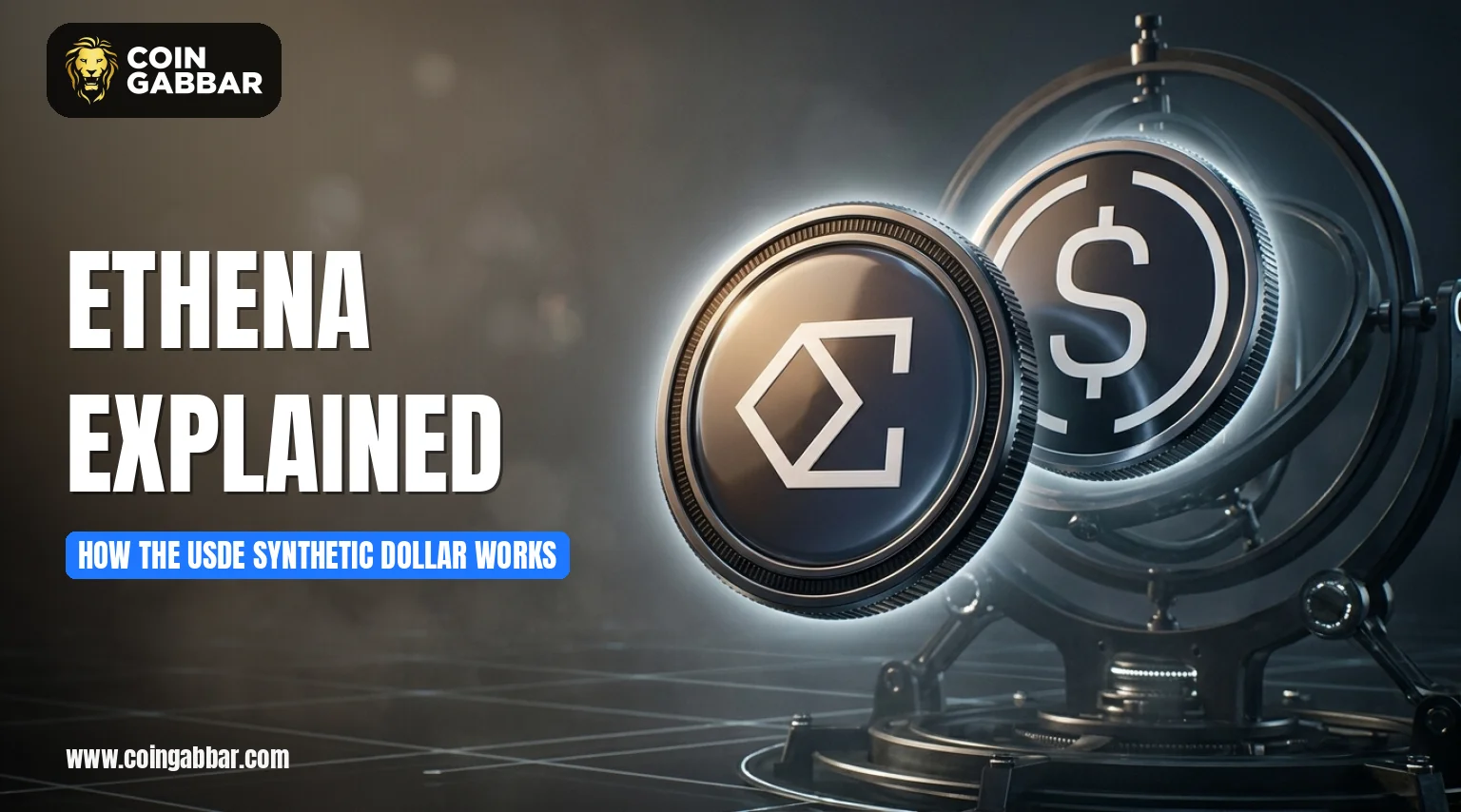
Ethena Explained: How the USDe Synthetic Dollar Works

Ethena Explained: Why Does a Dollar Token Depend on Future Trades
Is USDe a stablecoin, or a trading strategy with a ticker? That's the real question behind most searches for Ethena explained.
Ethena is a protocol that issues USDe, a synthetic dollar. It aims for $1 without a bank balance. It pairs crypto assets with offsetting short positions instead.
Attention is back because ENA has an unlock due this week, and the token trades near $0.17, down about 7.7% in 24 hours. This Ethena explained guide starts with the mechanism, then covers yield, the ENA token and the risks. You'll see how the hedge works, where sUSDe pays from, and what could break it.
Ethena in One Paragraph
Here is Ethena explained in one paragraph: approved users deposit assets and receive USDe. The protocol opens a hedge so the position holds its dollar value. Staking USDe gives sUSDe, which accrues rewards. ENA is a separate governance token.
A synthetic dollar copies a dollar's value using financial positions, not cash reserves. It isn't a bank deposit, and it isn't insured.
Only whitelisted participants mint and redeem USDe directly. Everyone else buys it on exchanges or DeFi pools. That detail shapes every Ethena explained answer about the peg.
The Delta-Neutral Engine Behind USDe
The core of Ethena explained is one idea. "Delta" measures how much a position moves when an asset's price moves. Delta-neutral means the net movement is close to zero.
The project's minting example shows the idea. A whitelisted user sends about $100 of USDT and receives about 100 USDe. The protocol opens a short perpetual futures position of roughly the same size. A perpetual future is a derivatives contract with no expiry date. A short gains when the price falls.
ETH price move | $100 of spot ETH | Short position | Net value |
Falls 10% | $90 | +$10 | $100 |
Rises 10% | $110 | -$10 | $100 |
Simplified; fees and funding payments are ignored.
How does USDe stay at $1?
The hedge cancels price swings in the backing. The mint-and-redeem route gives approved traders a reason to close gaps: buy USDe at $0.99, redeem it for $1. That's analysis, not a guarantee.
The project says backing assets stay onchain with off-exchange custody providers. Exchanges get delegated margin use, never custody.
Backing has changed since launch, so older Ethena explained posts can mislead. The docs now describe a mix. Volatile assets get a short hedge. Liquid stablecoins and short-duration real-world assets need none. A mid-year dashboard snapshot showed nearly half the backing in DeFi lending and the rest mostly in liquid stablecoins. The futures trade was a small fraction.
Where the Yield Really Comes From
Staking USDe gives sUSDe, and that's where the return sits. Where does Ethena yield come from? Three places:
Funding rates. Perpetual futures use periodic payments to track the spot price. When more traders bet up than down, longs pay shorts. Ethena holds the short, so it collects.
Staking rewards. Where the collateral is staked ETH, it earns network rewards on top.
Lending and stablecoin returns. This slice has grown with the new backing mix.
sUSDe doesn't pay out new tokens. Its value against USDe rises as rewards build. Ethena explained for savers: it's a savings token without deposit insurance.
The docs say sUSDe accrues only positive or flat rewards. A Reserve Fund absorbs negative periods.
The rate has cooled. Across 2025 it ranged from roughly 4% to 15%. Recent readings sit near 4%. When traders cool off, the yield follows.
ENA vs USDe: Two Different Things
USDe | ENA | |
Role | Synthetic dollar, $1 target | Governance token, floating price |
Supply | Moves with mint and redeem, about $4.8B recently | Fixed maximum of 15B |
Ethena explained for token holders starts with one question: what is ENA token used for? The project describes it as the governance token. Holders vote on backing mix, risk settings and revenue use. ENA can also be staked as sENA.
ENA trades near $0.1707. Market cap is $2.28B and FDV is $2.55B. Circulating supply is 13.4B of 15B. Market cap counts circulating tokens; FDV assumes all 15B exist. The gap is small because most tokens are out.
Allocation | Share | Purpose |
Core Contributors | 30% | Team and builders |
Ecosystem Incentives | 30% | Airdrops, growth rewards |
Investors | 25% | Early backers |
Foundation | 15% | Foundation reserves |
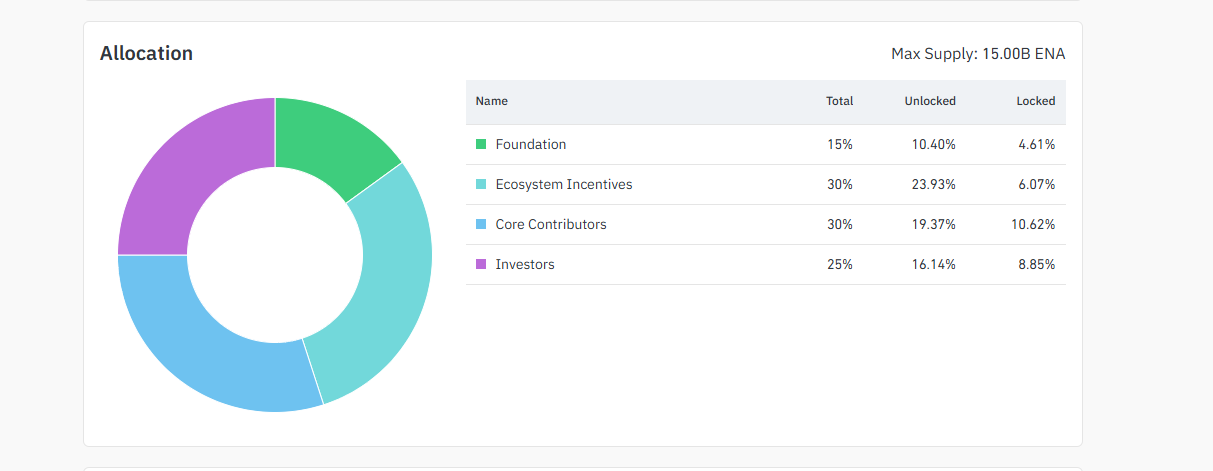
Two changes matter more than the table. A governance vote approved a fee switch. Buybacks start only once stablecoin supply passes $7.5B, and the share rises at higher tiers. Supply must grow by more than half to get there.
The Foundation also bought out some seed investors. Remaining investor tokens were released in one step on 5 October. The project says about 12% of supply stays locked. Some trackers still show about 30%, so check dates.
The Risk Register: Funding Flips, Custody, Depegs
Is Ethena safe? Safe is the wrong frame. Ethena explained as a risk map shows a different danger at each layer.
Funding flips
When shorts outnumber longs, funding turns negative. Ethena's short then pays instead of earns. The Reserve Fund covers the gap, but it's roughly $62M, about 1.3% of supply. One published breakdown says new revenue no longer flows into it. Months of negative funding would test it.
Custody and counterparty
Ethena explained at the custody level rests on trust in third parties. The project says off-exchange custody limits exchange risk. Custodians, exchanges and contracts can still fail.
Depegs and collateral risk
Ethena explained through its worst day: in October 2025, USDe fell to about $0.65 on one major exchange for roughly 90 minutes, while holding near $1 elsewhere. Ethena's founder blamed that venue's pricing. The protocol processed around $2B of redemptions in 24 hours, and the exchange later paid users $283M.
The peg held. Much of the supply didn't: USDe fell from a peak near $14.9B to about $4.8B.
The new mix shifts risk rather than removing it. With nearly half the backing in DeFi lending, credit and smart-contract risk now matter as much as funding rates.
This Week's Unlock in Context
Ethena explained through this week's calendar is simple. On 5 November, 171.85M ENA unlocks. That's 1.15% of maximum supply and about 1.3% of circulating supply. At $0.17, it's roughly $29M. Daily volume is about $325M, so the unlock equals around 9% of one day's trading.
The earlier investor release, reported at about 1.4B ENA, was roughly eight times larger.
An unlock isn't a sale. Recipients may hold, and the available data can't say which.
The Bottom Line: Where USDe Struggles
Ethena explained honestly comes down to this: USDe began as a trading strategy wearing a stablecoin's clothes. The outfit has changed, with more lending and stablecoins. The tailoring hasn't. It's still not a bank deposit.
USDe may struggle when:
Funding stays negative for months and drains the Reserve Fund.
A market-wide sell-off hits exchanges and lenders together.
A lending venue holding backing suffers a credit or contract failure.
Redemptions outrun liquid backing.
USDe supply stalls below $7.5B, keeping ENA buybacks switched off.
Check the official dashboard and docs before trusting any figure here. Ethena explained in a sentence: a hedged dollar whose safety depends on markets staying orderly. That's the Ethena explained takeaway worth keeping.
Disclaimer: This article is for information only and is not financial advice. Crypto assets, synthetic dollars and token unlocks carry high risk, and prices can fall sharply. Figures reflect the data reviewed at the time of writing. Do your own research before making any decision.