


Ethereum quantum resistance took a step on Tuesday, 24 November 2026. The Ethereum Foundation recommended Keccak-256 as the hash for its quantum-safe plan (EF blog, 24 November 2026). The post is a recommendation, not a finished upgrade.
A strong quantum computer could one day break the math behind wallet keys, known as public-key cryptography. The Foundation wants Ethereum ready first.
How Is Ethereum Preparing for Quantum Computers?
Ethereum is switching to hash-based security to resist quantum computers. The plan covers three things: how validators sign, how accounts sign, and how blob data is checked. On 24 November 2026, the EF recommended Keccak-256 as the hash. Ethereum.org says no quantum computer can break Ethereum today.
A hash function turns any input into a short fixed fingerprint.
What Triggered the Latest Ethereum Quantum Push?
Date | Event | Source |
Monday, 7 September 2026 | The Foundation set a December 2029 target. | |
Monday, 23 November 2026 | The Foundation published PQAI #0 on three work areas. | PQAI #0 |
Tuesday, 24 November 2026 | The Foundation published PQAI #1 on Keccak-256. | PQAI #1 |
Source: Ethereum Foundation blog posts on the dates shown, accessed 26 November 2026, 8:08 UTC. The pages show dates but no clock times.
More context for CoinGabbar covered the second post in a Keccak-256 news report.
Why Could Quantum Computers Threaten Ethereum?
Four parts of Ethereum need quantum-safe work (ethereum.org, updated 24 November 2026).
Area | Method today | Planned direction |
Account signatures | Accounts sign with ECDSA. | Wallets add hash-based signatures. |
Validator signatures | Validators vote with BLS signatures. | Validators sign with hash-based keys. |
Data commitments | Blob data uses KZG commitments. | Blobs move to hash-based commitments. |
Zero-knowledge proofs | Some proof systems use elliptic-curve pairings. | Hash-based proofs, such as STARKs, are part of the plan. |
Source: ethereum.org post-quantum page PQAI #0, accessed 26 November 2026, 8:08 UTC.
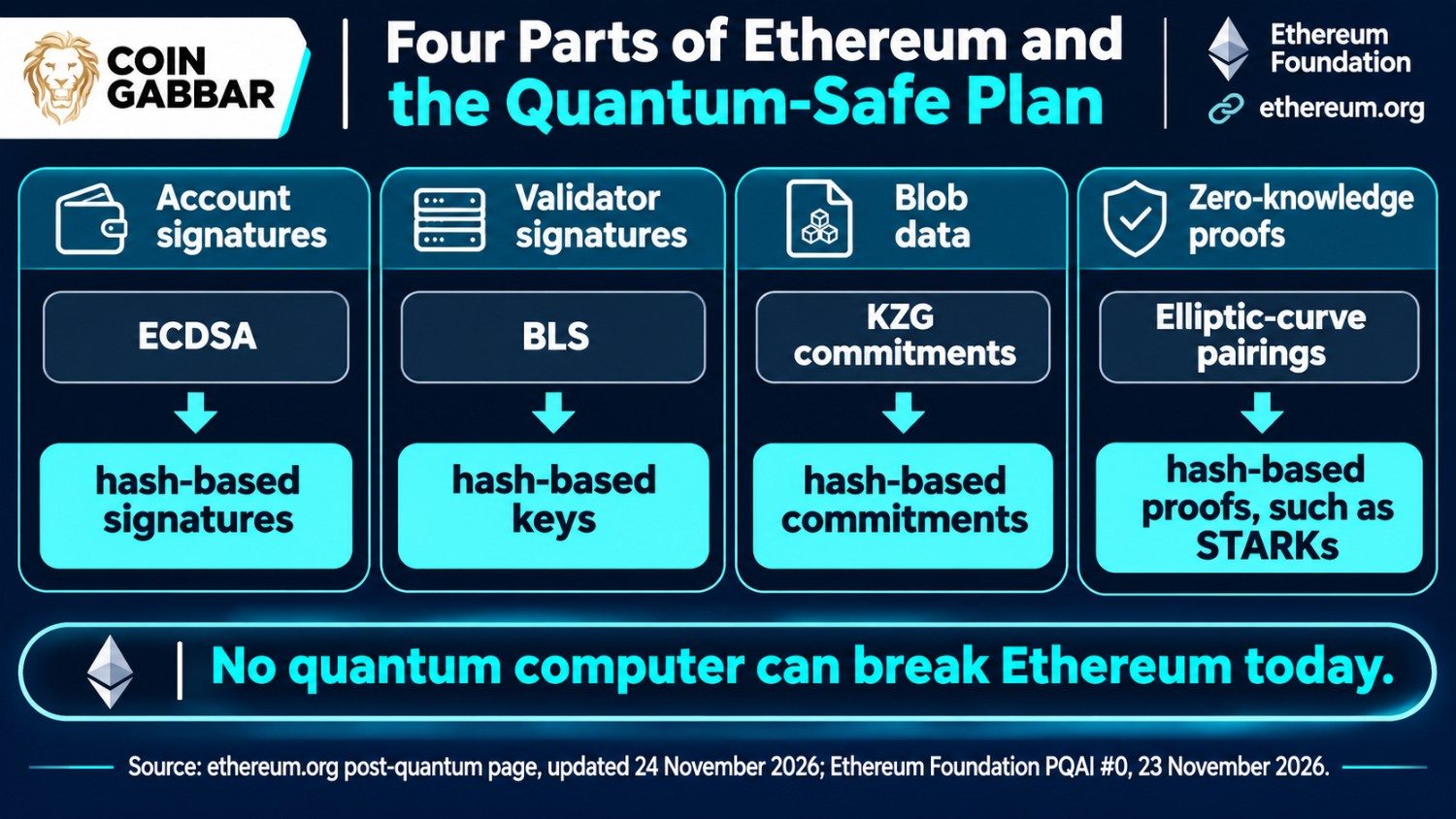
ECDSA and BLS are signature schemes. KZG commitments let the network check the blob data.
An account that has not yet sent a transaction has not exposed its public key on-chain. The page says that adds protection, but such accounts should still migrate later.
Why Did the Ethereum Foundation Pick Keccak-256?
Keccak-256 has a long record. The EF cites "nearly two decades of cryptanalysis" and a large security margin (PQAI #1, 24 November 2026). Ethereum already uses it, so no third general-purpose hash is needed.
Speed also changed. New provers handle standard hashes at or above a 500,000-per-second target. Speed no longer favors custom hashes, so security decides.
Candidate | The Foundation's stated view |
Poseidon and Poseidon 2 | The post says neither the full-round version is broken. |
BLAKE3 | It is the fastest traditional hash, but its cryptanalysis record is sparse. |
BLAKE2 | It is believed to be secure and fast, but others have more cryptanalysis. |
SHA2-256 | Its length-extension property needs extra care in new protocols. |
Keccak-256 | It combines a long record, a wide margin, and existing use in Ethereum. |
Source: Ethereum Foundation PQAI #1, 24 November 2026, accessed 26 November 2026, 8:08 UTC.
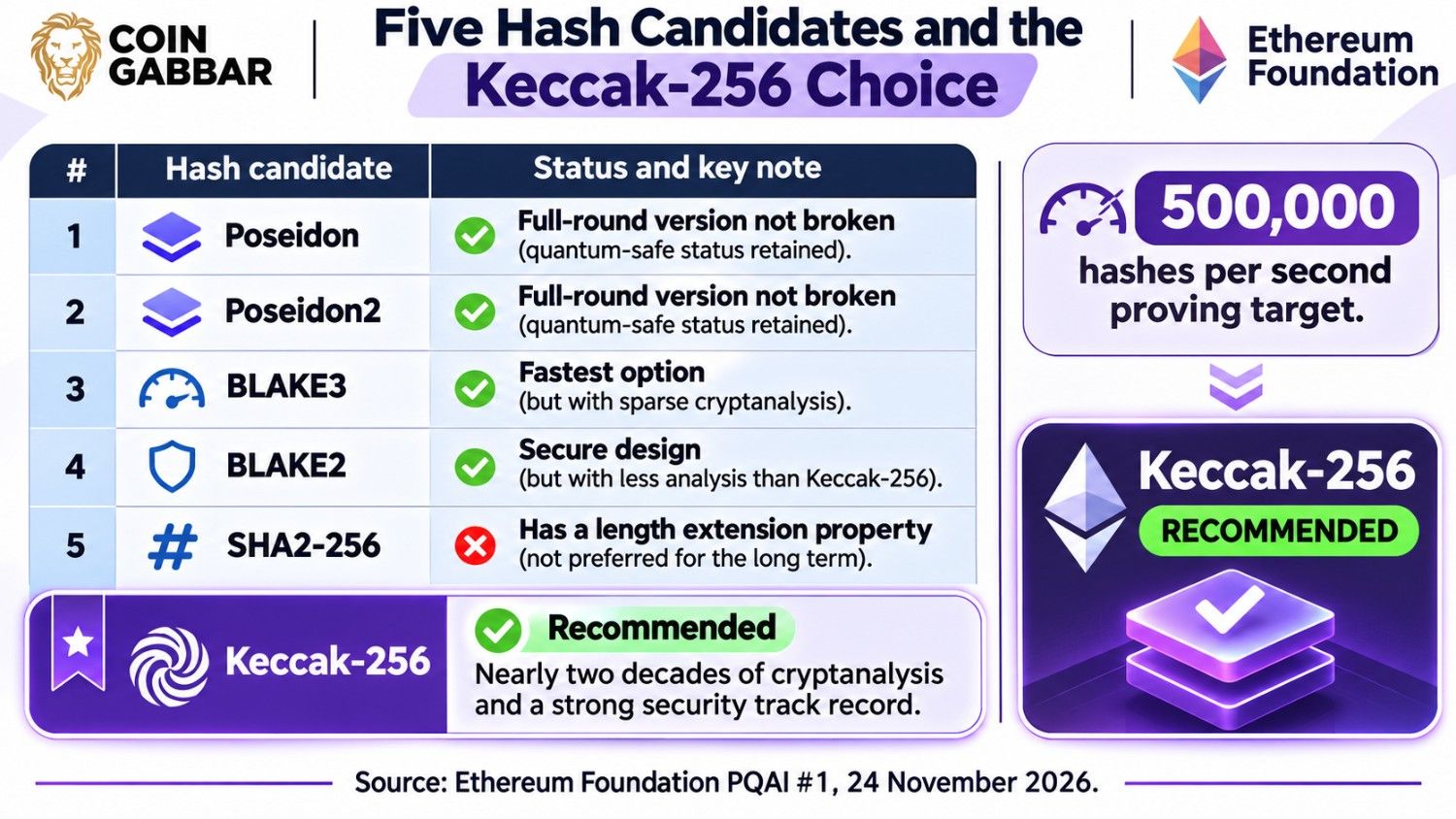
The post also names Keccak-duplex for proofs and SHAKE256 for random bits. In the long term it suggests moving Simple Serialize (SSZ), the consensus data format, from SHA2-256 to Keccak-256.
What Does Ethereum Quantum Resistance Cost in Signature Size?
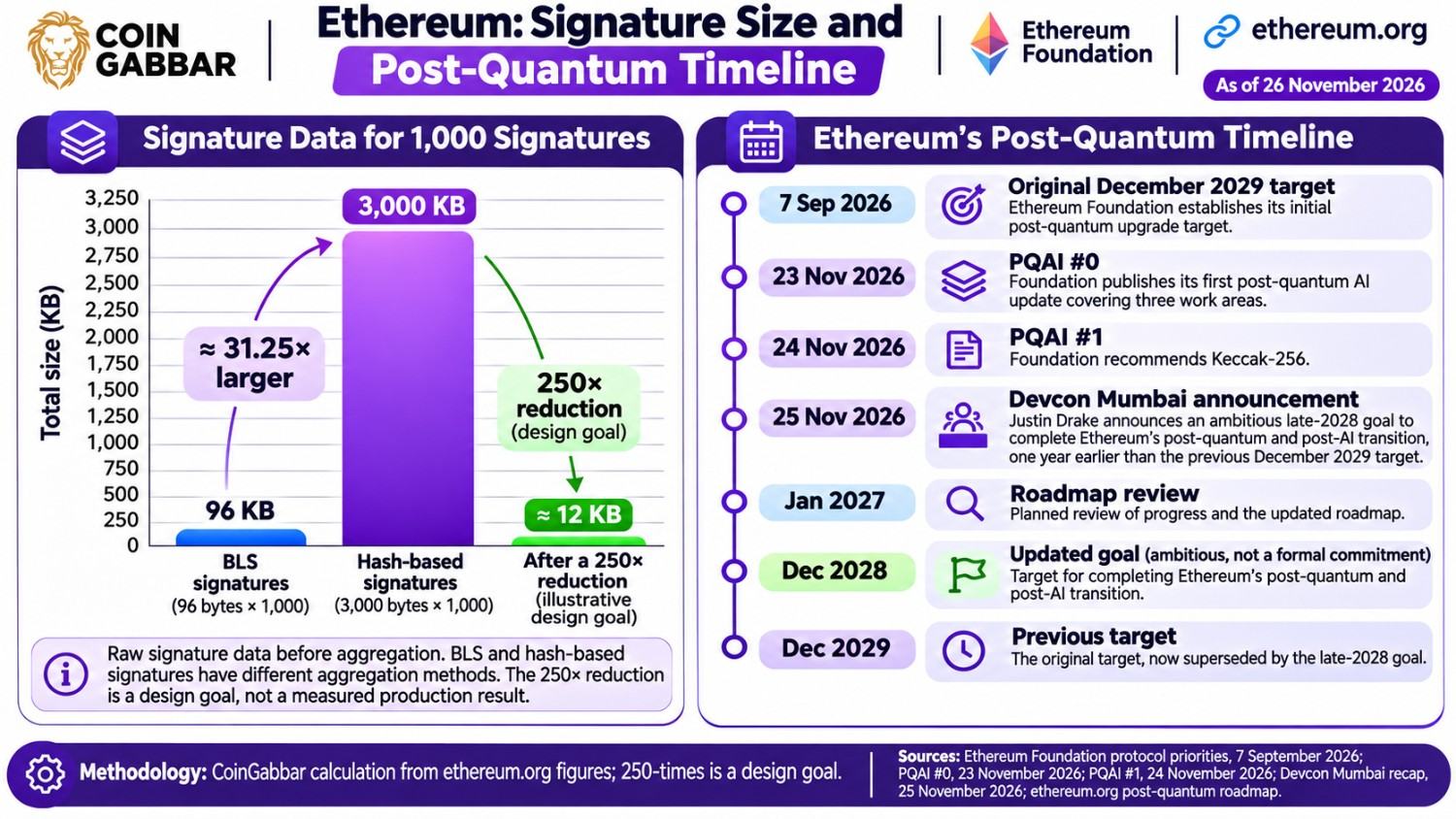
Hash-based signatures run about 3,000 bytes, against 96 bytes for BLS (ethereum.org). The leanVM tool aims to shrink grouped signature data about 250 times.
CoinGabbar ran an example of 1,000 signatures in decimal kilobytes.
Case | Size for 1,000 signatures |
BLS signatures, 96 bytes each | 96 KB |
Hash-based signatures, 3,000 bytes each | 3,000 KB, about 31 times larger |
Hash-based signatures after a 250-times reduction | About 12 KB |
Source: CoinGabbar calculation from ethereum.org figures, accessed 26 November 2026, 8:08 UTC.
Bigger messages add load for operators, a theme in node centralization.
How Were These Figures Calculated?
The inputs are 3,000 bytes, 96 bytes, and the 250-times figure from ethereum.org.
The method multiplies each size by 1,000, then divides 3,000 KB by 250.
The limit is that 250 times is a design goal, and real sizes will differ.
What Is the Timeline for Ethereum Quantum Resistance?
The December 2029 date is a self-set target. The protocol post treats it as fixed until at least January 2027, when outside experts review progress. It also plans for a quantum threat "as early as 2030" (Foundation protocol post, 7 September 2026).
During Devcon 8's opening ceremony in Mumbai on November 3, 2026 (4:40 AM UTC). Justin Drake announced an ambitious goal to complete Ethereum's post-quantum and post-AI transition by late 2028, one year earlier than the previous December 2029 target. The goal is not a formal commitment. The Foundation plans a roadmap review in January 2027.
Milestone | Planned capability |
First (named I*) | Validators register quantum-safe keys beside current keys. |
Second (J*) | Contracts and wallets verify quantum-safe signatures natively. |
Third (L*) | Quantum-safe votes and proofs arrive through leanVM. |
Fourth (M*) | Full signature grouping and quantum-safe blob commitments arrive. |
Source: ethereum.org post-quantum page, which calls these planning milestones not commitments.
Validator software changes also raise client diversity risk (February 23, 2026).
Expert Opinion: Is Ethereum Preparing Early Enough?
The Foundation calls its own plan tight. December 2029 needs 7.2 months per fork on average, which "leaves little room for error" (protocol post, 7 September 2026).
CoinGabbar analysis suggests the early start is the main protection for Ethereum quantum resistance. A dedicated team formed in January 2026 under Thomas Coratger (ethereum.org), and the hash choice came before any known threat. A target that slips a year still beats a crisis response. Builders of smart contracts should track the changes.
What Can ETH Holders Do Today?
The page says users need not act and that wallets should guide migration later.
Hold: Do not move funds because of this post.
Source: follow ethereum.org and the Foundation blog.
Wallet: watch for migration support from the wallet used.
Date: Note the January 2027 review.
Risk: treat this as a plan, not a promise.
Watch item | Where to verify it |
Hash decision and timeline | Ethereum Foundation blog, PQAI posts |
Milestones and user guidance | |
Standards context |
NIST finalized three quantum-safe standards on 13 August 2024. ML-KEM covers encryption. ML-DSA covers signatures. SLH-DSA is a signature backup. Ethereum's hash-based path is a separate design.
Key Takeaways on Ethereum Quantum Resistance?
Five hash functions were compared, and Keccak-256 was recommended (Ethereum Foundation, 24 November 2026).
On Ethereum quantum resistance, users need not act, and no quantum computer can break Ethereum today (ethereum.org, site updated 24 November 2026).
Ethereum quantum resistance has a target of December 2029 for Layer 1 (Foundation protocol post, 7 September 2026).
Larger signatures are the main cost, at about 3,000 bytes against 96 bytes .
Disclaimer: This article is news and education, not financial advice.
Frequently Asked Questions (FAQ)




Owned by:-
DCG Tech FZCO, UAE
Delivery Partner:-
Gabbar MediaTech Pvt Ltd.
Copyright © 2026 Coin Gabbar. All Rights Reserved












