FCA Market Maker Rules: UK Exchanges Face 2027 Liquidity Shake-Up Now


FCA Market Maker Rules: Why UK Exchanges Must Change by October 2027
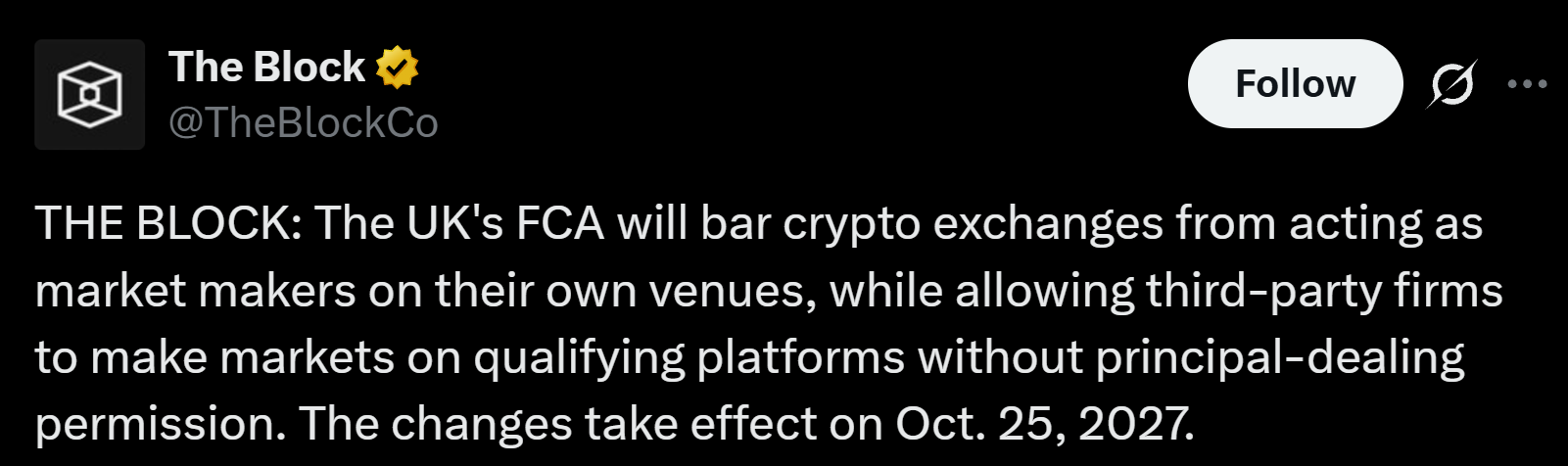
Crypto exchanges in the UK are about to lose a long-standing role. Under the new FCA market maker rules, a trading platform will not be allowed to quote buy and sell prices on its own venue.
Independent firms can still provide liquidity there without special permission. The changes take effect on 25 October 2027.
Source: The Block
What Is Changing for Crypto Exchanges
A firm that keeps offering to buy and sell an asset, so others can trade easily, is known as a market maker.
Some exchanges have done this themselves on their own order books. Under the new regime, that stops.
The regulator's guidance in Policy Statement PS26/11 says a firm cannot make markets on a UK qualifying cryptoasset trading platform (QCATP) that it operates.
The key points are:
Platform operators can no longer make markets on their own venues.
Independent firms can keep providing liquidity on qualifying platforms.
The changes take effect on 25 October 2027.
Why the Rule Exists: Keeping Exchanges Neutral
In PS26/11, respondents to the regulator's consultation agreed that UK platforms should be neutral trading venues.
The regulator also says platform operators should be risk-neutral venues. It chose conflict-of-interest safeguards over stricter options, such as forcing separate legal entities or banning affiliates from trading.
One of those safeguards is a rule that principal dealers cannot deal on their own platform.
In simple terms, an exchange that also trades on its own order book would be competing with its own users. The rule is designed to prevent that conflict.
How Independent Firms Can Still Make Markets
For third-party firms, the FCA market maker framework brings a clear benefit. The Treasury's Cryptoassets (Miscellaneous Amendments) Regulations 2026 (S.I. 2026/1219) were made on 18 November 2026. They add a new article, 9UA, to the rules on regulated activities.
Dealing in qualifying cryptoassets as principal is normally a regulated activity under Article 9T.
Article 9UA excludes two things from it: activity not carried on to provide a service to another person, and activity carried on as a market maker on a qualifying cryptoasset trading platform.
In practice, third-party firms making markets on such a platform do not need separate principal-dealing permission for it.
Who | Role on the platform | What the rules say |
Platform operator | Cannot make markets on its own venue | Barred under the FCA rules |
Independent firm | Can make markets on qualifying platforms | No principal-dealing permission needed for this activity |
Operator's affiliate | May access the platform | No preferential access allowed |
New Duties for Platforms That Host Market Makers
The rules do not only restrict exchanges. They also add duties for operators, as PS26/11 explains.
Under the FCA market maker approach, operators must:
Identify, document, and monitor users who run market-making strategies.
Document and disclose any incentive scheme or other arrangement with market makers, including its terms.
Set non-discriminatory access rules and non-discretionary order execution rules.
Monitor algorithmic trading under a principles-based approach.
Formal contracts with every market maker are not required. Operators can still act as a matched principal dealer, which means matching client orders, but only if they meet the relevant conditions.
Operators may also let affiliates trade on the platform, with safeguards so no affiliate gets preferential access.
Timeline, Reach and What Happens Next
Made: The Treasury regulations were made on 18 November 2026 and extend to England and Wales, Scotland and Northern Ireland.
Main changes: The amendments to the regulated activities and financial promotion rules come into force on 25 October 2027. Other parts started the day after the regulations were made.
Overseas platforms: Under PS26/11, firms must be authorised as a UK QCATP operator if they run a platform in the UK or serve UK consumers from overseas.
Impact: The Treasury says it expects no significant new costs beyond those already assessed for the main 2026 crypto regulations.
Conclusion
The FCA market maker rules draw a clear line. Exchanges run the venue, and independent firms provide the liquidity.
For users, the aim is fairer, more neutral trading. For exchanges with in-house trading desks, the business model must change before 25 October 2027.
This article is for information only and is not legal advice.
Disclaimer
This article is for educational and informational purposes only and is not financial or investment advice. Crypto assets are high risk, their prices can be very volatile, and you can lose some or all of your money. Always do your own research and consider speaking with a licensed financial advisor before making investment decisions.






